Roman Catholic
St Sigismund parish
05-507 Słomczyn
85 Wiślana Str.
Konstancin deanery
Warsaw archdiocese, Poland

full list:
displayClick to display full list

searchClick to search full list by categories
wyświetlKliknij by wyświetlić pełną listę po polsku

szukajKliknij by przeszukać listę wg kategorii po polsku

Martyrology of the clergy — Poland
XX century (1914 – 1989)
personal data
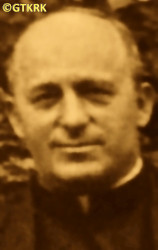
surname
SZUMIŁO
forename(s)
Rostislav (pl. Rościsław)
function
eparchial priest
creed
Ukrainian Greek Catholic GCmore on
en.wikipedia.org
[access: 2013.05.19]
diocese / province
Apostolic GC Exarchate of Lemkowszczyznamore on
en.wikipedia.org
[access: 2024.03.02]
Przemyśl GC eparchymore on
pl.wikipedia.org
[access: 2013.05.19]
nationality
Ukrainian
date and place
of death
11.08.1945

Zawadka Rymanowskatoday: Dukla gm., Krosno pov., Subcarpathia voiv., Poland
more on
en.wikipedia.org
[access: 2021.12.18]
alt. dates and places
of death
12.08.1945, 1944
details of death
From 1939, ministered in the parish of Zawadka Rymanowska, then on the western edge of Sanok County, Lviv Voivodeship, situated in the valley of a small stream, a tributary of the Jasiołka River, along which ran a highway leading from Dukla to Hungary through the Dukla Pass, the lowest pass in the main ridge of the Carpathians. At that time, there were c. 1,100 people living there who considered themselves Ruthenians, i.e. Greek Catholic Lemkos — apart from several dozen Poles — but in 1936 the parish had c. 1,595 faithful. In Sanok County, Lemkos constituted c. 54% of the population, while Roman Catholic Poles c. 41%, while in neighboring Krosno County, with which Zawadka Rymanowska had strong ties, Poles constituted a vast majority of c. 80%.
In the late 1920s, the so‐called Tylawa schism took place, i.e. a wave of mass conversions of Lemkos to Orthodoxy — as a result of which c. 18,000 Lemkos left the Greek Catholic Church — in protest against the Ukrainization policy of the hierarchy of that Church. The Church responded by establishing the Greek Catholic Apostolic Exarchate of Lemkowszczyzna, i.e. AEL. AEL managed to stop the Ukrainization efforts in the parishes under its control, which prevented further apostasy of the Lemkos, although prob. many priests of AEL still supported the radical Ukrainian national ideology. Mykhailo Baczyński, a member of the Seym, i.e. Parliament, of Poland, in his parliamentary speech of 21.01.1931, revealed what the Rusyns had to deal with within the Greek Catholic Church, who were not susceptible to the genocidal — as it turned out — ideology of Ukrainian nationalists: „The Greek Catholic Church was transformed after the war [the Polish–Ukrainian war of 1918‐1919] into an agitational Ukrainian political tribune from which words of love for one’s neighbor are sown, but words of hatred”. The administrator of the AEL, Fr Jacob Medwecki, published i.a. a ban in 1937 on the distribution of such magazines as Ukr. „Український Бескид” (Eng. „Ukrainian Beskids”), financed by the ordinary of the Greek Catholic Eparchy of Przemyśl, Bp Joseph Kocyłowski, whose circulation was confiscated several times by the Polish authorities; Ukr. „Наш Лемко” (Eng. „Our Lemko”), published in Lviv; and Ukr. „Діло” (Eng. „Work”), a newspaper also published in Lviv, which — as the justification stated — „spread discord, are hostile towards the Polish State and incline the local population negatively towards the decrees of the Holy See and the Government of the Republic of Poland”. Was a priest of AEL.
After the German and Russian attack on Poland in 09.1939 and the start of World War II, after the beginning of the German occupation, Zawadka Rymanowska found itself in the Germ. Kreishauptmannschaft Krosno (Eng. Krosno County) in the Germ. Distrikt Krakau (Eng. Kraków District), within the German‐occupied and run quasi‐state called the Germ. Generalgouvernement (Eng. General Governorate), i.e. GG. The German occupation authorities of the GG began to implement a policy of undermining the influence of the Roman Catholic Church and Polish culture by supporting the Greek Catholic rite and Ukrainian‐language education in schools. The policy of supporting the Ukrainian element was perhaps most visible in the social policy of the GG. The Germans allowed the activities of social and charitable organizations, but only the Ukrainian Central Committee UCK was partially financed from the GG budget. It could also use funds from Ukrainian cooperatives. On the other hand the Polish Central Welfare Council RGO and the Jewish Social Self‐Help had to rely exclusively on voluntary contributions. As a result, Polish and Jewish organizations could only conduct charitable activities: supporting food supplies, refugee aid, etc. Ukrainians/Rusyns, using GG funds, were able to build Ukrainian/Rusyns hospitals, orphanages, nurseries, and schools.
Lemko support for this policy was expressed, i.a. by the inhabitants of the village of Krępna, c. 22 km from Zawadka Rymanowska, where 80% of the inhabitants were Rusyns: „There was Poland, but it will never be again. Poles ruled, but now they will never be again. Poles have been twirling our tongues for two hundred years, and they won't twirl now”. This led to an escalation of the Polish–Ukrainian conflict. It could not have been otherwise, since the entrance door to the waiting room of the main train station in Kraków bore the inscription: Germ. niem.
„Nur für Deutsche aus dem Reich, Volksdeutsche und Ukrainer” (Eng. „Only for Germans from the Reich, Volksdeutsche, and Ukrainians”. The attitude of the Lemkos towards the Poles was not, however, clear. One member of the Polish clandestine organizations recalled that when, after the beginning of the German occupation, Polish soldiers and officers tried to get to Hungary to reach the Polish army forming in the west — then in France — „in the entire Subcarpathia, we had the greatest trust in the Lemkos […] No one betrayed as there […] The Lemkos did not betray the Poles”.
On 05.02.1941, after the death of the aforementioned Fr Jacob Medwecki, Fr Alexander Małynowski, a staunch supporter of the Ukrainization of the Lemko region, became the administrator of the AEL, in which he was supported by the German occupier. He immediately began the process of Ukrainization of the church structures under his control, removing priests who opposed it in independent Poland, introducing the Ukrainian language. He also collaborated with the organs of the genocidal Ukrainian organization OUN, tolerated and even supported by the Germans. He also relied on a large number — c. 20,000 — of Ukrainian refugees from the Russian occupation, mostly nationalists. In a memorandum to the Ordinary of the Roman Catholic Diocese of Kielce, Bp Czeslav Kaczmarek, a group of Greek Catholic priests, including Fr Volodymyr Wenhrynowicz, wrote about him: „He was always distinguished by a deep hatred for anything that was not Ukrainian and he did not choose means when it came to the destruction and oppression of his enemies”.
After the German attack on 22.06.1941, on its erstwhile ally, the Russians, and the occupation of the whole of Galicia, including Lviv, the Germans began to implement the German plan Germ. «Endlösung der Judenfrage» (Eng. Final Solution of the Jewish Question), which in the GG was carried out under the codename Germ. «Aktion Reinhardt» (Eng. Operation Reinhardt). In most places, members of the collaborative Germ. Ukrainische Hilfspolizei (Eng. Ukrainian Auxiliary Police), in some regions also referred to as the Germ. Schutzmannschaft (Eng. Protection Battalions), i.e. Schuma — took an active part in it. In Zawadka Rymanowska, there were no Jews, it seems, but information about the fate of e.g. Jews from Dukla, c. 10 km to the north, had to reach it. This is how the commissioner mayor of Dukla, a Ukrainian, Leo Bukatowicz, reported on the final liquidation of the ghetto on 12‐13.07.1942: „At night, the town was surrounded by the [Germ. Geheime Staatspolizei (Eng. Secret State Police), i.e.] Gestapo, from Jasło […], assisted by the border guard, German gendarmerie, and a unit of Ukrainians in black uniforms. All Jews were ordered to gather at 7 a.m. on the grounds of the manor estate, which was carried out by the Jewish council […] I saw that two Jews, the so‐called Goldman Jewish police, and another one, who were probably Gestapo informants and were tormenting Jews in a terrible way, were separated. After being sorted, they were loaded into cars and taken somewhere towards Barwinek. As I heard later, they were shot somewhere there, but I did not see it, and finally, two of those Jews, informers, were shot”. In the vicinity of Barwinek, c. 10 km south of Zawadka Rymanowska, on the aforementioned Dukla‐Hungary road, c. 400 Jews were murdered; 1,000 were deported to the Germ. Vernichtungslager (Eng. Extermination camp) VL Belzec and murdered there.
Immediately afterwards, information began to reach about the situation in Volyn, several hundred kilometers to the east, where in 02.1943 Roman Shukhevych, nom de guerre „Taras Chuprynka”, the chief commander of the Ukrainian, genocidal OUN/UPA organisation, who in 1941 was a member of the Ukrainian Germ. Sondergruppe Nachtigall (Eng. Special Group Nightingale) — a unit of the Germ. Wehrmacht (Eng. Armed Forces) that took part in the German attack on Russians in 1941, accused of participating in the Jewish pogrom in Lviv in 1941 — and later a member of the Germ. Schutzmannschaftsbataillon 201 (Eng. 201st Protection team Battalion) — responsible for the murder of Jews and civilians in the territory of Belarus — issued an order: „The extermination operation should be carried out according to the following principles: Polish villages are to be burned, and their populations massacred. Attacks on towns will take place in broad daylight, not at night. In mixed villages, the Polish population alone should be liquidated, and farmsteads should be burned only if they are 15 meters away and when there is no risk of the fire spreading to neighboring Ukrainian buildings. The Ukrainian population will receive instructions as to where to gather during the attack […] For every Ukrainian murdered, whether by Poles or Germans, 100 (one hundred) Poles will be executed”.
It was the de facto signal for the commencement of the «Genocidium Atrox» — i.e. the genocide perpetrated by Ukrainians, known as „Volyn genocide”.
Next, in 03.1943, the UPA issued an appeal to members of the Germ. Ukrainische Hilfspolizei to desert and join the UPA ranks. Perhaps as many as 10,000 Ukrainians did so. This should not have been surprising, since a large part of the command staff of the genocidal OUN/UPA was trained in 1939‐1941 — under strict German control — in the Germ. Distrikt Krakau, e.g. at the so‐called „Konovalets Officers' School” in Kraków. Other prominent activists were trained — in tracking down political and ideological opponents and their physical liquidation — as agents of the Ukr. Служба Безпеки (Eng. Security Service), i.e. SB OUN, founded in 1940, e.g. in Zakopane, in the „Stamary” hotel. As the contemporary website of this hotel states, „the training included the principles of sabotage, Gestapo methods of interrogation and methods of killing”. At the same time, i.e. on 20.02.1940, in Zakopane, at the „Pan Tadeusz” (Eng. „Sir Thaddeus”) and „Telimena” villas, the third so‐called „thematic conference” of the Gestapo, and the Russian Rus. Народный Комиссариат Внутренних Дел (Eng. People's Commissariat of Internal Affairs), i.e. NKVD, two genocidal allied organizations, debating cooperation and ways of combating and exterminating Poles in the territories they occupied. In Zakopane, all these undertakings were supervised by the Gestapo, which had its headquarters in the „Palace” villa, where Polish patriots were being murdered.
Volyn was drenched in Polish blood. Tens of thousands of Poles were murdered by the Ukrainians — with German passivity — in an extremely barbaric manner. Hundreds of villages were burned.
In 1943‐1944, Polish refugees from Volyn began to reach the Germ. Distrikt Krakau, bringing with them terrible, vivid stories of Ukrainian barbarity. This did not help to reduce tensions between the Polish and Lemko communities. On the contrary. Especially since at the turn of 1943/1944, in the face of signs of Germany's growing defeat and the approaching German–Russian front, the command of the genocidal OUN decided to expand the «Genocidium Atrox» to the GG, including the Germ. Distrikt Krakau. Until then, the genocidal UPA, so as not to „annoy” its German ally, had not formally operated there.
There are essentially no records of the direct, active participation of the Lemko inhabitants of Zawadka Rymanowska in these events, which formed the cruel backdrop of those years. The village was most affected by another event, i.e. the crossing of the German–Russian front in 1944. After the great Russian offensive, today known as the Lviv–Sandomierz Operation, was stopped in 08.1944 as a result of the outbreak of the Polish Warsaw Uprising on 01.08.1944 and the tactical, temporary Russian‐German alliance — as such should be considered the decision of the highest Russian authorities to halt the offensive and not to provide aid to the insurgents, and even to hinder the provision of aid — which enabled the Germans to crush the Uprising, the Russians decided to provide aid to another uprising, the so‐called Slovak National Uprising of 29.08‐28.10.1944. In that uprising, c. 4,200 Slovaks were killed — for comparison, in Warsaw the Germans committed genocide of c. 200,000 inhabitants of the Polish capital. On 08.09.1944 the Russians began the so‐called Dukla‐Prešov Operation, the aim of which was to break German resistance and get through the Dukla Pass to Slovakia. In extremely bloody fighting, on c. 23.09.1944, the Russians captured Zawadka Rymanowska. Some part of the village was prob. destroyed. The operation was not however successful, the Germans defended themselves fiercely and did not allow the Russians to break through to Slovakia — c. 126,211 Russian soldiers and 20,000‐70,000 German soldiers were killed, wounded or missing.
The Russian occupation began. It was not yet known at the time that already on 28.11 01.12.1943, at the Tehran Conference, the treacherous British and American allies had agreed to establish the post‐war Polish border on the so‐called Curzon–Namier line, i.e. de facto recognizing the legitimacy of the Russian invasion of Poland in 09.1939 and Russian claims expressed in the genocidal German–Russian agreement of 23.08.1939, known as the Molotov–Ribbentrop Pact, confirmed on 28.09.1939 by the so‐called „Treaty on the Frontiers and Friendship of Germany‐Russia”, also known as the Second Molotov–Ribbentrop Pact, which led to the outbreak of World War II. This also meant that after the end of hostilities, Zawadka Rymanowska was to be located in the area assigned to the Polish Commie‐Nazi Russian regime, to the Russian Polish Republic called in short prl.
One of the first effects of the beginning of the Russian occupation was the massive deportation of the population, consistent with the standard, centuries‐old, criminal Russian practice of solving social and national problems. Millions of Poles were to be deported from the east and resettled westward, to territories that had belonged to Germany before World War II. Ukrainians and Lemkos were to be resettled from the prl, to territories directly occupied by the Russians. The deportations of Ukrainians took place in four stages. In the first, „voluntary” stage, 15.10‐31.12.1944, c. 20,000 Ukrainians were forced to leave, mainly from the Polish Lublin Voivodeship. In the second stage, also mostly „voluntary”, in the spring of 1945, Lemkos were forced to leave eastward from the areas covered by the aforementioned Dukla–Prešov Operation.
Some of his parish village then left for Ukraine.
Some, however, stayed — including him.
At that time, the Russians and their Polish proxies in the prl decided to forcibly relocate Ukrainians and Lemkos to the east. The third stage began on 01.09.1945.
Even earlier, however, the uniformed services of the Commie‐Nazi prl — officers of the MO Citizens' Militia and the criminal UB Security Service, soldiers of the Polish Army WP military units — began agitating and persecuting Ukrainians who resisted. I.a. there are reports of Greek Catholic priests being approached in the evenings and at night, interrogated at the armed services" headquarters, harassed, accused of collaborating with the genocidal OUN/UPA — often probably justifiably — and attempts to force a declaration of departure and the beginning of agitation of the faithful to leave.
This was prob. true in his case.
According to Ukrainian sources, on 11/12.08.1945, a „Polish gang attacked” his rectory.
Was allegedly beaten and robbed.
Suffered a heart attack and died.
The last Lemko inhabitants of Zawadka Rymanowska left the village in 1947, as part of the so‐called „Action Vistula”, the last deportation of Lemkos carried out by the Russians and the Commie‐Nazis collaborating with them in the prl — no longer to Ukraine, but to the territories of western and northern Poland, which had belonged to Germany before 1939. Earlier, in 1945‐1946, c. 170 farms, slowly taken over by Polish settlers, were burned down by gangs of the genocidal OUN/UPA, murdering c. 6 Poles in the process.
cause of death
extermination
perpetrators
Poles (?)
sites and events
«Genocidium Atrox»Click to display the description, GeneralgouvernementClick to display the description, Ribbentrop‐MolotovClick to display the description, Pius XI's encyclicalsClick to display the description
date and place
of birth
02.01.1894

Szlachtowatoday: Szczawnica gm., Nowy Targ pov., Lesser Poland voiv., Poland
more on
en.wikipedia.org
[access: 2022.01.28]
parents
SZUMIŁO Michael
🞲 26.10.1865, Yavorivtoday: Yavoriv urban hrom., Yavoriv rai., Lviv obl., Ukraine
more on
en.wikipedia.org
[access: 2021.10.09] — 🕆 10.10.1955, Rychahivtoday: Mykolaiv urban hrom., Stryi rai., Lviv obl., Ukraine
more on
uk.wikipedia.org
[access: 2025.03.18]

PODŁUCKA Sidonia
🞲 01.12.1863, ? — 🕆 16.02.1933, ?
presbyter (holy orders)
ordination
14.04.1929

Przemyśltoday: Przemyśl city pov., Subcarpathia voiv., Poland
more on
en.wikipedia.org
[access: 2021.04.01]
St Therese GC cathedral churchmore on
en.wikipedia.org
[access: 2025.03.14]
positions held
1939 – 1945
parish priest — Zawadka Rymanowskatoday: Dukla gm., Krosno pov., Subcarpathia voiv., Poland
more on
en.wikipedia.org
[access: 2021.12.18] ⋄ Intercession of the Blessed Virgin Mary GC parish ⋄ Rymanówtoday: Rymanów gm., Krosno pov., Subcarpathia voiv., Poland
more on
en.wikipedia.org
[access: 2021.10.09] GC deanery
till c. 1945
priest — Chyrowatoday: Dukla gm., Krosno pov., Subcarpathia voiv., Poland
more on
en.wikipedia.org
[access: 2022.01.22] ⋄ Intercession of the Blessed Virgin Mary GC parish ⋄ Duklatoday: Dukla gm., Krosno pov., Subcarpathia voiv., Poland
more on
en.wikipedia.org
[access: 2021.10.09] GC deanery — acting („ad interim”)
till c. 1945
priest — Polanytoday: Krempna gm., Jasło pov., Subcarpathia voiv., Poland
more on
en.wikipedia.org
[access: 2022.01.22] ⋄ St John Chrysostom GC parish ⋄ Duklatoday: Dukla gm., Krosno pov., Subcarpathia voiv., Poland
more on
en.wikipedia.org
[access: 2021.10.09] GC deanery — acting („ad interim”)
till c. 1945
priest — Tylawatoday: Dukla gm., Krosno pov., Subcarpathia voiv., Poland
more on
en.wikipedia.org
[access: 2022.01.22] ⋄ Nativity of the Blessed Virgin Mary GC parish ⋄ Duklatoday: Dukla gm., Krosno pov., Subcarpathia voiv., Poland
more on
en.wikipedia.org
[access: 2021.10.09] GC deanery — acting („ad interim”)
1944 – 1945
priest — Mszanatoday: Dukla gm., Krosno pov., Subcarpathia voiv., Poland
more on
en.wikipedia.org
[access: 2022.01.22] ⋄ Assumption of the Blessed Virgin Mary GC parish ⋄ Duklatoday: Dukla gm., Krosno pov., Subcarpathia voiv., Poland
more on
en.wikipedia.org
[access: 2021.10.09] GC deanery — acting („ad interim”)
1944 – 1945
priest — Myscowatoday: Krempna gm., Jasło pov., Subcarpathia voiv., Poland
more on
en.wikipedia.org
[access: 2022.01.22] ⋄ St Paraskeva Pyatnitsa GC parish ⋄ Duklatoday: Dukla gm., Krosno pov., Subcarpathia voiv., Poland
more on
en.wikipedia.org
[access: 2021.10.09] GC deanery — acting („ad interim”)
1938 – 1939
administrator — Jaworkitoday: Szczawnica gm., Nowy Targ pov., Lesser Poland voiv., Poland
more on
en.wikipedia.org
[access: 2022.01.17] ⋄ St John Chrysostom GC parish ⋄ Muszynatoday: Muszyna gm., Nowy Sącz pov., Lesser Poland voiv., Poland
more on
en.wikipedia.org
[access: 2021.04.01] GC deanery
1933 – 1938
vicar — Nowy Sącztoday: Nowy Sącz pov., Lesser Poland voiv., Poland
more on
en.wikipedia.org
[access: 2021.04.01] ⋄ GC parish ⋄ St Nicholas the Wonderworker GC chapel ⋄ Muszynatoday: Muszyna gm., Nowy Sącz pov., Lesser Poland voiv., Poland
more on
en.wikipedia.org
[access: 2021.04.01] GC deanery
1932 – 1933
administrator — Maherivtoday: Dobrosyn‐Maheriv hrom., Lviv rai., Lviv obl., Ukraine
more on
en.wikipedia.org
[access: 2022.01.16] ⋄ St George the Martyr GC parish ⋄ Nemyrivtoday: Yavoriv urban hrom., Yavoriv rai., Lviv obl., Ukraine
more on
en.wikipedia.org
[access: 2022.01.16] GC deanery
1931 – 1932
administrator — Lypovetstoday: Yavoriv urban hrom., Yavoriv rai., Lviv obl., Ukraine
more on
uk.wikipedia.org
[access: 2023.03.02] ⋄ Assumption of the Blessed Virgin Mary GC parish ⋄ Lubaczówtoday: Lubaczów urban gm., Lubaczów pov., Subcarpathia voiv., Poland
more on
en.wikipedia.org
[access: 2020.11.20] GC deanery
1931
administrator — Budynintoday: Ulhówek gm., Tomaszów Lubelski pov., Lublin voiv., Poland
more on
en.wikipedia.org
[access: 2021.12.18] ⋄ Intercession of the Blessed Virgin Mary GC parish ⋄ Belztoday: Belz urban hrom., Sheptytskyi rai., Lviv obl., Ukraine
more on
en.wikipedia.org
[access: 2020.11.15] GC deanery
1929 – 1930
vicar — Budynintoday: Ulhówek gm., Tomaszów Lubelski pov., Lublin voiv., Poland
more on
en.wikipedia.org
[access: 2021.12.18] ⋄ Intercession of the Blessed Virgin Mary GC parish ⋄ Belztoday: Belz urban hrom., Sheptytskyi rai., Lviv obl., Ukraine
more on
en.wikipedia.org
[access: 2020.11.15] GC deanery
1925 – 1929
student — Przemyśltoday: Przemyśl city pov., Subcarpathia voiv., Poland
more on
en.wikipedia.org
[access: 2021.04.01] ⋄ philosophy and theology, Greek Catholic Theological Seminary
others related
in death
ANDREJCZUKClick to display biography Peter, DIAKClick to display biography Basil, DOBRZAŃSKIClick to display biography Nicholas, HAJDUKClick to display biography Michael, HAJDUKClick to display biography Michael, HOŁOWACZClick to display biography Nicholas, HORECZKOClick to display biography Michael, LESZCZUKClick to display biography Joseph, KOSTYSZYNClick to display biography Vladimir, LISKIEWICZClick to display biography Nicholas, ŁEMCIOClick to display biography Vladimir, NIMYŁOWICZClick to display biography Demetrius, SZAŁASZClick to display biography Steven, SZCZERBAClick to display biography Yaroslav, SZEWCZUKClick to display biography Basil, WEŁYCZKOClick to display biography Michael, WENHRYNOWICZClick to display biography Orestes, WENHRYNOWICZClick to display biography Stephen Emilian, WENHRYNOWICZClick to display biography Vladimir, ZAWOROTIUKClick to display biography Michael
sites and events
descriptions
«Genocidium Atrox»: In 1939‐1947, especially in 1943‐1944, independent Ukrainian units, mainly belonging to genocidal Ukrainian organizations OUN (political arm) and UPA (military arm), supported by local Ukrainian population, murdered — often in extremely brutal way — in Volyn and surrounding regions of pre‐war Poland, from 130,000 to 180,000 Poles, all civilians: men, women, children, old and young. Polish‐Ukrainian conflict that openly emerged during and after World War I (in particular resulting in Polish‐Ukrainian war of 1918‐1919), that survived and even deepened later when western Ukraine became a part Poland, exploded again after the outbreak of the World War II in 09.1939. During Russian occupation of 1939‐1941, when hundreds of thousands of Poles were deported into central Russia, when tens of thousands were murdered (during so‐called Katyń massacres, among others), this open conflict had a limited character, helped by the fact that at that time Ukrainians, Ukrainian nationalists in particular, were also persecuted by the Russians. The worst came after German‐Russian war started on 22.06.1941 and German occupation resulted. Initially Ukrainians supported Germans (Ukrainian police was initiated, Ukrainians co—participated in extermination of the Jews and were joining army units fighting alongside Germans). Later when German ambivalent position towards Ukraine became apparent Ukrainians started acting independently. And in 1943 one of the units of aforementioned Ukrainian OUN/UPA organization, in Volyn, started and perpetrated a genocide of Polish population of this region. In mere few weeks OUN/UPA murdered, with Germans passively watching on the sidelines, more than 40,000 Poles. This strategy was consequently approved and adopted by all OUN/UPA organisations and similar genocides took place in Eastern Lesser Poland (part of Ukraine) where more than 20,000 Poles were slaughtered, meeting however with growing resistance from Polish population. Further west, in Chełm, Rzeszów, etc. regions this genocide turned into an extremely bloody conflict. In general genocide, perpetrated by Ukrainian nationalists, partly collaborating with German occupants, on vulnerable Polish population took part in hundreds of villages and small towns, where virtually all Polish inhabitants were wiped out. More than 200 priests, religious and nuns perished in this holocaust — known as «Genocidium Atrox» (Eng. „savage genocide”) The nature and purpose of genocide is perhaps best reflected in the song sung by the murderers: „We will slaughter the Poles, we will cut down the Jews, we must conquer the great Ukraine” (ukr. „Поляків виріжем, Євреїв видусим, велику Україну здобути мусим”). This holocaust and conflict ended up in total elimination of Polish population and Polish culture from Ukraine, in enforced deportations in 1944‐1945 of remaining Poles from Ukraine and some Ukrainians into Ukraine proper, and finally in deportation of Ukrainians from East‐South to the Western parts of Polish republic prl by Commie‐Nazi Russian controlled Polish security forces („Vistula Action”). (more on: www.swzygmunt.knc.plClick to attempt to display webpage
[access: 2021.06.20])
Generalgouvernement: After the Polish defeat in the 09.1939 campaign, which was the result of the Ribbentrop‐Molotov Pact and constituted the first stage of World War II, and the beginning of German occupation in part of Poland (in the other, eastern part of Poland, the Russian occupation began), the Germans divided the occupied Polish territory into five main regions. In two of them new German provinces were created, two other were incorporated into other provinces. However, the fifth part was treated separately, and in a political sense it was supposed to recreate the German idea from 1915 (during World War I, after the defeat of the Russians in the Battle of Gorlice in 05.1915) of creating a Polish enclave within Germany. Illegal in the sense of international law, i.e. Hague Convention, and public law, managed by the Germans according to separate laws — especially established for the Polish Germ. Untermenschen (Eng. subhumans) — till the Russian offensive in 1945 it constituted part of the Germ. Großdeutschland (Eng. Greater Germany). Till 31.07.1940 formally called Germ. Generalgouvernement für die besetzten polnischen Gebiete (Eng. General Government for the occupied Polish lands) — later simply Germ. Generalgouvernement (Eng. General Governorate), as in the years 1915‐1918. From 07.1941, i.e. after the German attack on 22.06.1941 against the erstwhile ally, the Russians, it also included the Galicia district, i.e. the Polish pre‐war south‐eastern voivodeships. A special criminal law was enacted and applied to Poles and Jews, allowing for the arbitrary administration of the death penalty regardless of the age of the „perpetrator”, and sanctioning the use of collective responsibility. After the end of the military conflict of the World War UU, the government of the Germ. Generalgouvernement was recognized as a criminal organization, and its leader, governor Hans Frank, guilty of war crimes and crimes against humanity and executed. (more on: en.wikipedia.orgClick to attempt to display webpage
[access: 2024.12.13])
Ribbentrop‐Molotov: Genocidal Russian‐German alliance pact between Russian leader Joseph Stalin and German leader Adolf Hitler signed on 23.08.1939 in Moscow by respective foreign ministers, Mr. Vyacheslav Molotov for Russia and Joachim von Ribbentrop for Germany. The pact sanctioned and was the direct cause of joint Russian and German invasion of Poland and the outbreak of the World War II in 09.1939. In a political sense, the pact was an attempt to restore the status quo ante before 1914, with one exception, namely the „commercial” exchange of the so‐called „Kingdom of Poland”, which in 1914 was part of the Russian Empire, fore Eastern Galicia (today's western Ukraine), in 1914 belonging to the Austro‐Hungarian Empire. Galicia, including Lviv, was to be taken over by the Russians, the „Kingdom of Poland” — under the name of the General Governorate — Germany. The resultant „war was one of the greatest calamities and dramas of humanity in history, for two atheistic and anti‐Christian ideologies — national and international socialism — rejected God and His fifth Decalogue commandment: Thou shall not kill!” (Abp Stanislav Gądecki, 01.09.2019). The decisions taken — backed up by the betrayal of the formal allies of Poland, France and Germany, which on 12.09.1939, at a joint conference in Abbeville, decided not to provide aid to attacked Poland and not to take military action against Germany (a clear breach of treaty obligations with Poland) — were on 28.09.1939 slightly altered and made more precise when a treaty on „German‐Russian boundaries and friendship” was agreed by the same murderous signatories. One of its findings was establishment of spheres of influence in Central and Eastern Europe and in consequence IV partition of Poland. In one of its secret annexes agreed, that: „the Signatories will not tolerate on its respective territories any Polish propaganda that affects the territory of the other Side. On their respective territories they will suppress all such propaganda and inform each other of the measures taken to accomplish it”. The agreements resulted in a series of meeting between two genocidal organization representing both sides — German Gestapo and Russian NKVD when coordination of efforts to exterminate Polish intelligentsia and Polish leading classes (in Germany called «Intelligenzaktion», in Russia took the form of Katyń massacres) where discussed. Resulted in deaths of hundreds of thousands of Polish intelligentsia, including thousands of priests presented here, and tens of millions of ordinary people,. The results of this Russian‐German pact lasted till 1989 and are still in evidence even today. (more on: en.wikipedia.orgClick to attempt to display webpage
[access: 2015.09.30])
Pius XI's encyclicals: Facing the creation of two totalitarian systems in Europe, which seemed to compete with each other, though there were more similarities than contradictions between them, Pope Pius XI issued in 03.1937 (within 5 days) two encyclicals. In the „Mit brennender Sorge” (Eng. „With Burning Concern”) published on 14.03.1938, condemned the national socialism prevailing in Germany. The Pope wrote: „Whoever, following the old Germanic‐pre‐Christian beliefs, puts various impersonal fate in the place of a personal God, denies the wisdom of God and Providence […], whoever exalts earthly values: race or nation, or state, or state system, representatives of state power or other fundamental values of human society, […] and makes them the highest standard of all values, including religious ones, and idolizes them, this one […] is far from true faith in God and from a worldview corresponding to such faith”. On 19.03.1937, published „Divini Redemptoris” (Eng. „Divine Redeemer”), in which criticized Russian communism, dialectical materialism and the class struggle theory. The Pope wrote: „Communism deprives man of freedom, and therefore the spiritual basis of all life norms. It deprives the human person of all his dignity and any moral support with which he could resist the onslaught of blind passions […] This is the new gospel that Bolshevik and godless communism preaches as a message of salvation and redemption of humanity”… Pius XI demanded that the established human law be subjected to the natural law of God , recommended the implementation of the ideal of a Christian state and society, and called on Catholics to resist. Two years later, National Socialist Germany and Communist Russia came together and started World War II. (more on: www.vatican.vaClick to attempt to display webpage
[access: 2023.05.28], www.vatican.vaClick to attempt to display webpage
[access: 2023.05.28])
sources
personal:
www.vox-populi.com.uaClick to attempt to display webpage
[access: 2014.09.21], er.ucu.edu.uaClick to attempt to display webpage
[access: 2020.01.26]
bibliographical:
„Clergy of Przemyśl Eparchy and Apostolic Exarchate of Lemkivshchyna”, Bogdan Prach, Ukrainian Catholic University Publishing House, Lviv 2015
„Encyclopedia of Camps and Ghettos, 1933‐1945”, The United States Holocaust Memorial Museum, ed. Martin Dean, volume II: „Ghettos in German–Occupied Eastern Europe”, part A
„Genocidium Atrox”, GTKRK, https://www.swzygmunt.knc.pl/GENOCIDEs/15 GENOCIDUM ATROX/vPOLISH/MAINs/GENATROXsearch01.htm
LETTER to CUSTODIAN/ADMINISTRATOR
If you have an Email client on your communicator/computer — such as Mozilla Thunderbird, Windows Mail or Microsoft Outlook, described at WikipediaPatrz:
en.wikipedia.org, among others — try the link below, please:
LETTER to CUSTODIAN/ADMINISTRATORClick and try to call your own Email client
If however you do not run such a client or the above link is not active please send an email to the Custodian/Administrator using your account — in your customary email/correspondence engine — at the following address:

giving the following as the subject:
MARTYROLOGY: SZUMIŁO Rostislav
To return to the biography press below:
 Click to return to biography