Roman Catholic
St Sigismund parish
05-507 Słomczyn
85 Wiślana Str.
Konstancin deanery
Warsaw archdiocese, Poland

full list:
displayClick to display full list

searchClick to search full list by categories
wyświetlKliknij by wyświetlić pełną listę po polsku

szukajKliknij by przeszukać listę wg kategorii po polsku

Martyrology of the clergy — Poland
XX century (1914 – 1989)
personal data
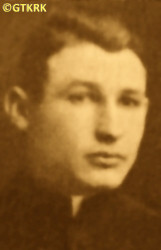
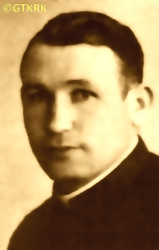
surname
NIMYŁOWICZ
forename(s)
Demetrius (pl. Demetriusz)
forename(s)
versions/aliases
Dmitry (pl. Dymitr)
function
eparchial priest
creed
Ukrainian Greek Catholic GCmore on
en.wikipedia.org
[access: 2013.05.19]
diocese / province
Apostolic GC Exarchate of Lemkowszczyznamore on
en.wikipedia.org
[access: 2024.03.02]
nationality
Ukrainian
date and place
of death
08.09.1943

Grabówkatoday: Dydnia gm., Brzozów pov., Subcarpathia voiv., Poland
more on
en.wikipedia.org
[access: 2021.12.18]
details of death
In 08.1939, prob. in connection with the announced mobilization, the Polish authorities prob. interned him and then expelled from the Grabówka curacy to Polesye, to the village of Zlovskye? near Kobryn in Belarus. Polish authorities, faced with the inevitability of war, arrested people deemed „unreliable” and having favorable to Germany or Russia views. Was recognized as such a person — as a priest of the Greek Catholic Apostolic Administration of the Lemko Region, i.e. AAL. AAL was established after the so‐called Tylawa schism, i.e. a wave of mass conversions of Lemkos to Orthodoxy at the turn of the 1920s and 1930s — as a result of which c. 18,000 Lemkos/Rusyns left the Greek Catholic Church — in protest against the Ukrainization policy of the hierarchy of that Church. The AAL stopped Ukrainization efforts in parishes under its control, which prevented further apostasy of the Lemkos. Many priests in the AAL, however, continued to support the radical Ukrainian national ideology. Mykhailo Baczyński, a member of the Polish Parliament, in his parliamentary speech of 21.01.1931, revealed what the Rusyns within the Greek Catholic Church, who were not susceptible to the genocidal — as it turned out — ideology of Ukrainian nationalists had to cope with: „The Greek Catholic Church established after the [Polish–Ukrainian 1918‐1919] war was turned into an agitational Ukrainian political tribune, from which words of hate are sown, not love of neighbor”.
The village of „Zlovskye,” to which, according to Ukrainian sources, was supposedly taken to, does not exist. It is probably a toponymic variation of the name of the village of Zalesye, located near the Tevle railway station on the line from Brest to Byaroza‐Kartuskaya, then in Kobryn County in the Polish Polesye Voivodeship. It is known that some of the internees were transported to the internment camp in Byaroza‐Kartuskaya, so it seems reasonable that could have been taken from the train at the aforementioned station and moved to Zalesye, c. 2 km away.
In 09.1939, the Germans and Russians attacked Poland, and World War II began. On c. 17.09.1939, i.e. the day of the Russian invasion of Poland, the internees and prisoners were released. In an unknown way — Polesye, in accordance with the Molotov–Ribbentrop Pact, was occupied by the Russians — in 10.1939 made his way back to the Lemko region, on the left side of the San River, then already under German occupation.
Unable to return to his Jabłonica Ruska parish, located on the right bank of the San River, which was under Russian occupation, took up curacy in the village of Grabówka, which was initially administratively part of the Germ. Kreishauptmannschaft Jasło (Eng Jasło County), on 01.01.1941 becoming part of the Germ. Kreishauptmannschaft Krosno (Eng. Krosno County) in the Germ. Distrikt Krakau (Eng. Kraków District), within the German‐occupied and run quasi‐state called the Germ. Generalgouvernement (Eng. General Governorate), i.e. GG. In 1939, Grabówka had a population of c. 800, of whom Roman Catholic Poles constituted c. 39%, Greek Catholic Rusyns c. 59%, and Jews c. 2% (there were a dozen or so of them). However, in the Brzozów county, to which Grabówka belonged in 1939, the Polish population constituted c. 80%, and the Ukrainian population only 16%.
The authors of «Liber Albus» are not familiar with the specific situation in Grabówka during the German occupation. It can be assumed, however, that it was a reflection of German policy — more precisely, of the GG authorities — in the GG. One of its goals was an attempt to break the influence of the Roman Catholic Church and Polish culture by supporting the Greek Catholic rite and Ukrainian‐language education in schools. The policy of supporting the Ukrainian element was perhaps most visible in the social policy of the GG. The Germans allowed the activities of social and charitable organizations, but only the Ukrainian Central Committee UCK was partially financed from the GG budget. It could also use funds from Ukrainian cooperatives. On the other hand the Polish Central Welfare Council RGO and the Jewish Social Self‐Help had to rely exclusively on voluntary contributions. As a result, Polish and Jewish organizations could only conduct charitable activities: supporting food supplies, refugee aid, etc. Ukrainians/Rusyns, using GG funds, were able to build Ukrainian/Rusyns hospitals, orphanages, nurseries, and schools.
This led to an escalation of the Polish–Ukrainian conflict. It could not have been otherwise, since the entrance door to the waiting room of the main train station in Kraków bore the inscription: Germ. niem.
„Nur für Deutsche aus dem Reich, Volksdeutsche und Ukrainer” (Eng. „Only for Germans from the Reich, Volksdeutsche, and Ukrainians”.
In 1942‐1943, on the territory of the GG, the Germans carried out — as part of the German plan called Germ. «Endlösung der Judenfrage» (Eng. Final Solution of the Jewish Question), which in the GG was implemented under the codename Germ. «Aktion Reinhardt» (Eng. Operation Reinhardt), and in which in most locations members of the collaborative Germ. Ukrainische Hilfspolizei (Eng. Ukrainian Auxiliary Police), in some regions also referred to as the Germ. Schutzmannschaft (Eng. Protection Battalions), i.e. Schuma, actively participated — the extermination of Jews. Such was also the case in Brzozów, where at the end of 1941 or at the beginning of 1942, a ghetto was established, and on 18.06.1942, c. 400 Jews were brought there from the surrounding villages, including prob. from Grabówka. The ghetto was administered by the Jewish Germ. Judenrat (Eng. Jewish Council), and police functions were performed by the collaborationist Germ. Jüdischer Ordnungsdienst (Eng. Jewish Police Service). Guard functions for the entire ghetto were performed mainly by Polish local units of the Germ. Ortsschutz (Eng. Local Security), subordinate to the Germ. Polnische Polizei im Generalgouvernement (Eng. Polish Police of the General Governorate), known as the „blue police”, which in turn was subordinate to local commanders of the Germ. German Ordnungspolizei (Eng. Order Police), i.e. OrPo. To prevent „acts of sabotage” and ensure the effective operation of the Germ. Ortsschutz, the Germans designated 15 prominent Poles in the town as hostages. Each such „act” threatened the hostages with death.
Sources are inconsistent regarding the liquidation of the ghetto. On 05.05.1942, there were supposedly c. 1,000 Jews in the ghetto. On 18.06.1942, i.e. on the day when Jews from nearby villages were brought to Brzozów, c. 400 Jews were also supposed to be transported — according to some sources — to the Germ. Zwangsarbeitslager (Eng. Forced Labor Camp) ZL Plaszow near Kraków. Next at the beginning of 08.1942, c. 258 Jews were supposed to be transported either to ZL Plaszow or to the Germ. Vernichtungslager (Eng. Extermination Camp) VL Belzec. Finally, on 10.08.1942, all remaining Jews were ordered to appear at the local stadium with their luggage up to 20 kg. There, the Germans — agents of the genocidal Germ. Die Schutzstaffel der NSDAP (Eng. NSDAP Protection Squad), i.e. «SS», a paramilitary formation subordinate to the ruling National Socialist German Workers' Party NSDAP in Germany — loaded them onto trucks. They were taken to the forest near the village of Zmiennica, where were ordered to undress, after which they were herded to a forest clearing used by the local population as a picnic spot. There, on the edge of previously dug pits, the Germans murdered them by shooting them in the back of the head. In the case of children, the Germans saved on ammunition and murdered them by hitting them with iron crowbars. This is how c. 700‐800 Jews were to be murdered.
Immediately afterwards, information began to arrive about the situation in Volyn, several hundred kilometers to the east, where in 02.1943 Roman Shukhevych, nom de guerre „Taras Chuprynka”, the chief commander of the Ukrainian, genocidal OUN/UPA organisation, who in 1941 was a member of the Ukrainian Germ. Sondergruppe Nachtigall (Eng. Special Group Nightingale) — a unit of the Germ. Wehrmacht (Eng. Armed Forces) that took part in the German attack on Russians in 1941, accused of participating in the Jewish pogrom in Lviv in 1941 — and later a member of the Germ. Schutzmannschaftsbataillon 201 (Eng. 201st Protection team Battalion) — responsible for the murder of Jews and civilians in the territory of Belarus — issued an order: „The extermination operation should be carried out according to the following principles: Polish villages are to be burned, and their populations massacred. Attacks on towns will take place in broad daylight, not at night. In mixed villages, the Polish population alone should be liquidated, and farmsteads should be burned only if they are 15 meters away and when there is no risk of the fire spreading to neighboring Ukrainian buildings. The Ukrainian population will receive instructions as to where to gather during the attack […] For every Ukrainian murdered, whether by Poles or Germans, 100 (one hundred) Poles will be executed”.
It was the de facto signal for the commencement of the «Genocidium Atrox» — i.e. the genocide perpetrated by Ukrainians, known as „Volyn genocide”.
Immediately thereafter, in 03.1943, the UPA issued an appeal to members of the Germ. Ukrainische Hilfspolizei to desert and join the UPA. Perhaps as many as 10,000 Ukrainians did so.
Volyn was drenched in Polish blood. Tens of thousands of Poles were murdered by the Ukrainians — with German passivity — in an extremely barbaric manner. Hundreds of villages were burned.
The OUN/UPA in 1943 formally did not function in the GG, e.g. in Germ. Distrikt Krakau. The groups operating there — so as not to „annoy” the Germans — were mainly operating under the euphemistic Ukrainian name Ukr. Українська Народна Самооборона (Eng. Ukrainian National Self–Defense), i.e. UNS, reinforced by deserters from the Germ. Ukrainische Hilfspolizei and Schuma, seasoned in the genocide of Jews. But the scale of the genocide in Volyn, reinforced by reports from Polish escapees from «Genocidium Atrox», inflamed Polish–Ukrainian relations immensely.
His ministry and activities in Grabówka became the subject of interest for cells of the Polish, clandestine Home Army AK (part of the Polish Clandestine State). The AK, the most powerful clandestine organization in German–occupied Europe, began preparing in 1943 for a general uprising against the German occupier, later codenamed Pl. „Burza” (Eng „Tempest”). Not only was propaganda activity conducted, leaflets and clandestine newspapers published, but regular military training and officer cadet training were also conducted. Sanitary services were trained. Acts of sabotage were organized and executed, targeting strategic supply and logistics lines. The Polish Clandestine State conducted clandestine education and also operated a secret judiciary, issuing sentences against the most harmful Germans and their Polish agents. Death sentences were carried out by special AK units.
Grabówka belonged to the AK Brzozów District, whose commander — until the end of 1943 — was Ignatius Casimir Wanic, nom de guerre „Yaxa”, „Andrew”. And sometime in the summer of 1943, the AK received information about nationalist, pro–Ukrainian stance of Grabówka parish priest. He allegedly openly called for the murder of Poles and conducted public prayers for a German victory. According to other sources, supported the actions of „Ukrainian bands that harassed the local Polish population”.
At that time, the Polish Clandestine State issued a death sentence on him. It is unclear whether this was the so‐called Civilian Special Court — primarily dealing with crimes against the Polish nation and state, collaboration with the occupiers, banditry, etc. — or perhaps the Military Special Court — primarily dealing with cases of treason, espionage, and denunciation.
According to Polish sources, the execution was carried out by an AK unit.
According to Ukrainian sources, „murdered by a 12‐strong Polish militia during an attack on the rectory in Grabówka” — beaten, dragged out into the yard, and shot.
cause of death
murder
perpetrators
Poles
sites and events
«Genocidium Atrox»Click to display the description, GeneralgouvernementClick to display the description, Ribbentrop‐MolotovClick to display the description, Pius XI's encyclicalsClick to display the description
date and place
of birth
23.10.1907

Drohobychtoday: Drohobych urban hrom., Drohobych rai., Lviv obl., Ukraine
more on
en.wikipedia.org
[access: 2021.10.09]
alt. dates and places
of birth
25.10.1907
parents
NIMYŁOWICZ Michael
🞲 1875, ? — 🕆 1941, ?

WALUCH Catherine
🞲 1883, ? — 🕆 1965, ?
presbyter (holy orders)
ordination
22.03.1931

Przemyśltoday: Przemyśl city pov., Subcarpathia voiv., Poland
more on
en.wikipedia.org
[access: 2021.04.01]
St Therese GC cathedral churchmore on
en.wikipedia.org
[access: 2025.03.14]
positions held
1939 – 1943
curatus/rector/expositus — Grabówkatoday: Dydnia gm., Brzozów pov., Subcarpathia voiv., Poland
more on
en.wikipedia.org
[access: 2021.12.18] ⋄ St Nicholas GC church ⋄ Lalintoday: Sanok gm., Sanok pov., Subcarpathia voiv., Poland
more on
en.wikipedia.org
[access: 2022.01.16], St George the Martyr GC parish ⋄ Sanoktoday: Sanok urban gm., Sanok pov., Subcarpathia voiv., Poland
more on
en.wikipedia.org
[access: 2021.10.09] GC deanery — also: from c. prefect of a primary school
1933 – 1939
vicar — Jabłonica Ruskatoday: Dydnia gm., Brzozów pov., Subcarpathia voiv., Poland
more on
en.wikipedia.org
[access: 2022.01.16] ⋄ St Cosma and St Damian the Martyrs GC parish ⋄ Dynówtoday: Dynów urban gm., Rzeszów pov., Subcarpathia voiv., Poland
more on
en.wikipedia.org
[access: 2021.10.09] GC deanery
1931 – 1933
administrator — Dobryachyntoday: Sheptytskyi urban hrom., Sheptytskyi rai., Lviv obl., Ukraine
more on
uk.wikipedia.org
[access: 2023.03.02] ⋄ Exaltation of the Holy Cross GC parish ⋄ Sokaltoday: Sokal urban hrom., Sheptytskyi rai., Lviv obl., Ukraine
more on
en.wikipedia.org
[access: 2020.11.20] GC deanery
1927 – 1931
student — Przemyśltoday: Przemyśl city pov., Subcarpathia voiv., Poland
more on
en.wikipedia.org
[access: 2021.04.01] ⋄ philosophy and theology, Greek Catholic Theological Seminary
others related
in death
ANDREJCZUKClick to display biography Peter, DIAKClick to display biography Basil, DOBRZAŃSKIClick to display biography Nicholas, HAJDUKClick to display biography Michael, HAJDUKClick to display biography Michael, HOŁOWACZClick to display biography Nicholas, HORECZKOClick to display biography Michael, LESZCZUKClick to display biography Joseph, KOSTYSZYNClick to display biography Vladimir, LISKIEWICZClick to display biography Nicholas, ŁEMCIOClick to display biography Vladimir, SZAŁASZClick to display biography Steven, SZCZERBAClick to display biography Yaroslav, SZEWCZUKClick to display biography Basil, SZUMIŁOClick to display biography Rostislav, WEŁYCZKOClick to display biography Michael, WENHRYNOWICZClick to display biography Orestes, WENHRYNOWICZClick to display biography Stephen Emilian, WENHRYNOWICZClick to display biography Vladimir, ZAWOROTIUKClick to display biography Michael
sites and events
descriptions
«Genocidium Atrox»: In 1939‐1947, especially in 1943‐1944, independent Ukrainian units, mainly belonging to genocidal Ukrainian organizations OUN (political arm) and UPA (military arm), supported by local Ukrainian population, murdered — often in extremely brutal way — in Volyn and surrounding regions of pre‐war Poland, from 130,000 to 180,000 Poles, all civilians: men, women, children, old and young. Polish‐Ukrainian conflict that openly emerged during and after World War I (in particular resulting in Polish‐Ukrainian war of 1918‐1919), that survived and even deepened later when western Ukraine became a part Poland, exploded again after the outbreak of the World War II in 09.1939. During Russian occupation of 1939‐1941, when hundreds of thousands of Poles were deported into central Russia, when tens of thousands were murdered (during so‐called Katyń massacres, among others), this open conflict had a limited character, helped by the fact that at that time Ukrainians, Ukrainian nationalists in particular, were also persecuted by the Russians. The worst came after German‐Russian war started on 22.06.1941 and German occupation resulted. Initially Ukrainians supported Germans (Ukrainian police was initiated, Ukrainians co—participated in extermination of the Jews and were joining army units fighting alongside Germans). Later when German ambivalent position towards Ukraine became apparent Ukrainians started acting independently. And in 1943 one of the units of aforementioned Ukrainian OUN/UPA organization, in Volyn, started and perpetrated a genocide of Polish population of this region. In mere few weeks OUN/UPA murdered, with Germans passively watching on the sidelines, more than 40,000 Poles. This strategy was consequently approved and adopted by all OUN/UPA organisations and similar genocides took place in Eastern Lesser Poland (part of Ukraine) where more than 20,000 Poles were slaughtered, meeting however with growing resistance from Polish population. Further west, in Chełm, Rzeszów, etc. regions this genocide turned into an extremely bloody conflict. In general genocide, perpetrated by Ukrainian nationalists, partly collaborating with German occupants, on vulnerable Polish population took part in hundreds of villages and small towns, where virtually all Polish inhabitants were wiped out. More than 200 priests, religious and nuns perished in this holocaust — known as «Genocidium Atrox» (Eng. „savage genocide”) The nature and purpose of genocide is perhaps best reflected in the song sung by the murderers: „We will slaughter the Poles, we will cut down the Jews, we must conquer the great Ukraine” (ukr. „Поляків виріжем, Євреїв видусим, велику Україну здобути мусим”). This holocaust and conflict ended up in total elimination of Polish population and Polish culture from Ukraine, in enforced deportations in 1944‐1945 of remaining Poles from Ukraine and some Ukrainians into Ukraine proper, and finally in deportation of Ukrainians from East‐South to the Western parts of Polish republic prl by Commie‐Nazi Russian controlled Polish security forces („Vistula Action”). (more on: www.swzygmunt.knc.plClick to attempt to display webpage
[access: 2021.06.20])
Generalgouvernement: After the Polish defeat in the 09.1939 campaign, which was the result of the Ribbentrop‐Molotov Pact and constituted the first stage of World War II, and the beginning of German occupation in part of Poland (in the other, eastern part of Poland, the Russian occupation began), the Germans divided the occupied Polish territory into five main regions. In two of them new German provinces were created, two other were incorporated into other provinces. However, the fifth part was treated separately, and in a political sense it was supposed to recreate the German idea from 1915 (during World War I, after the defeat of the Russians in the Battle of Gorlice in 05.1915) of creating a Polish enclave within Germany. Illegal in the sense of international law, i.e. Hague Convention, and public law, managed by the Germans according to separate laws — especially established for the Polish Germ. Untermenschen (Eng. subhumans) — till the Russian offensive in 1945 it constituted part of the Germ. Großdeutschland (Eng. Greater Germany). Till 31.07.1940 formally called Germ. Generalgouvernement für die besetzten polnischen Gebiete (Eng. General Government for the occupied Polish lands) — later simply Germ. Generalgouvernement (Eng. General Governorate), as in the years 1915‐1918. From 07.1941, i.e. after the German attack on 22.06.1941 against the erstwhile ally, the Russians, it also included the Galicia district, i.e. the Polish pre‐war south‐eastern voivodeships. A special criminal law was enacted and applied to Poles and Jews, allowing for the arbitrary administration of the death penalty regardless of the age of the „perpetrator”, and sanctioning the use of collective responsibility. After the end of the military conflict of the World War UU, the government of the Germ. Generalgouvernement was recognized as a criminal organization, and its leader, governor Hans Frank, guilty of war crimes and crimes against humanity and executed. (more on: en.wikipedia.orgClick to attempt to display webpage
[access: 2024.12.13])
Ribbentrop‐Molotov: Genocidal Russian‐German alliance pact between Russian leader Joseph Stalin and German leader Adolf Hitler signed on 23.08.1939 in Moscow by respective foreign ministers, Mr. Vyacheslav Molotov for Russia and Joachim von Ribbentrop for Germany. The pact sanctioned and was the direct cause of joint Russian and German invasion of Poland and the outbreak of the World War II in 09.1939. In a political sense, the pact was an attempt to restore the status quo ante before 1914, with one exception, namely the „commercial” exchange of the so‐called „Kingdom of Poland”, which in 1914 was part of the Russian Empire, fore Eastern Galicia (today's western Ukraine), in 1914 belonging to the Austro‐Hungarian Empire. Galicia, including Lviv, was to be taken over by the Russians, the „Kingdom of Poland” — under the name of the General Governorate — Germany. The resultant „war was one of the greatest calamities and dramas of humanity in history, for two atheistic and anti‐Christian ideologies — national and international socialism — rejected God and His fifth Decalogue commandment: Thou shall not kill!” (Abp Stanislav Gądecki, 01.09.2019). The decisions taken — backed up by the betrayal of the formal allies of Poland, France and Germany, which on 12.09.1939, at a joint conference in Abbeville, decided not to provide aid to attacked Poland and not to take military action against Germany (a clear breach of treaty obligations with Poland) — were on 28.09.1939 slightly altered and made more precise when a treaty on „German‐Russian boundaries and friendship” was agreed by the same murderous signatories. One of its findings was establishment of spheres of influence in Central and Eastern Europe and in consequence IV partition of Poland. In one of its secret annexes agreed, that: „the Signatories will not tolerate on its respective territories any Polish propaganda that affects the territory of the other Side. On their respective territories they will suppress all such propaganda and inform each other of the measures taken to accomplish it”. The agreements resulted in a series of meeting between two genocidal organization representing both sides — German Gestapo and Russian NKVD when coordination of efforts to exterminate Polish intelligentsia and Polish leading classes (in Germany called «Intelligenzaktion», in Russia took the form of Katyń massacres) where discussed. Resulted in deaths of hundreds of thousands of Polish intelligentsia, including thousands of priests presented here, and tens of millions of ordinary people,. The results of this Russian‐German pact lasted till 1989 and are still in evidence even today. (more on: en.wikipedia.orgClick to attempt to display webpage
[access: 2015.09.30])
Pius XI's encyclicals: Facing the creation of two totalitarian systems in Europe, which seemed to compete with each other, though there were more similarities than contradictions between them, Pope Pius XI issued in 03.1937 (within 5 days) two encyclicals. In the „Mit brennender Sorge” (Eng. „With Burning Concern”) published on 14.03.1938, condemned the national socialism prevailing in Germany. The Pope wrote: „Whoever, following the old Germanic‐pre‐Christian beliefs, puts various impersonal fate in the place of a personal God, denies the wisdom of God and Providence […], whoever exalts earthly values: race or nation, or state, or state system, representatives of state power or other fundamental values of human society, […] and makes them the highest standard of all values, including religious ones, and idolizes them, this one […] is far from true faith in God and from a worldview corresponding to such faith”. On 19.03.1937, published „Divini Redemptoris” (Eng. „Divine Redeemer”), in which criticized Russian communism, dialectical materialism and the class struggle theory. The Pope wrote: „Communism deprives man of freedom, and therefore the spiritual basis of all life norms. It deprives the human person of all his dignity and any moral support with which he could resist the onslaught of blind passions […] This is the new gospel that Bolshevik and godless communism preaches as a message of salvation and redemption of humanity”… Pius XI demanded that the established human law be subjected to the natural law of God , recommended the implementation of the ideal of a Christian state and society, and called on Catholics to resist. Two years later, National Socialist Germany and Communist Russia came together and started World War II. (more on: www.vatican.vaClick to attempt to display webpage
[access: 2023.05.28], www.vatican.vaClick to attempt to display webpage
[access: 2023.05.28])
sources
personal:
maydan.drohobych.netClick to attempt to display webpage
[access: 2015.03.01], docplayer.plClick to attempt to display webpage
[access: 2020.01.06], dds.edu.uaClick to attempt to display webpage
[access: 2015.03.01], ru.openlist.wikiClick to attempt to display webpage
[access: 2019.05.30]
bibliographical:
„Clergy of Przemyśl Eparchy and Apostolic Exarchate of Lemkivshchyna”, Bogdan Prach, Ukrainian Catholic University Publishing House, Lviv 2015
„Encyclopedia of Camps and Ghettos, 1933‐1945”, The United States Holocaust Memorial Museum, ed. Martin Dean, volume II: „Ghettos in German–Occupied Eastern Europe”, part A
„Genocidium Atrox”, GTKRK, https://www.swzygmunt.knc.pl/GENOCIDEs/15 GENOCIDUM ATROX/vPOLISH/MAINs/GENATROXsearch01.htm
original images:
drohobychyna-com-ua.translate.googClick to attempt to display webpage
[access: 2026.07.13]
LETTER to CUSTODIAN/ADMINISTRATOR
If you have an Email client on your communicator/computer — such as Mozilla Thunderbird, Windows Mail or Microsoft Outlook, described at WikipediaPatrz:
en.wikipedia.org, among others — try the link below, please:
LETTER to CUSTODIAN/ADMINISTRATORClick and try to call your own Email client
If however you do not run such a client or the above link is not active please send an email to the Custodian/Administrator using your account — in your customary email/correspondence engine — at the following address:

giving the following as the subject:
MARTYROLOGY: NIMYŁOWICZ Demetrius
To return to the biography press below:
 Click to return to biography