Roman Catholic
St Sigismund parish
05-507 Słomczyn
85 Wiślana Str.
Konstancin deanery
Warsaw archdiocese, Poland

full list:
displayClick to display full list

searchClick to search full list by categories
wyświetlKliknij by wyświetlić pełną listę po polsku

szukajKliknij by przeszukać listę wg kategorii po polsku

Martyrology of the clergy — Poland
XX century (1914 – 1989)
personal data
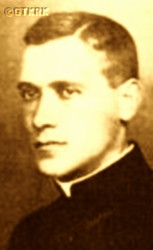
surname
KRAŚNICKI
surname
versions/aliases
KWAŚNICKI
forename(s)
Andrew (pl. Andrzej)
function
diocesan priest
creed
Latin (Roman Catholic) Church RCmore on
en.wikipedia.org
[access: 2014.09.21]
diocese / province
Lviv archdiocesemore on
en.wikipedia.org
[access: 2013.05.19]
academic distinctions
Doctor of Sacred Theology
honorary titles
Expositorii Canonicalis canonmore on
en.wikipedia.org
[access: 2014.11.14]
(c. 1930)
date and place
of death
08.12.1943

Yazlovetstoday: Buchach urban hrom., Chortkiv rai., Ternopil obl., Ukraine
more on
en.wikipedia.org
[access: 2020.11.15]
alt. dates and places
of death
Bazartoday: Bilobozhnytsya hrom., Chortkiv rai., Ternopil obl., Ukraine
more on
uk.wikipedia.org
[access: 2023.03.02]
Pozhezhatoday: Buchach urban hrom., Chortkiv rai., Ternopil obl., Ukraine
more on
uk.wikipedia.org
[access: 2023.08.19]
details of death
From 1934, ministered as parish priest of Yazlovets, a town located c. 13 km south of the then‐municipal town of Buchach, on the Strypa River, tributary of the Dniester, in the southern part of the Ternopil Voivodeship. In 1939, it had an estimated population of c. 3,500 people, i.a. c. 2,000 Poles — Roman Catholics —constituting c. 58% of the population, 25% Ukrainians, and several hundred, i.e. 18% Jews.
After the German and Russian invasion of Poland in 09.1939 and the start of World War II, after the beginning of the Russian occupation, due to his inability to pay the exorbitant taxes imposed by the communist occupier, the Russians robbed him of all his furniture. Many teachers, officers and military settlers, political activists, estate owners, businessmen, officials and other wealthy people, considered a „hostile and harmful element”, were deported by the Russians deep into Russia, „to Siberia”, in particular on c. 10.02.1940, the date of the great deportation of Poles.
After the German attack on 22.06.1941 on their erstwhile ally, the Russians, and the beginning of the German occupation, the town became part of the Germ. Landkreis Czortków (Eng. Chortkiv County), within the Germ. Distrikt Galizien (Eng. Galicia District) of the occupation entity called the Germ. Generalgouvernement (Eng. General Governorate), i.e. GG.
Became a witness of the manifestation of the first great wave of Ukrainian hatred towards the Polish population. On 28.09.1941, a nun, Sr Sophie Matilde Ustyanowicz CSIC, who was serving at the time in the Sisters of the Immaculate Conception CSIC, i.e. CSIC nuns, Congregation house in Yazlovets, wrote a significant entry in a letter to her superior: „We must devote ourselves to the local population (I am talking about educational work) […] Spreading hatred towards everything Polish has completely depraved these unfortunate people. Social relations after this war will change the world even more than after the other one [i.e. World War I]”.
The Russians fled Yazlovets on 27.06.1941. The main fighting front bypassed Yazlovets, so due to the initial lack of significant German units in the town, the Ukrainians immediately took over. They established their own „commune board” and organized police militias, which they called the „Ukrainian Sich”. Staged a large demonstration, supported by the local Greek Catholic priest, during which the crowd shouted Ukr. „Смерть' Лахам та єврейкомуністом” (Eng. „death to the Poles and Jewish‐communists”). Several dozen Poles were arrested and placed in custody at the CSIC nuns" house. Beaten to the point of bloodshed and unconsciousness. Women and men. At least one was murdered. The rest were released when Hungarians fighting alongside the Germans, whose unit was stationed in Zolotyi Potik, c. 10 km away, appeared in the town.
When the Germans finally took over the real power in Yazlovets, Jews started to be targetted. Although the „Ukrainian Sich” was disbanded, in its place the Ukrainian, collaborationist Germ. Ukrainische Hilfspolizei (Eng. Ukrainian Auxiliary Police), operating as Germ. Schutzmannschaft (Eng. Security Battalions), i.e. Schuma, was established. And it immediately joined in the implementation of the emerging German genocidal plan, the Germ. «Endlösung der Judenfrage» (Eng. Final Solution of the Jewish Question), which from 1942 onwards was carried out in the GG under the German codename Germ. «Aktion Reinhardt» (Eng. Operation Reinhardt).
The first act was the arrest of c. 20 young Jews. After several days of abuse, the Ukrainians tied their hands with barbed wire, herded them to the Strypa River, shot them, and threw their bodies into the river. In the late summer of 1941, at a swampy lake c. 4 km east of Yazlovets, Ukrainians — even „Ukrainian officials”, as sources state, under the direction of agents of the Germ. Die Schutzstaffel der NSDAP (Eng. NSDAP Protection Squad), i.e. «SS», a paramilitary formation subordinate to the ruling National Socialist German Workers' Party NSDAP in Germany — murdered c. 3,000‐4,000 Jews from Hungary. It is unclear from where precisely — it was though remembered that they spoke Hungarian. They were brought by train to Buchach, c. 13 km to the north, and from there by car to the ruined castle in Yazlovets, from where they were driven to the crime scene. If they rebelled, they were beaten by Ukrainians with rifle butts, batons, and whips — men, women, and children. The bodies were thrown into the lake.
The persecution of Poles continued as well. The Germans pursued a policy that one CSIS nun described as follows: „The two‐faced German policy aimed to arouse an increasingly stronger national hatred. They pretended to be the guardians towards the Poles and tried to establish social relations, at the same time promising the Ukrainians an independent Ukraine, secretly allowing them to accumulate weapons and create armed organizations in order to exterminate the Poles”. And in the autumn of 1941, Ukrainian collaborators arrested more Poles. Under trumped‐up charges, transported them to the prison in Buchach. There, they were beaten and tortured for three months. When the Germans finally took over the investigation, they were all released — it turns out that the Lat. „Etiam latrones suis legibus parent” (Eng. „Even bandits have their rights”).
In 1942, the fate of the Jews of Yazlovets was sealed. In 03.1942 it became clear that all the Jews of Yazlovets would be deported to the ghetto in Buchach. At that time, some Jews began to hide, mainly in Polish homes. Despite that from 15.10.1939, a decree of the German governor of the GG was in force, which included, among other things, the following provisions: „(1) Jews who leave their assigned district without authorization are subject to the death penalty. The same punishment applies to persons who knowingly provide such Jews with a hiding place. (2) Instigators and accomplices are subject to the same punishment as the perpetrator; an attempted act will be punished as a completed act”.
In the autumn, the Jews of Yazlovets were driven by the Germ. Ukrainische Hilfspolizei to the Buchach ghetto. A witness recalled: „An order was issued that all Jews with their entire families, on a specified day and hour, were to leave their homes with their personal belongings and form a column on the main road. Police units with dogs ensured this; those who refused were set on dogs and driven out into the streets […] A column of several hundred people, thus formed, was escorted to Buchach […] This human procession, driven by armed policemen with dogs on leashes, people by people, was a pathetic sight”. The Germ. Jüdischer Ordnungsdienst (Eng. Jewish Order Service) was particularly active. From Buchach, in late 1942, 3,100‐4,100 Jews were deported and murdered in VL Belzec extermination camp. The rest, c. 7,000‐10,700, were murdered after the end of VL Belzec's operation, mainly in 1943, in the Buchach area.
Those who tried to hide were practically hunted down, in full view of the helpless inhabitants of the town. The aforementioned witness wrote: „Many young Jews and Jewish women left their homes early, hiding in fields, forests or neighbors" farm buildings […] They were hunted down like wild animals, and the dead were taken to the Jewish cemetery and buried there in mass graves”. A few managed to hide in the surrounding forests. According to sources, „The most common source of their supplies was a field belonging to the Sisters of the Immaculate Conception, called Kamienny Garb (Stone Garb), […] surrounded on three sides by forest […] The nuns left potatoes in the field, knowing who they would serve. They themselves led the operation of hiding Jews and organized help for them. There was even talk of issuing Christian birth certificates for them”.
If such was the case, the only person authorized to issue baptismal certificates was the local parish priest. Some of his parishioners were, in fact, honored after the war by the Yad Vashem Institute in Jerusalem with the title of „Righteous Among the Nations” for hiding Jews.
And it was then, in 02 1943, that Roman Szuchewycz, nom de guerre „Taras Chuprynka”, the chief commander of the genocidal Ukrainian organization OUN/UPA, issued the order: „The extermination operation should be carried out according to the following principles: Polish villages are to be burned, and their populations massacred. Attacks on towns will take place in broad daylight, not at night. In mixed villages, the Polish population alone should be liquidated, and farmsteads should be burned only if they are 15 meters away and when there is no risk of the fire spreading to neighboring Ukrainian buildings. The Ukrainian population will receive instructions as to where to gather during the attack […] For every Ukrainian murdered, whether by Poles or Germans, 100 (one hundred) Poles will be executed”.
It was the de facto signal for the commencement of the «Genocidium Atrox» — i.e. the genocide perpetrated by Ukrainians, known as „Volyn genocide”.
Immediately thereafter, in 03.1943, the UPA issued an appeal to members of the Germ. Ukrainische Hilfspolizei, to desert and join the UPA. Perhaps as many as 10,000 Ukrainians did so.
In early 1944, after the extermination of the Polish population in Volyn — amid German passivity — the genocide killer „Taras Chuprynka” Shukhevych issued an order to initiate the «Genocidium Atrox» in Eastern Galicia. To accomplish it, the euphemistically named, to mislead the Germans, Ukr. Українська Народна Самооборона (Eng. Ukrainian National Self–Defense), i.e. UNS, operating in Eastern Galicia — significantly reinforced in 1943 by deserters from the genocidal Germ. Ukrainische Hilfspolizei — was renamed as OUN/UPA „UPA‐West” operational group. In the Ternopil Voivodeship, its command was assumed in 12.1943 by W Vasyl Sydor, nom de guerre „Shelest”, who ordered „to strike continuously at Poles until they are completely destroyed from these lands”. The Buchach region, meanwhile, fell under the control of the UPA Military District WO‐3 „Lysonya”, whose commander at that time was a certain Emilian (Omelyan) Polowy, nom de guerre „Ostap”, prob. a deserter from the 201st Schuma Battalion, infamous for its extermination operations against Jews in Belarus.
«Genocidium Atrox» reached Yazlovets, a town where, according to German sources, on 01.03.1943 — as a result of deportations „to Siberia” during the Russian occupation and extermination of Jews — only 1,632 inhabitants remained, less than half in 1939.
Then, on 27.08.1943 — according to other sources, it could have been later, i.e. „in early December”, perhaps 03.12.1943 — survived an attack by a Ukrainian gang on his rectory. „Unknown perpetrators” smashed a window with a stone and then began banging on the rectory door. Then his vicar, [Fr Aloisy Schmidt], „saw the barrel of a rifle in the half–open door, which he snatched from the attacker”, and then quickly „worked the bolt”, i.e. prepared the rifle to fire. At that sound, the attackers fled.
The next day, the „head of the community”, i.e. prob. chairman of the Yazlovets commune — in the GG, Yazlovets became the capital of such — of Ukrainian nationality, appeared at the rectory and … „demanded the surrender the rifle”.
Despite this, did not leave his parish. For a while, spent the nights in the church attic or in the local monastery of the Sisters of the Immaculate Conception CSIC, but in 11.1943, returned to the rectory.
On the night of 07‐08.12.1943, i.e. the feast of Immaculate Conception of the Virgin Mary, attacked again by the Ukrainian bandits, disguised in German uniforms.
The murderers broke down the rectory door and captured him.
Tortured.
Refused to break the seal of confession and provide information about the location of the Jews, whom prob. himself hid in the rectory, but also knew where others were hiding. Many years later, one of the Polish families hiding Jews in Yazlovets received Israel's highest honor, „Righteous Among the Nations”, awarded by the Yad Vashem Institute.
Broke free and threw bottles at the attackers from the rectory's attic, screaming for help.
However, was caught. Beaten, had ribs, arms, and legs broken, was dragged down the stairs by feet, and then was thrown out the window onto a pile of stones and bricks.
Unconscious, was carried out of town on a sleigh and drowned in a nearby lake, where captured Jews were previously believed to have been drowned.
Nearby, the Ukrainian genocidal OUN/UPA sotnia ukr. „Сірі вовки” (Eng. „Grey Wolves”) was prowling, under the command of the Peter Khamchuk, nom de guerre „Bystry” (Eng. „Smart”), organized and operating in the Buchach and Chortkiv region at that time, later infamous for the murders near Krystynopil by Lviv, which committed murders of Poles in the surrounding villages. But Yazlovets it did not dare to attack. It can be hypothesized that the murder of the Polish priest was committed by a group of Ukrainians from Yazlovets — perhaps in cooperation with the ukr. „Сірі вовки” — with the full knowledge of the Ukrainian municipal authorities, the passivity of the Germans, and the active, undisguised support of the local Greek Catholic parish priest, Fr Michael Śnihurowycz, whose son was allegedly involved in the attack and murder.
On 12.10.2007, the génocidaire Roman Shukhevych was posthumously awarded the title of Hero of Ukraine. On 10.12.2017, on behalf of the „Coordination Council for the Commemoration of Decorated Knights of the OUN and UPA”, génocidaire Vasyl Sydor was posthumously awarded in Lviv the Silver Cross of Military Merit of the UPA, 1st Class (No. 009). In several locations, monuments and commemorative plaques have been erected to these Lat. „hostis humani generis”, the schools were named after them.
Lat. „O Tempora! O mores!”
alt. details of death
According to other sources murdered on the fields of Pozhezha or Bazar villages, c. 5‐7 km from Yazlovets.
cause of death
murder
perpetrators
Ukrainians
sites and events
«Genocidium Atrox»Click to display the description, Help to the JewsClick to display the description, VL BelzecClick to display the description, GeneralgouvernementClick to display the description, Ribbentrop‐MolotovClick to display the description, Pius XI's encyclicalsClick to display the description
date and place
of birth
19.11.1895Birth certification on:
agadd.home.net.pl
[access: 2026.07.13]

Stryivkatoday: Zbarazh urban hrom., Ternopil rai., Ternopil obl., Ukraine
more on
uk.wikipedia.org
[access: 2023.03.12]
alt. dates and places
of birth
1890
parents
KRAŚNICKI Charles
🞲 ?, ? — 🕆 ?, ?

KOMINEK Mary
🞲 ?, ? — 🕆 ?, ?
baptism
19.11.1895Birth certification on:
agadd.home.net.pl
[access: 2026.07.13]

Zbarazhtoday: Zbarazh urban hrom., Ternopil rai., Ternopil obl., Ukraine
more on
en.wikipedia.org
[access: 2022.10.15]
St Anthony of Padua RC church
presbyter (holy orders)
ordination
1921

Lvivtoday: Lviv urban hrom., Lviv rai., Lviv obl., Ukraine
more on
en.wikipedia.org
[access: 2022.01.16]
positions held
1934 – 1944
parish priest — Yazlovetstoday: Buchach urban hrom., Chortkiv rai., Ternopil obl., Ukraine
more on
en.wikipedia.org
[access: 2020.11.15] ⋄ Assumption of the Blessed Virgin Mary RC parish ⋄ Yazlovetstoday: Buchach urban hrom., Chortkiv rai., Ternopil obl., Ukraine
more on
en.wikipedia.org
[access: 2020.11.15] RC deanery
1933 – 1934
administrator — Varyazhtoday: Sokal urban hrom., Sheptytskyi rai., Lviv obl., Ukraine
more on
en.wikipedia.org
[access: 2020.11.22] ⋄ St Mark the Evangelist RC parish ⋄ Belztoday: Belz urban hrom., Sheptytskyi rai., Lviv obl., Ukraine
more on
en.wikipedia.org
[access: 2020.11.15] RC deanery
1932 – 1933
resident — Zakopanetoday: Zakopane urban gm., Tatra pov., Lesser Poland voiv., Poland
more on
en.wikipedia.org
[access: 2021.12.18] ⋄ Holy Family RC parish ⋄ Nowy Targtoday: Nowy Targ gm., Nowy Targ pov., Lesser Poland voiv., Poland
more on
en.wikipedia.org
[access: 2021.06.07] RC deanery — sick leave
1925 – 1932
prefect — Lvivtoday: Lviv urban hrom., Lviv rai., Lviv obl., Ukraine
more on
en.wikipedia.org
[access: 2022.01.16] ⋄ studies, Metropolitan Theological Seminary
1927 – 1931
assistant — Lvivtoday: Lviv urban hrom., Lviv rai., Lviv obl., Ukraine
more on
en.wikipedia.org
[access: 2022.01.16] ⋄ library, Theological Institute, John Casimir University [i.e. clandestine John Casimir University (1941‐1944) / Ivan Franko University (1940‐1941) / John Casimir University (1919‐1939) / Franciscan University (1817‐1918)]
till 1927
PhD student — Lvivtoday: Lviv urban hrom., Lviv rai., Lviv obl., Ukraine
more on
en.wikipedia.org
[access: 2022.01.16] ⋄ Department of Theology, John Casimir University [i.e. clandestine John Casimir University (1941‐1944) / Ivan Franko University (1940‐1941) / John Casimir University (1919‐1939) / Franciscan University (1817‐1918)] — on 03.12.1927 public defense of the PhD thesis in Sacred Theology
1924 – 1925
vicar — Berezhanytoday: Berezhany urban hrom., Ternopil rai., Ternopil obl., Ukraine
more on
en.wikipedia.org
[access: 2020.11.15] ⋄ Nativity of the Blessed Virgin Mary RC parish ⋄ Berezhanytoday: Berezhany urban hrom., Ternopil rai., Ternopil obl., Ukraine
more on
en.wikipedia.org
[access: 2020.11.15] RC deanery
1921 – 1924
vicar — Kozovatoday: Kozova hrom., Ternopil rai., Ternopil obl., Ukraine
more on
en.wikipedia.org
[access: 2020.11.24] ⋄ St Stanislav the Bishop and Martyr RC parish ⋄ Berezhanytoday: Berezhany urban hrom., Ternopil rai., Ternopil obl., Ukraine
more on
en.wikipedia.org
[access: 2020.11.15] RC deanery
1917 – 1921
student — Lvivtoday: Lviv urban hrom., Lviv rai., Lviv obl., Ukraine
more on
en.wikipedia.org
[access: 2022.01.16] ⋄ philosophy and theology, Metropolitan Theological Seminary
author of i.a. „Posts in old Poland”, Lviv 1931
others related
in death
KOGUTClick to display biography Marianne (Sr Beata), SUSZCZYŃSKIClick to display biography Joseph, KOSIOROWSKAClick to display biography Hedwig (Sr Francesca), KULPAClick to display biography Sophia (Sr Mary Leocadia), SKAŁECKAClick to display biography Anne (Sr Mary Therese), SZEMBEKClick to display biography Mary Wanda Rosalie (Sr Mary Laetitia of God's Love), USTYANOWICZClick to display biography Matilde Stephanie Anne (Sr Mary Sophia of Heart of Jesus)
sites and events
descriptions
«Genocidium Atrox»: In 1939‐1947, especially in 1943‐1944, independent Ukrainian units, mainly belonging to genocidal Ukrainian organizations OUN (political arm) and UPA (military arm), supported by local Ukrainian population, murdered — often in extremely brutal way — in Volyn and surrounding regions of pre‐war Poland, from 130,000 to 180,000 Poles, all civilians: men, women, children, old and young. Polish‐Ukrainian conflict that openly emerged during and after World War I (in particular resulting in Polish‐Ukrainian war of 1918‐1919), that survived and even deepened later when western Ukraine became a part Poland, exploded again after the outbreak of the World War II in 09.1939. During Russian occupation of 1939‐1941, when hundreds of thousands of Poles were deported into central Russia, when tens of thousands were murdered (during so‐called Katyń massacres, among others), this open conflict had a limited character, helped by the fact that at that time Ukrainians, Ukrainian nationalists in particular, were also persecuted by the Russians. The worst came after German‐Russian war started on 22.06.1941 and German occupation resulted. Initially Ukrainians supported Germans (Ukrainian police was initiated, Ukrainians co—participated in extermination of the Jews and were joining army units fighting alongside Germans). Later when German ambivalent position towards Ukraine became apparent Ukrainians started acting independently. And in 1943 one of the units of aforementioned Ukrainian OUN/UPA organization, in Volyn, started and perpetrated a genocide of Polish population of this region. In mere few weeks OUN/UPA murdered, with Germans passively watching on the sidelines, more than 40,000 Poles. This strategy was consequently approved and adopted by all OUN/UPA organisations and similar genocides took place in Eastern Lesser Poland (part of Ukraine) where more than 20,000 Poles were slaughtered, meeting however with growing resistance from Polish population. Further west, in Chełm, Rzeszów, etc. regions this genocide turned into an extremely bloody conflict. In general genocide, perpetrated by Ukrainian nationalists, partly collaborating with German occupants, on vulnerable Polish population took part in hundreds of villages and small towns, where virtually all Polish inhabitants were wiped out. More than 200 priests, religious and nuns perished in this holocaust — known as «Genocidium Atrox» (Eng. „savage genocide”) The nature and purpose of genocide is perhaps best reflected in the song sung by the murderers: „We will slaughter the Poles, we will cut down the Jews, we must conquer the great Ukraine” (ukr. „Поляків виріжем, Євреїв видусим, велику Україну здобути мусим”). This holocaust and conflict ended up in total elimination of Polish population and Polish culture from Ukraine, in enforced deportations in 1944‐1945 of remaining Poles from Ukraine and some Ukrainians into Ukraine proper, and finally in deportation of Ukrainians from East‐South to the Western parts of Polish republic prl by Commie‐Nazi Russian controlled Polish security forces („Vistula Action”). (more on: www.swzygmunt.knc.plClick to attempt to display webpage
[access: 2021.06.20])
Help to the Jews: During World War II on the Polish occupied territories Germans forbid to give any support to the Jews under penalty of death. E.g., on 15.10.1941, the Germ. Generalgouverneur (Eng. General Governor) of the Germ. Generalgouvernement (Eng. General Governorate), i.e. GG, Hans Frank, issued the „3rd Ordinance on Restrictions on Residence in the General Governorate”, in which §1 stated that: „1) Jews who leave their designated district without authorization are subject to the death penalty. The same penalty applies to persons who knowingly provide such Jews with a hiding place”; and „2) Instigators and accomplices are subject to the same punishment as the perpetrator; an attempted act will be punished as a completed act. In less serious cases, severe imprisonment or prison may be imposed”. This ordinance was further elaborated by the district leaders of GG. E.g., on 10.11.1941, the Germ. Gouverneur (Eng. Governor) of the Germ. Distrikt Warschau (Eng. Warsaw District) in GG, Ludwig Fischer, issued a proclamation stating that: „A Jew who in the future unauthorizedly leaves the residential district assigned to him will be punished with death”. And added: „The same punishment applies to anyone who knowingly provides shelter to such Jews or helps them in any other way (e.g., by providing accommodation, board, by taking them on vehicles of any kind, etc.)”. In practice, this meant that responsibility for hiding Jews rested not only with the owners of the premises, but also with all the people being there, generally the family of the person hiding them. When at the turn of 1941/1942 the Germans began to implement the genocidal plan Germ. Endlösung der Judenfrage (Eng. Final Solution of the Jewish Question), when the deportation of Jews from the Warsaw ghetto to the Germ. Vernichtungslager (Eng. extermination camp) VL Treblinka was underway, the Polish writer Sophie Kossak–Szczucka on 11.08.1942 issued an appeal „Protest!”, published in the underground press in a circulation of 5,000 copies. She wrote: „The world looks at this crime, more terrible than anything history has ever seen, and — it remains silent […] This silence cannot be tolerated any longer. Whatever its motives — it is despicable. We cannot remain passive in the face of crime. Whoever remains silent in the face of murder becomes an accomplice to the murderer. Whoever does not condemn, consents. Therefore, we, Catholics — Poles, are speaking out. Our feelings towards Jews have not changed. We do not cease to consider them political, economic, and ideological enemies of Poland. Moreover, we realize that they hate us more than they hate Germans […] Awareness of these feelings, however, does not release us from the obligation to condemn the crime […] Whoever does not understand this, whoever would dare to link Poland's proud, free future with the despicable joy of their neighbor's misfortune — is therefore neither a Catholic nor a Pole!” The „Protest” was signed by the „Front for the Rebirth of Poland”, i.e. FOP, a clandestine Catholic organization that was a continuation of Catholic Action during the German occupation. On 27.09.1942, the Polish Clandestine State, the largest resistance organization in German–occupied Europe, at the initiative of Sophie Kossak–Szczucka and Wanda Krahelska–Filipowicz, a member of the Polish Socialist Party, established the Provisional Committee to Aid Jews. On 04.12.1942, the Council to Aid Jews at the Polish Government Delegature in occupied Poland, codenamed „Conrad Żegota”, was established in its place. Hundreds of Polish priests and religious extended help to the Jews, under threat of life. Many of them were caught and murdered.
VL Belzec: German Germ. Vernichtungslager (Eng. Extermination camp) VL — oficially known as SS‐Sonderkommando Belzec — operational from 03.1942 till 06.1943 n. Belzec village, c. 8 km to the south of Tomaszów Lubelski, founded as part of German „Reinhardt” program of extermination of Jewish population. Victims were mainly Polish Jews from ghettos and camps in German‐run General Governorate, mainly from Galicia, Cracow and Lublin districts; but also Austrian, Czech, German, Slovak and Hungarian Jews. The victims were murdered in stationary gas chambers with exhaust fumes. The number of exterminated is estimated to reach c. 450,000. The camp was run by c. 20. German and Austrian SS functionaries at any one time. They were supported by a company of watchmen (Germ. SS‐Wachmannschaften) — mainly former Russian POWs who switched sides, in general of Ukrainian nationality. (more on: en.wikipedia.orgClick to attempt to display webpage
[access: 2020.02.08])
Generalgouvernement: After the Polish defeat in the 09.1939 campaign, which was the result of the Ribbentrop‐Molotov Pact and constituted the first stage of World War II, and the beginning of German occupation in part of Poland (in the other, eastern part of Poland, the Russian occupation began), the Germans divided the occupied Polish territory into five main regions. In two of them new German provinces were created, two other were incorporated into other provinces. However, the fifth part was treated separately, and in a political sense it was supposed to recreate the German idea from 1915 (during World War I, after the defeat of the Russians in the Battle of Gorlice in 05.1915) of creating a Polish enclave within Germany. Illegal in the sense of international law, i.e. Hague Convention, and public law, managed by the Germans according to separate laws — especially established for the Polish Germ. Untermenschen (Eng. subhumans) — till the Russian offensive in 1945 it constituted part of the Germ. Großdeutschland (Eng. Greater Germany). Till 31.07.1940 formally called Germ. Generalgouvernement für die besetzten polnischen Gebiete (Eng. General Government for the occupied Polish lands) — later simply Germ. Generalgouvernement (Eng. General Governorate), as in the years 1915‐1918. From 07.1941, i.e. after the German attack on 22.06.1941 against the erstwhile ally, the Russians, it also included the Galicia district, i.e. the Polish pre‐war south‐eastern voivodeships. A special criminal law was enacted and applied to Poles and Jews, allowing for the arbitrary administration of the death penalty regardless of the age of the „perpetrator”, and sanctioning the use of collective responsibility. After the end of the military conflict of the World War UU, the government of the Germ. Generalgouvernement was recognized as a criminal organization, and its leader, governor Hans Frank, guilty of war crimes and crimes against humanity and executed. (more on: en.wikipedia.orgClick to attempt to display webpage
[access: 2024.12.13])
Ribbentrop‐Molotov: Genocidal Russian‐German alliance pact between Russian leader Joseph Stalin and German leader Adolf Hitler signed on 23.08.1939 in Moscow by respective foreign ministers, Mr. Vyacheslav Molotov for Russia and Joachim von Ribbentrop for Germany. The pact sanctioned and was the direct cause of joint Russian and German invasion of Poland and the outbreak of the World War II in 09.1939. In a political sense, the pact was an attempt to restore the status quo ante before 1914, with one exception, namely the „commercial” exchange of the so‐called „Kingdom of Poland”, which in 1914 was part of the Russian Empire, fore Eastern Galicia (today's western Ukraine), in 1914 belonging to the Austro‐Hungarian Empire. Galicia, including Lviv, was to be taken over by the Russians, the „Kingdom of Poland” — under the name of the General Governorate — Germany. The resultant „war was one of the greatest calamities and dramas of humanity in history, for two atheistic and anti‐Christian ideologies — national and international socialism — rejected God and His fifth Decalogue commandment: Thou shall not kill!” (Abp Stanislav Gądecki, 01.09.2019). The decisions taken — backed up by the betrayal of the formal allies of Poland, France and Germany, which on 12.09.1939, at a joint conference in Abbeville, decided not to provide aid to attacked Poland and not to take military action against Germany (a clear breach of treaty obligations with Poland) — were on 28.09.1939 slightly altered and made more precise when a treaty on „German‐Russian boundaries and friendship” was agreed by the same murderous signatories. One of its findings was establishment of spheres of influence in Central and Eastern Europe and in consequence IV partition of Poland. In one of its secret annexes agreed, that: „the Signatories will not tolerate on its respective territories any Polish propaganda that affects the territory of the other Side. On their respective territories they will suppress all such propaganda and inform each other of the measures taken to accomplish it”. The agreements resulted in a series of meeting between two genocidal organization representing both sides — German Gestapo and Russian NKVD when coordination of efforts to exterminate Polish intelligentsia and Polish leading classes (in Germany called «Intelligenzaktion», in Russia took the form of Katyń massacres) where discussed. Resulted in deaths of hundreds of thousands of Polish intelligentsia, including thousands of priests presented here, and tens of millions of ordinary people,. The results of this Russian‐German pact lasted till 1989 and are still in evidence even today. (more on: en.wikipedia.orgClick to attempt to display webpage
[access: 2015.09.30])
Pius XI's encyclicals: Facing the creation of two totalitarian systems in Europe, which seemed to compete with each other, though there were more similarities than contradictions between them, Pope Pius XI issued in 03.1937 (within 5 days) two encyclicals. In the „Mit brennender Sorge” (Eng. „With Burning Concern”) published on 14.03.1938, condemned the national socialism prevailing in Germany. The Pope wrote: „Whoever, following the old Germanic‐pre‐Christian beliefs, puts various impersonal fate in the place of a personal God, denies the wisdom of God and Providence […], whoever exalts earthly values: race or nation, or state, or state system, representatives of state power or other fundamental values of human society, […] and makes them the highest standard of all values, including religious ones, and idolizes them, this one […] is far from true faith in God and from a worldview corresponding to such faith”. On 19.03.1937, published „Divini Redemptoris” (Eng. „Divine Redeemer”), in which criticized Russian communism, dialectical materialism and the class struggle theory. The Pope wrote: „Communism deprives man of freedom, and therefore the spiritual basis of all life norms. It deprives the human person of all his dignity and any moral support with which he could resist the onslaught of blind passions […] This is the new gospel that Bolshevik and godless communism preaches as a message of salvation and redemption of humanity”… Pius XI demanded that the established human law be subjected to the natural law of God , recommended the implementation of the ideal of a Christian state and society, and called on Catholics to resist. Two years later, National Socialist Germany and Communist Russia came together and started World War II. (more on: www.vatican.vaClick to attempt to display webpage
[access: 2023.05.28], www.vatican.vaClick to attempt to display webpage
[access: 2023.05.28])
sources
personal:
www.glaukopis.plClick to attempt to display webpage
[access: 2012.11.23], nawolyniu.plClick to attempt to display webpage
[access: 2013.01.06], agadd.home.net.plClick to attempt to display webpage
[access: 2026.07.13], cracovia-leopolis.plClick to attempt to display webpage
[access: 2013.01.06], czaz.akademiazamojska.edu.plClick to attempt to display webpage
[access: 2026.07.13], archiwumkresowe.plClick to attempt to display webpage
[access: 2026.07.13], biografistykapedagogiczna.plClick to attempt to display webpage
[access: 2022.04.17]
bibliographical:
„Register of Latin rite Lviv metropolis clergy’s losses in 1939‐45”, Józef Krętosz, Maria Pawłowiczowa, editors, Opole, 2005
„Biographical lexicon of Lviv Roman Catholic Metropoly clergy victims of the II World War 1939‐1945”, Mary Pawłowiczowa (ed.), Fr Joseph Krętosz (ed.), Holy Cross Publishing, Opole, 2007
„Schematismus Universi Saecularis et Regularis Cleri Archi Diaeceseos Metropol. Leopol. Rit. Lat.”, Lviv Metropolitan Curia, from 1860 till 1938
„Mysterium iniquitatis. Clergy and religious of the Latin rite murdered by Ukrainian nationalists in 1939‐1945”, Fr Józef Marecki, Institute of National Remembrance IPN, Kraków 2020
„Encyclopedia of Camps and Ghettos, 1933‐1945”, The United States Holocaust Memorial Museum, ed. Martin Dean, volume II: „Ghettos in German–Occupied Eastern Europe”, part A
„Genocidium Atrox”, GTKRK, https://www.swzygmunt.knc.pl/GENOCIDEs/15 GENOCIDUM ATROX/vPOLISH/MAINs/GENATROXsearch01.htm
original images:
www.kchodorowski.republika.plClick to attempt to display webpage
[access: 2013.05.19], wegliniec.plClick to attempt to display webpage
[access: 2014.10.31]
LETTER to CUSTODIAN/ADMINISTRATOR
If you have an Email client on your communicator/computer — such as Mozilla Thunderbird, Windows Mail or Microsoft Outlook, described at WikipediaPatrz:
en.wikipedia.org, among others — try the link below, please:
LETTER to CUSTODIAN/ADMINISTRATORClick and try to call your own Email client
If however you do not run such a client or the above link is not active please send an email to the Custodian/Administrator using your account — in your customary email/correspondence engine — at the following address:

giving the following as the subject:
MARTYROLOGY: KRAŚNICKI Andrew
To return to the biography press below:
 Click to return to biography