Roman Catholic
St Sigismund parish
05-507 Słomczyn
85 Wiślana Str.
Konstancin deanery
Warsaw archdiocese, Poland




full list:
displayClick to display full list

searchClick to search full list by categories
wyświetlKliknij by wyświetlić pełną listę po polsku

szukajKliknij by przeszukać listę wg kategorii po polsku

Martyrology of the clergy — Poland
XX century (1914 – 1989)
personal data
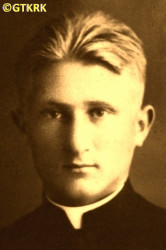
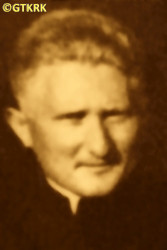
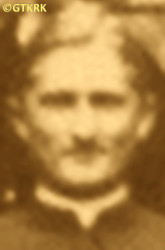
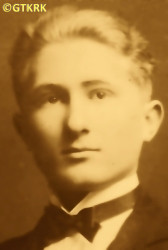
surname
ŚLUSARCZYK
forename(s)
Adam
function
eparchial priest
creed
Ukrainian Greek Catholic GCmore on
en.wikipedia.org
[access: 2013.05.19]
diocese / province
Przemyśl GC eparchymore on
pl.wikipedia.org
[access: 2013.05.19]
academic distinctions
Doctor
nationality
Ukrainian
date and place
of death
19.09.1947

Monasterztoday: Horyniec‐Zdrój gm., Lubaczów pov., Subcarpathia voiv., Poland
more on
pl.wikipedia.org
[access: 2021.12.18]
details of death
After the German and Russian invasion of Poland in 09.1939 and the start of World War II, pursuant to the genocidal German–Russian agreement of 23.08.1939, known as the Molotov–Ribbentrop Pact, confirmed on 28.09.1939, by the so‐called „Treaty on the Borders and Friendship between Germany and Russia”, also known as the second Molotov–Ribbentrop Pact, prob. ministered in the territory of their eparchy, which the two allies awarded to Russia. The Russian occupation began. As a first step, the Russian occupiers arrested Polish intelligentsia, teachers, doctors, landowners, government officials, foresters, policemen, and the families of Polish servicemen. In the years 1940‐1941, many Poles became victims of four large waves of deportations „to Siberia”. Accounts often mention that „they came at night, without warning, and took away entire families, from infants to the elderly”. „When we went out into the yard, they allowed my mother to look into the chest — unfortunately, it was empty, because our neighbors had already emptied it. We took practically nothing, because they did not allow us to move around the house […] There were large snowdrifts and heavy frost”. In addition, 150,000–200,000 men were conscripted into the Russian army, and c. 100,000 were forced to work for Russian industry, mainly in the mines of the Donets Basin, in heavy industry plants in the Urals and in Siberia. Then the surveillance of priests and monks began. The clergy were subjected to high taxes.
After the German attack on 22.06.1941 on its erstwhile ally, when the Germans pushed the Russians far to the east, and the German occupation also began in his parish, in c. 1943 was moved as an exposit/administrator to Lubliniec Stary, belonging to the parish of Lubliniec Nowy, on the other side of the small Wirowa River, in the San river basin, situated on the Tarnogród Plateau, on the edge of Eastern Roztocze, among the Roztocze forests, i.e. more or less in the middle of a forest belt c. 120 km long and c. 20 km wide, stretching from the Vistula in a south‐east direction to Lviv.
In 1939, Lubliniec Stary had an estimated population of c. 1,500 people, of whom Greek Catholic Ukrainians constituted c. 94%. Furthermore, there were c. 25 Roman Catholic Poles and c. 65 Jews. The neighboring Lubliniec Nowy was a slightly larger village, inhabited by c. 2,300 people, with a similar national and religious structure — there may have been c. 80 Poles and c. 40 Jews. From 09.1939, both villages were under German occupation and administratively found themselves in the Germ. Kreishauptmannschaft Zamość (Eng. Zamość County), within the Germ. Distrikt Lublin (Eng. District of Lublin), which was part of the German‐occupied and run quasi‐state called the Germ. Generalgouvernement (Eng. General Governorate), i.e. GG. The Germ. SS‐ und Polizeiführer (Eng. SS and Police Commander) in the Germ. Distrikt Lublin, and de facto deputy governor of this district, was one of the greatest criminals in human history, the Austrian, Odilo Lotario Globočnik, whom one historian described as „the most vile individual in the most vile organization that has ever existed”.
In the first years of the occupation, the Germans subjected Poles to particular repression. The details were specified — pursuant to the Molotov–Ribbentrop Pacts — at four so‐called thematic conferences, when the Germ. Geheime Staatspolizei (Eng. Secret State Police), i.e. Gestapo, and the Rus. Народный Комиссариат Внутренних Дел (Eng. People's Commissariat of Internal Affairs), i.e. NKVD, two genocidal allied organizations, debated cooperation and ways of combating and exterminating Poles in the territories they occupied. The first took place on 27.11.1939 in Brest‐on‐the‐Bug; the second immediately afterwards in Przemyśl. The third was held on 20.02.1940 in Zakopane, in the villas „Pan Tadeusz” (Eng. „Sir Thaddeus”) and „Telimena”, the fourth in 03.1940 in Kraków. In the meantime, at the beginning of 02.1940, in Hermann Göring's hunting lodge in Rominty in the Romincka Forest, a meeting of two génocidaires, Heinrich Himmler and Lavrentiy Beria, took place, where the decision to exterminate Polish society and combat the Polish resistance movement was probably finalized. As a consequence, in 04.1940, almost simultaneously, the genocidal murders of Polish prisoners of war began in Russia, which went down in history as the «Katyn genocide», and in the German‐occupied and run quasi‐state called the Germ. Generalgouvernement (Eng. General Governorate), i.e. GG, the Germ. Außerordentliche Befriedungsaktion (Eng. Extraordinary Pacification Action) began, i.e. «Aktion AB», which was part of the so‐called Germ. «Intelligenzaktion» (Eng. Operation Intelligentsia), aimed at exterminating Polish political and intellectual elites. Repressions also continued in the later years of the occupation.
Ukrainians, on the other hand, were deliberately favored by the Germans. The Germans even allowed the establishment of a special „Konovalets Officers' School” in Krakow, whose „graduates” — under the watchful care of the Gestapo — acquired skills that proved indispensable in the later implementation of «Genocidium Atrox», i.e. the genocide of Poles. The Germans also allowed the open activity of such organizations as the Organization of Ukrainian Nationalists OUN, the Ukrainian Central Committee UCC, which became the Ukrainian representation before the German authorities, as well as the creation in 1940 of the ukr. Служба Безпеки (Eng. Security Service), i.e. SB OUN, whose task was to track down political and ideological opponents of the OUN.
SB OUN training was conducted, among others, in Zakopane, at the „Stamary” hotel. According to the contemporary website of this hotel, „the training included the principles of sabotage, sabotage, Gestapo methods of interrogation and killing methods”.
When arrived at the new parish, there were no Jews in its territory, for at the turn of 1941/1942, the Germans began implementing the genocidal plan Germ. «Endlösung der Judenfrage» (Eng. Final Solution of the Jewish Question), i.e. physical extermination of the Jewish population. Jews from both Lubliniec villages were herded into a ghetto established in 12.1941 in Cieszanów, located c. 7 km to the south. There were no Jews from Cieszanów itself in the ghetto — in 1939, when Cieszanów de facto became a border town, they escaped under Russian occupation — but the Germans quickly filled the vacant buildings with Jews from the surrounding area. The first larger group of Jews known to have been placed there were 700‐817 Jews from Tomaszów Lubelski, brought on 25.02.1942. The next 465‐500 people were brought by the Germans from Mielec. The ghetto was not surrounded by a fence or wall, but from 15.10.1941, the German „law on the limitation of stay” in the GG, signed by the Germ. Generalgouverneur (Eng. Governor General) of the GG, Hans Frank, according to which „Jews who leave their designated district without authorization are subject to the death penalty. The same punishment applies to persons who knowingly provide hiding places for such Jews”, and „Instigators and accomplices are subject to the same punishment as the perpetrator; an attempted act will be punished as a completed act. In less serious cases, a heavy prison sentence or imprisonment may be imposed”. The Jews, crowded, i.a. in houses near the town square, were guarded by Ukrainians from the Germ. Ukrainische Hilfspolizei (Eng. Ukrainian Auxiliary Police), established by the Germans at the end of 1939, and a unit of the Germ. Sonderdienst (Eng. Special Service), called „Hans Frank's private police”, i.e. an auxiliary police established by Frank and composed of Ukrainians. Soon after, in 03.1942, in Bełżec, c. 30 km to the east — on the site of the former Germ. Arbeitslager — the Germ. Vernichtungslager (Eng. extermination camp) VL Belzec, founded by the genocide killer Globočnik, began to „function”, formally referred to as Germ. SS‐Sonderkommando Belzec (Eng. SS Special Commando Belzec). The main „working” roles in VL Belzec were filled in by the Germ. SS‐Wachmannschaften (Eng. SS guards), consisting of former Russian prisoners of war who had defected to Germany, mostly of Ukrainian nationality. In 05.1942 (or in mid‐06.1942), therefore, Jews from Cieszanów — prob. together with the Jews from Tomaszów Lubelski, who were deported on 22.05.1942 — were transported to VL Belzec. And there all were murdered.
Although there were prob. no Jews in Lubliniec Stary, when arrived there, but there were Poles and they became the next victim of the German order. In 11.1942, the German SS‐ und Polizeiführer Odilo Globočnik shifted his main interest to the Germ. Aktion Zamość (Eng. Operation Zamość), i.e. a series of displacement and pacification operations of Polish villages in the Zamość region, in the Germ. Distrikt Lublin, as part of the Germ. Generalplan Ost (Eng. General Plan East), i.e. the German settlement and Germanization program, in order to gain Germ. Lebensraum (Eng. living space) for the Germ. Herrenvolk (Eng. master race). The intention was to displace hundreds of thousands of Poles and bring in German colonists in their place. In total, the Germans managed, with the help of Ukrainian collaborators, to displace 100,000‐110,000 Poles, including 30,000 children, some of whom — considered the most racially „pure” — were taken from their parents and given to families deep inside Germany.
But not everything went according to the Germans" plans. The first stage of the Germ. Aktion Zamość began on 28.11.1942, and encompassed 116 Polish villages, of which c.21% of the displaced were designated for extermination and sent to concentration camps. This stage ended on 03.03.1943. However, it was met with an armed reaction from Polish partisan forces — units of the Home Army AK, the Peasant Battalions BCh (part of the Polish Clandestine State), and the Commie‐Nazi People's Guard GL. In 12.1942, the Zamość Uprising began, in which Polish partisans responded to the expulsions by attacking villages of German and Ukrainian colonists. It was then only in 06.1943, when the VL Belzec extermination camp ceased its „operations”, that the Germans began the second phase of the Germ. Aktion Zamość, codenamed Germ. Aktion Werwolf (Eng. Operation Werewolf). It was intended to lead not only to the displacement of all Poles, but also to the Ukrainian colonization of the „cleansed area” and the creation of a protection zone, a barrier of villages in which a German‐friendly Ukrainian community was to be settled. This part of the operation was carried out under the codename Germ. „Ukraineraktion” (Eng. Operation Ukraine).
His parish village did not suffer during the Germ. Aktion Zamość, for obvious reasons — it was, after all, a Ukrainian village — but it was actually considered by the Germans as part of the „protection zone” for German colonization, as part of the Germ. „Ukraineraktion”.
At the same time, the Germans began large‐scale deportations of able‐bodied men and boys — often detained in so‐called roundups — to forced labor deep into Germany. This took place in Germ. Distrikt Lublin, i.a. in the summer of 1943.
The result of these actions was an increase in the numbers and activity of Polish partisans, mainly belonging to the Polish Clandestine State, but also of the National Armed Forces NSZ, which recognized the authority of the Polish government operating in London but did not recognize the structures of the Polish Clandestine State. At the same time, the NSZ considered both Germany and Russia to be enemies, while the London government considered Russia an „ally of our allies”.
At the same time, to the east of the Germ, Distrikt Lublin, in Volyn, in 02.1943 Roman Shukhevych, nom de guerre „Taras Chuprynka”, the chief commander of the Ukrainian, genocidal OUN/UPA organisation, who in 1941 was a member of the Ukrainian Germ. Sondergruppe Nachtigall (Eng. Special Group Nightingale) — a unit of the Germ. Wehrmacht (Eng. Armed Forces) that took part in the German attack on Russians in 1941, accused of participating in the Jewish pogrom in Lviv in 1941 — and later a member of the Germ. Schutzmannschaftsbataillon 201 (Eng. 201st Protection team Battalion) — responsible for the murder of Jews and civilians in the territory of Belarus — issued an order: „The extermination operation should be carried out according to the following principles: Polish villages are to be burned, and their populations massacred. Attacks on towns will take place in broad daylight, not at night. In mixed villages, the Polish population alone should be liquidated, and farmsteads should be burned only if they are 15 meters away and when there is no risk of the fire spreading to neighboring Ukrainian buildings. The Ukrainian population will receive instructions as to where to gather during the attack […] For every Ukrainian murdered, whether by Poles or Germans, 100 (one hundred) Poles will be executed”.
It was the de facto signal for the commencement of the «Genocidium Atrox» — i.e. the genocide perpetrated by Ukrainians, known as „Volyn genocide”.
Immediately thereafter, in 03.1943, the UPA issued an appeal to members of the Germ. Ukrainische Hilfspolizei to desert and join the UPA ranks. Perhaps as many as 10,000 Ukrainians did so.
Volyn was drenched in Polish blood. Tens of thousands of Poles were murdered by the Ukrainians — with German passivity — in an extremely barbaric manner. Hundreds of villages were burned.
In 1943, Volyn was not in the GG, but belonged to the Germ. Reichskommissariat Ukraine (Eng.Reich Commissariat Ukraine), an occupational body established by the Germans after the German attack on the Russians on 22.06.1941. The choice of Volyn for the beginning of the «Genocidium Atrox» and the genocide of Poles by the OUN/UPA was not accidental. Firstly, Volyn in pre‐war Poland had prob. the smallest percentage of the Polish population in the entire country. Secondly, it was prob. the least economically developed voivodeship of Poland, which resulted from the deliberate policy of the Russians, who occupied that part of Poland in the 19th century — the direct route to the heart of Russia, to Moscow, runs through Volyn, so no roads were laid there, no bridges built, no marshy areas around the Pripyat drained, no industry located, and no schools established. Thirdly, and finally, it was Volyn (and the Chełm region) that was incorporated during World War I into the borders of the short‐lived Ukrainian state by the Central Powers (German Empire, Austro–Hungarian Monarchy), which was to be established on the basis of the Treaty of Brest‐Litovsk of 09.02.1918 — in 1943, the Germans simply fulfilled the obligations undertaken at that time.
When at the turn of 1943/1944 it became clear that Germany was losing the war in the East — on 24.12.1943, a large Russian offensive called the Dnieper–Carpathian Operation began, which in 04.1944 reached a line about 80 km east of Lviv — the OUN/UPA decided to extend the «Genocidium Atrox» to the Germ. Distrikt Galizien (Eng. District of Galicia) and Germ. Distrikt Lublin. Until then, the groups active there were mainly operating — in order not to „annoy” the Germans — under the euphemistic Ukrainian name Ukr. Українська Народна Самооборона (Eng. Ukrainian National Self‐Defense), i.e. UNS, and later also Ukr. Самооборонні кущові відділи (Eng. Self‐Defense Unit), i.e. SKW, reinforced with deserters from the Germ. Ukrainische Hilfspolizei and Schuma, seasoned in the genocide of Jews. The Ukrainian génocidaires then formed, among others, the OUN/UPA operational group „UPA‐West”, under the command of Vasyl Sydor, nom de guerre „Shelest”, who ordered „to strike Poles continuously until they are destroyed to the last one from these lands”. The OUN/UPA Military District WO‐6 „San” was responsible for carrying out the «Genocidium Atrox» in the vicinity of Lubliniec Stary, from 1945 commanded by Miroslav Onyshkevych, nom de guerre „Orest”.
The genocidal OUN/UPA began to penetrate the Germ. Distrikt Lublin in early 1944. The murders of the Polish population began, following the Volyn pattern. And so the genocidal „Orest” became famous for his order issued on 06.04.1944, in which specified the tasks of the UPA units subordinate to him: „I order the immediate purging of my region of the Polish element […] The purging should be carried out in the villages sparsely populated by Poles. For this purpose, a militia should be created in the region, composed of our members, whose task would be to eliminate the above‐mentioned. Larger villages will be cleared of this element by our military units even in broad daylight […] The clearing of the area must be completed before our Easter, so that we can celebrate it without Poles […] Wage a hard, ruthless fight against them. Spare no one, even in the case of mixed marriages. Pull the Poles out of their homes, but do not eliminate the Ukrainians and children in these houses […] Take out your weapons. Death to the Poles”.
In the vicinity of Lubliniec Stary and Cieszanów, this order was carried out by the UPA kuren/unit Ukr. „Ме́сники” (Eng. „Avengers”), belonging to the so‐called „Bastion” Tactical Sector, which was part of the aforementioned OUN/UPA Military District WO‐6 „San”. Its commander was the génocidaire Ivan Szpontak, nom de guerre „Zalizniak”, and his deputy, Ivan Szymański, nom de guerre Pl. „Szum” (Eng. „Noise”), from Lubliniec Nowy — both had gained experience in the collaborationist Germ. Ukrainische Hilfspolizei. It seems that Lubliniec Stary and Lubliniec Nowy were places of concentration and support for some of the sotnias of this kuren. And this kuren was prob. responsible — or local members of the SKW „self‐defense”, as some Polish sources seem to suggest — for the murder of only a few Polish inhabitants of his Lubliniec Stary. On 02.05.1944, according to Polish sources, they murdered „in a brutal manner on the road three Polish escaping families, numbering 18 people, and robbed their belongings, carts and horses”. The next day, the kuren attacked Cieszanów, murdering 50 local Poles and burning the town.
The «Genocidium Atrox» reached his parish. And this was not accidental either — the area between the so‐called Curzon–Namier line and the San, i.e. between the Bug and San rivers, was referred to by Ukrainians as „Zakerzonia”, and the OUN/UPA considered it the western part of the future Ukrainian state. The Curzon–Namier Line was a demarcation line between Poland and the Russian Bolsheviks, proposed to the Russians on 11.07.1920, by the British Foreign Minister, George Curzon, during the great Russian offensive during the Polish–Russian War of 1919‐1921, suggested by the so‐called expert, Lewis Bernstein Namier, a Jew of Polish origin. Russia — contrary to the plans of the British imperialists — suffered defeat in 1920, but the concept of the Curzon–Namier Line, running through the center of Poland, became a cause célèbre for all imperial concepts of dividing Central Europe, especially the Russian and German ones.
It turned out, however, that despite the fact that due to the situation on the German–Russian front, the Germans in many places of the Germ. Distrikt Lublin left the internal control over the occupied territories almost exclusively to collaborationist formations — such as the Germ. Gendarmerie (Eng. Gendarmerie), Schuma, the Germ. Galizisches SS Freiwilligen Regiment 5 – Polizei (Eng. 5th Galician Volunteer Regiment of SS – police), i.e. SS‐GFR5P, units of the genocidal Germ. Die Schutzstaffel der NSDAP (Eng. NSDAP Protection Squad), i.e. «SS», a paramilitary formation subordinate to the ruling National Socialist German Workers' Party NSDAP in Germany, consisting largely of Ukrainians — retaining only general supervisory functions, the genocidal actions of OUN/UPA, supported by the UNS units, which were de facto branches of the OUN/UPA, met with resistance from Polish partisan units of the AK and BCh, as well as partisans of the NSZ. A guerrilla war began, in which the Ukrainian génocidaires initially enjoyed at least tactical support from the German occupier. In some cases, the Polish partisans — many of whom were traumatized refugees from Volyn, where they had lost entire families murdered by the OUN/UPA — responded with attacks on Ukrainian villages, particularly those favorable to the OUN/UPA.
The situation changed with the German defeat and in 07.1944 the start of — as a result of the so‐called Lviv–Sandomierz operation and the Russian offensive reaching the Vistula line — the Russian occupation. The OUN/UPA, of course, did not change its plans to exterminate the Polish population, but it no longer had German support, and Russian troops were stationed in the area, preparing for a further offensive towards Germany. For some time, the OUN/UPA lay low and stopped attacking Polish villages. At the same time, there were signs of active Russian combat against the OUN/UPA, although the Russian occupier allocated incomparably greater forces to combating Polish units of the Polish Clandestine State, the National Military Union NZW and the National Military Organization NOW.
The Russians began combating the OUN/UPA in his region with deportations. It was not yet known then that already on 28.11‐01.12.1943, at the conference in Tehran, the treacherous English and Americans agreed to establish the post‐war Polish border on the aforementioned Curzon–Namier line, which meant de facto recognition of the legitimacy of the Russian invasion of Poland in 09.1939 and recognition of Russian claims expressed in the Molotov–Ribbentrop Pact of 1939. This also meant that after the end of the war, Lubliniec Stary was to be located in the area assigned to the Polish Commie‐Nazi Russian agents, in the Russian Polish Republic called „prl”. Therefore, one of the first effects of the beginning of the Russian occupation were massive deportations of the population, in line with the standard, centuries‐old, criminal Russian practice of solving social and national problems. Millions of Poles were to be deported from the east and resettled west, to the territories that before World War II belonged to to Germany; Ukrainians were resettled from the „prl”, to the territory directly occupied by the Russians. The deportations of Ukrainians took place in four stages. In the first, „voluntary”, from 15.10‐31.12.1944, c. 20,000 Ukrainians were forced to leave, mainly from the Polish Lublin Voivodeship.
It is unclear whether it was then, or perhaps during the second stage of deportation, from 01.01‐01.08.1945, also „voluntary”, that some of the inhabitants of Lubliniec Stary and Lubliniec Nowy, along with their parish priest, left, deciding to go to the territory directly occupied by the Russians. He remained with those who decided not to leave their hometowns, despite the fact that the uniformed services of the Commie‐Nazi „prl” — officers of the Citizens' Militia MO and the criminal Security Service UB, soldiers of the military units of the Polish Army — began agitation and persecution against the resisting Ukrainians. It is known i.a. about Greek Catholic priests being visited in the evenings and at night, interrogated at militia's HQs, harassed, accused of collaborating with the genocidal OUN/UPA — often prob. justifiably — and attempts to force declarations of departure and to start agitation for the departure of the faithful.
There are reports, prob. of Ukrainian origin, that due to „the threat from the Polish underground, he often spent the nights outside the rectory in the homes of villagers”. The „Polish underground” was undergoing a period of change at that time, as on 19.01.1945, the Polish government in exile in London dissolved the largest clandestine resistance organization in German–occupied Europe, the Home Army AK (part of the Polish Clandestine State). At the same time, genocidal Russian organizations, such as the NKVD and the Russian‐controlled Commie‐Nazi UB, did not cease pursuing members of the AK and other clandestine organizations. Many were forced to choose the path of continued armed partisan resistance. From then on, these units, faithful to their oath to the Republic of Poland, today referred to as „cursed soldiers”, fought not only against the Russian occupier, but also against the Ukrainian génocidaires from the OUN/UPA.
For his Lubliniec Stary and neighboring Lubliniec Nowy, however, the armed units of the Commie‐Nazi „prl” proved to be a much more dangerous threat. On 21.03.1945 the 2nd Independent Operational Battalion of the Commie‐Nazi Internal Troops, collaborating with — or perhaps rather controlled by — the units of the Russian genocidal NKVD, prob. attempting to force the „voluntary deportation” of Ukrainians from both Lubliniec villages, murdered c. 59‐66 Ukrainians who resisted deportations from „prl”.
Managed to survive the murder — in hiding, in the rectory.
The same unit of the Commie‐Nazi Internal Troops, two weeks later, on 05.04.1945, attacked the village of Gorajec, c. 10 km away, murdering c. 174 people, including „32 women, 35 children and 19 people over 60 years of age”. The OUN/UPA responded with an attack on 17.04.1945, by the kuren of génocidaire Ivan Shpontak, nom de guerre „Zalizniak”, on the village of Wiązownica, c. 35 km to the southwest. C. 91‐130 village inhabitants were murdered, over 100 farms were burned down, which constituted almost half of the houses in the village. In retaliation, the very next day a unit of the Polish National Military Union NZW — established after the dissolution of the AK, formed by former soldiers of the AK and the National Military Organization NOW, pursued by the Russian occupiers, whose goals included, among others, „liberating Poland from Soviet occupation and influence”, and declaring that „We will not give up the fight for Greater Poland under the influence of the terror of Soviet Russia and its agents” — under the command of Joseph Zadzierski, nom de guerre Pl. „Wołyniak” (Eng. „Volynman”) carried out the pacification of the Ukrainian village of Piskorowice, described as a „terrorist‐cleansing action”. C. 120‐173 people were murdered, including women and children.
Engaged then in establishing some kind of modus vivendi between the genocidal OUN/UPA and the Polish units of the „cursed soldiers”. In Polish sources, based mainly on the memories of Polish participants in those events, there is a short entry that in Lubliniec Stary „at the beginning of 1945, militants of the SB OUN shot the Uniate vicar, Father Anthony Ślusarczyk, for helping a Pole escape”. It seems that in the Przemyśl eparchy there was no Ślusarski priest named „Anthony” — there was one ministering in Lubliniec Stary, i.e. Adam. And he definitely did not die then, but the fact that Father „Anthony” „helped a Pole escape” was remembered by the Polish inhabitants of the area is significant.
It coincides with his decision to take the initiative for a tactical agreement between Ukrainians and Poles and to postpone the resolution of the mutual conflict until the future — in view of Russian repressions and murders, and the collaboration with the Russian occupiers of the Commie‐Nazi „prl” authorities. According to Polish sources, „the talks took place on May 21, 1945, in the village of Ruda Różaniecka. Catholic and Orthodox priests served as intermediaries. A local agreement was then concluded between [the post‐AK organization Freedom and Independence] WiN and the UPA. Both sides committed to cease attacks on civilians. The Zamość region was divided into the zones of influence of WiN and UPA. They also decided to cooperate in the fight against the [Commie‐Nazi] UB, NKVD, and KBW. In September 1945, this agreement was extended to the Chełm region and Podlasie”.
At the same time, on 01.09.1945, the third stage of the deportation of Ukrainians to the east began. During this period, over 80,000 people were forcibly relocated, and on 20.09.1945, the Commie‐Nazis arrested the ordinary of the Przemyśl eparchy, Bishop Jozafat Kocyłowski, who had refused to issue a proclamation calling on the faithful and clergy to emigrate to Ukraine.
By then, was prob. already the chaplain of the genocidal OUN/UPA, nom de guerre „Roman” and Ukr. „Kniha” (Eng. „Book”). Was in hiding — although may have started hiding later, in 1946, when the fourth stage of the forced deportations of Ukrainians beyond the borders of the „prl” began, lasting from 01.01.1946 to 15.06.1946. Commie‐Nazis deported over 250,000 people at that time.
The OUN/UPA conducted attacks mainly on the centers of Commie‐Nazi power in the „prl”. They were carried out by forest units operating i.a. from hideouts in the Roztocze forests between Lubaczów / Cieszanów, and Rava‐Ruska. From there, most of the population was expelled much earlier, in 1939‐1941, by the Russians, who were then constructing — along the border with the German–occupied areas — the so‐called „Molotov Line”, i.e. a series of defensive forts and trenches, in that area known as the 6th Rava‐Ruska Fortified Area. Part of this „line” was a strip c. 800meters wide, from which people were expelled along its entire length.
From 10.1946, hid in a bunker near Monasterz, a deserted village near Werchrata, in the middle of forests, known for the fact that in 1891 friar Brother Albert Chmielowski founded there, next to the ruins of a Basilian monastery, the first hermitage for Albertine monks in Roztocze, which survived until 1905. The bunker housed the so‐called National Technical Center of the OUN „Wulkan”, i.e. a disguised publishing and propaganda cell at the Ukr. „Крайовий Провід” (Eng. National Leadership) of the OUN in „Zakerzonia”.
Translated OUN/UPA leaflets and publications, next distributed to Western embassies in Poland, into English and French.
According to Ukrainian sources, is credited with „the first instructions issued by the Ukrainian underground in Poland, prohibiting offensive actions against Poles, especially the Polish population”.
The situation of the genocidal OUN/UPA units became critical after the launch of the last, large–scale deportation of Ukrainians — this time not to areas directly occupied by the Russians, but to the west and north of the „prl”, i.e. the lands that were part of Germany until 1939 — known as „Operation Vistula”. The OUN/UPA lost the support of Ukrainian villages in the region.
Perished in the bunker where was hiding — surrounded by troops of the murderous, Russian‐controlled, Commie‐Nazi Internal Security Corps KBW, successor to the aforementioned Internal Troops, and the criminal Security Services UB, a unit of the criminal Russian MVD — while attempting to escape, reportedly with a gun in his hand.
His body was taken to an unknown location.
A day later, in the same area, the head of the Ukr. „Крайовий Провід” of the OUN in „Zakerzonia”, Yaroslav Staruch, nom de guerre „Stiah”, was killed.
The fate of Polish supporters of Polish‐Ukrainian understanding was not significantly better. Marian Gołębiewski, a „silent and unseen” parachutist of the Polish Army in the West, commander of the Hrubieszów District of AK, later a member of WiN, one of the initiators of the agreement in Ruda Różaniecka between the OUN/UPA and WiN, was arrested by the Commie‐Nazi UB on 21.01.1946. Beaten, tortured, sentenced to death — the „punishment” was commuted to life imprisonment — spent ten years in „prl” prisons.
cause of death
in a round-up
perpetrators
Russians / Poles
sites and events
«Genocidium Atrox»Click to display the description, GeneralgouvernementClick to display the description, Ribbentrop‐MolotovClick to display the description, Pius XI's encyclicalsClick to display the description
date and place
of birth
24.08.1912

Dąbrówka Ruskatoday: part of Dąbrówka district in Sanok, Sanok urban gm., Sanok pov., Subcarpathia voiv., Poland
more on
en.wikipedia.org
[access: 2021.10.09]
parents
ŚLUSARCZYK Alex
🞲 ?, ? — 🕆 ?, ?

JAROSZ Catherine
🞲 ?, ? — 🕆 ?, ?
presbyter (holy orders)
ordination
18.04.1937

Rometoday: Rome prov., Lazio reg., Italy
more on
en.wikipedia.org
[access: 2021.12.18]
GC chapelmore on
en.wikipedia.org
[access: 2019.12.26] (at Ukrainian Pontifical College of Saint Josaphat)
positions held
1943 – c. 1946
curatus/rector/expositus — Stary Lubliniectoday: Cieszanów gm., Lubaczów pov., Subcarpathia voiv., Poland
more on
en.wikipedia.org
[access: 2022.01.16] ⋄ Transfiguration of the Lord GC church ⋄ Nowy Lubliniectoday: Cieszanów gm., Lubaczów pov., Subcarpathia voiv., Poland
more on
en.wikipedia.org
[access: 2022.01.16], Transfiguration of the Lord GC parish ⋄ Cieszanówtoday: Cieszanów gm., Lubaczów pov., Subcarpathia voiv., Poland
more on
en.wikipedia.org
[access: 2020.11.20] GC deanery — also: prefect of a primary school; according to some sources, assumed the position at the turn of 1939/1940
1940 – 1943
administrator — Hrushivtoday: Yavoriv urban hrom., Yavoriv rai., Lviv obl., Ukraine
more on
uk.wikipedia.org
[access: 2023.03.02] ⋄ St Michael the Archangel GC parish ⋄ Nemyrivtoday: Yavoriv urban hrom., Yavoriv rai., Lviv obl., Ukraine
more on
en.wikipedia.org
[access: 2022.01.16] GC deanery
c. 1939 – c. 1940
priest — Kwaszeninatoday: Ustrzyki Dolne gm., Bieszczady pov., Subcarpathia voiv., Poland
more on
en.wikipedia.org
[access: 2026.07.13] ⋄ St Nicholas GC parish ⋄ Dobromyltoday: Dobromyl urban hrom., Sambir rai., Lviv obl., Ukraine
more on
en.wikipedia.org
[access: 2021.10.09] GC deanery — prob.
c. 1939
vicar — Bełżectoday: Bełżec gm., Tomaszów Lubelski pov., Lublin voiv., Poland
more on
en.wikipedia.org
[access: 2021.12.18] ⋄ St Basil the Great GC parish ⋄ Rava‐Ruskatoday: Rava‐Ruska urban hrom., Lviv rai., Lviv obl., Ukraine
more on
en.wikipedia.org
[access: 2022.01.16] GC deanery — prob.
01.01.1934 – 1938
PhD student — Rometoday: Rome prov., Lazio reg., Italy
more on
en.wikipedia.org
[access: 2021.12.18] ⋄ theology, Pontifical College of St Josaphat [Ukrainian Pontifical College of St Josaphat (from 1932) / St Josaphat College (1904‐1932) / Pontifical Rutheanum College (till 1904)] — studies crowned on 15.07.1938 with PhD diploma
1930 – 1933
student — Przemyśltoday: Przemyśl city pov., Subcarpathia voiv., Poland
more on
en.wikipedia.org
[access: 2021.04.01] ⋄ philosophy and theology, Greek Catholic Theological Seminary
till 1930
pupil — Sanoktoday: Sanok urban gm., Sanok pov., Subcarpathia voiv., Poland
more on
en.wikipedia.org
[access: 2021.10.09] ⋄ Queen Sophie State Gymnasium — studies crowned in 1930 with the maturity diploma (i.e. matura)
sites and events
descriptions
«Genocidium Atrox»: In 1939‐1947, especially in 1943‐1944, independent Ukrainian units, mainly belonging to genocidal Ukrainian organizations OUN (political arm) and UPA (military arm), supported by local Ukrainian population, murdered — often in extremely brutal way — in Volyn and surrounding regions of pre‐war Poland, from 130,000 to 180,000 Poles, all civilians: men, women, children, old and young. Polish‐Ukrainian conflict that openly emerged during and after World War I (in particular resulting in Polish‐Ukrainian war of 1918‐1919), that survived and even deepened later when western Ukraine became a part Poland, exploded again after the outbreak of the World War II in 09.1939. During Russian occupation of 1939‐1941, when hundreds of thousands of Poles were deported into central Russia, when tens of thousands were murdered (during so‐called Katyń massacres, among others), this open conflict had a limited character, helped by the fact that at that time Ukrainians, Ukrainian nationalists in particular, were also persecuted by the Russians. The worst came after German‐Russian war started on 22.06.1941 and German occupation resulted. Initially Ukrainians supported Germans (Ukrainian police was initiated, Ukrainians co—participated in extermination of the Jews and were joining army units fighting alongside Germans). Later when German ambivalent position towards Ukraine became apparent Ukrainians started acting independently. And in 1943 one of the units of aforementioned Ukrainian OUN/UPA organization, in Volyn, started and perpetrated a genocide of Polish population of this region. In mere few weeks OUN/UPA murdered, with Germans passively watching on the sidelines, more than 40,000 Poles. This strategy was consequently approved and adopted by all OUN/UPA organisations and similar genocides took place in Eastern Lesser Poland (part of Ukraine) where more than 20,000 Poles were slaughtered, meeting however with growing resistance from Polish population. Further west, in Chełm, Rzeszów, etc. regions this genocide turned into an extremely bloody conflict. In general genocide, perpetrated by Ukrainian nationalists, partly collaborating with German occupants, on vulnerable Polish population took part in hundreds of villages and small towns, where virtually all Polish inhabitants were wiped out. More than 200 priests, religious and nuns perished in this holocaust — known as «Genocidium Atrox» (Eng. „savage genocide”) The nature and purpose of genocide is perhaps best reflected in the song sung by the murderers: „We will slaughter the Poles, we will cut down the Jews, we must conquer the great Ukraine” (ukr. „Поляків виріжем, Євреїв видусим, велику Україну здобути мусим”). This holocaust and conflict ended up in total elimination of Polish population and Polish culture from Ukraine, in enforced deportations in 1944‐1945 of remaining Poles from Ukraine and some Ukrainians into Ukraine proper, and finally in deportation of Ukrainians from East‐South to the Western parts of Polish republic prl by Commie‐Nazi Russian controlled Polish security forces („Vistula Action”). (more on: www.swzygmunt.knc.plClick to attempt to display webpage
[access: 2021.06.20])
Generalgouvernement: After the Polish defeat in the 09.1939 campaign, which was the result of the Ribbentrop‐Molotov Pact and constituted the first stage of World War II, and the beginning of German occupation in part of Poland (in the other, eastern part of Poland, the Russian occupation began), the Germans divided the occupied Polish territory into five main regions. In two of them new German provinces were created, two other were incorporated into other provinces. However, the fifth part was treated separately, and in a political sense it was supposed to recreate the German idea from 1915 (during World War I, after the defeat of the Russians in the Battle of Gorlice in 05.1915) of creating a Polish enclave within Germany. Illegal in the sense of international law, i.e. Hague Convention, and public law, managed by the Germans according to separate laws — especially established for the Polish Germ. Untermenschen (Eng. subhumans) — till the Russian offensive in 1945 it constituted part of the Germ. Großdeutschland (Eng. Greater Germany). Till 31.07.1940 formally called Germ. Generalgouvernement für die besetzten polnischen Gebiete (Eng. General Government for the occupied Polish lands) — later simply Germ. Generalgouvernement (Eng. General Governorate), as in the years 1915‐1918. From 07.1941, i.e. after the German attack on 22.06.1941 against the erstwhile ally, the Russians, it also included the Galicia district, i.e. the Polish pre‐war south‐eastern voivodeships. A special criminal law was enacted and applied to Poles and Jews, allowing for the arbitrary administration of the death penalty regardless of the age of the „perpetrator”, and sanctioning the use of collective responsibility. After the end of the military conflict of the World War UU, the government of the Germ. Generalgouvernement was recognized as a criminal organization, and its leader, governor Hans Frank, guilty of war crimes and crimes against humanity and executed. (more on: en.wikipedia.orgClick to attempt to display webpage
[access: 2024.12.13])
Ribbentrop‐Molotov: Genocidal Russian‐German alliance pact between Russian leader Joseph Stalin and German leader Adolf Hitler signed on 23.08.1939 in Moscow by respective foreign ministers, Mr. Vyacheslav Molotov for Russia and Joachim von Ribbentrop for Germany. The pact sanctioned and was the direct cause of joint Russian and German invasion of Poland and the outbreak of the World War II in 09.1939. In a political sense, the pact was an attempt to restore the status quo ante before 1914, with one exception, namely the „commercial” exchange of the so‐called „Kingdom of Poland”, which in 1914 was part of the Russian Empire, fore Eastern Galicia (today's western Ukraine), in 1914 belonging to the Austro‐Hungarian Empire. Galicia, including Lviv, was to be taken over by the Russians, the „Kingdom of Poland” — under the name of the General Governorate — Germany. The resultant „war was one of the greatest calamities and dramas of humanity in history, for two atheistic and anti‐Christian ideologies — national and international socialism — rejected God and His fifth Decalogue commandment: Thou shall not kill!” (Abp Stanislav Gądecki, 01.09.2019). The decisions taken — backed up by the betrayal of the formal allies of Poland, France and Germany, which on 12.09.1939, at a joint conference in Abbeville, decided not to provide aid to attacked Poland and not to take military action against Germany (a clear breach of treaty obligations with Poland) — were on 28.09.1939 slightly altered and made more precise when a treaty on „German‐Russian boundaries and friendship” was agreed by the same murderous signatories. One of its findings was establishment of spheres of influence in Central and Eastern Europe and in consequence IV partition of Poland. In one of its secret annexes agreed, that: „the Signatories will not tolerate on its respective territories any Polish propaganda that affects the territory of the other Side. On their respective territories they will suppress all such propaganda and inform each other of the measures taken to accomplish it”. The agreements resulted in a series of meeting between two genocidal organization representing both sides — German Gestapo and Russian NKVD when coordination of efforts to exterminate Polish intelligentsia and Polish leading classes (in Germany called «Intelligenzaktion», in Russia took the form of Katyń massacres) where discussed. Resulted in deaths of hundreds of thousands of Polish intelligentsia, including thousands of priests presented here, and tens of millions of ordinary people,. The results of this Russian‐German pact lasted till 1989 and are still in evidence even today. (more on: en.wikipedia.orgClick to attempt to display webpage
[access: 2015.09.30])
Pius XI's encyclicals: Facing the creation of two totalitarian systems in Europe, which seemed to compete with each other, though there were more similarities than contradictions between them, Pope Pius XI issued in 03.1937 (within 5 days) two encyclicals. In the „Mit brennender Sorge” (Eng. „With Burning Concern”) published on 14.03.1938, condemned the national socialism prevailing in Germany. The Pope wrote: „Whoever, following the old Germanic‐pre‐Christian beliefs, puts various impersonal fate in the place of a personal God, denies the wisdom of God and Providence […], whoever exalts earthly values: race or nation, or state, or state system, representatives of state power or other fundamental values of human society, […] and makes them the highest standard of all values, including religious ones, and idolizes them, this one […] is far from true faith in God and from a worldview corresponding to such faith”. On 19.03.1937, published „Divini Redemptoris” (Eng. „Divine Redeemer”), in which criticized Russian communism, dialectical materialism and the class struggle theory. The Pope wrote: „Communism deprives man of freedom, and therefore the spiritual basis of all life norms. It deprives the human person of all his dignity and any moral support with which he could resist the onslaught of blind passions […] This is the new gospel that Bolshevik and godless communism preaches as a message of salvation and redemption of humanity”… Pius XI demanded that the established human law be subjected to the natural law of God , recommended the implementation of the ideal of a Christian state and society, and called on Catholics to resist. Two years later, National Socialist Germany and Communist Russia came together and started World War II. (more on: www.vatican.vaClick to attempt to display webpage
[access: 2023.05.28], www.vatican.vaClick to attempt to display webpage
[access: 2023.05.28])
sources
personal:
pl.wikipedia.orgClick to attempt to display webpage
[access: 2013.05.19], www.vox-populi.com.uaClick to attempt to display webpage
[access: 2020.01.26], www.cerkiew.gorowo.plClick to attempt to display webpage
[access: 2020.01.26]
bibliographical:
„Clergy of Przemyśl Eparchy and Apostolic Exarchate of Lemkivshchyna”, Bogdan Prach, Ukrainian Catholic University Publishing House, Lviv 2015
„Encyclopedia of Camps and Ghettos, 1933‐1945”, The United States Holocaust Memorial Museum, ed. Martin Dean, volume II: „Ghettos in German–Occupied Eastern Europe”, part A
„Genocidium Atrox”, GTKRK, https://www.swzygmunt.knc.pl/GENOCIDEs/15 GENOCIDUM ATROX/vPOLISH/MAINs/GENATROXsearch01.htm
original images:
www.vox-populi.com.uaClick to attempt to display webpage
[access: 2020.01.26], mzw.com.plClick to attempt to display webpage
[access: 2020.01.26], pl.wikipedia.orgClick to attempt to display webpage
[access: 2020.01.26], www.vox-populi.com.uaClick to attempt to display webpage
[access: 2020.01.26]
.jpg)
LETTER to CUSTODIAN/ADMINISTRATOR
If you have an Email client on your communicator/computer — such as Mozilla Thunderbird, Windows Mail or Microsoft Outlook, described at WikipediaPatrz:
en.wikipedia.org, among others — try the link below, please:
LETTER to CUSTODIAN/ADMINISTRATORClick and try to call your own Email client
If however you do not run such a client or the above link is not active please send an email to the Custodian/Administrator using your account — in your customary email/correspondence engine — at the following address:

giving the following as the subject:
MARTYROLOGY: ŚLUSARCZYK Adam
To return to the biography press below:
 Click to return to biography