Roman Catholic
St Sigismund parish
05-507 Słomczyn
85 Wiślana Str.
Konstancin deanery
Warsaw archdiocese, Poland


full list:
displayClick to display full list

searchClick to search full list by categories
wyświetlKliknij by wyświetlić pełną listę po polsku

szukajKliknij by przeszukać listę wg kategorii po polsku

Martyrology of the clergy — Poland
XX century (1914 – 1989)
personal data
surname
CIMIŃSKI
forename(s)
George John (pl. Jerzy Jan)
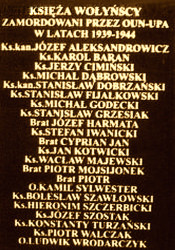
function
diocesan priest
creed
Latin (Roman Catholic) Church RCmore on
en.wikipedia.org
[access: 2014.09.21]
diocese / province
Lutsk diocesemore on
en.wikipedia.org
[access: 2013.05.19]
date and place
of death
05.1943

Rohiznetoday: Demydivka hrom., Dubno rai., Rivne obl., Ukraine
more on
uk.wikipedia.org
[access: 2024.01.26]
alt. dates and places
of death
Vovkovyitoday: Demydivka hrom., Dubno rai., Rivne obl., Ukraine
more on
uk.wikipedia.org
[access: 2022.08.05]
details of death
In 1939, began his ministry in the small town of Zofjówka, located in the forests, c. 30 km northeast of the Lutsk district, in the Polish Volyn Voivodeship. It was essentially a Jewish town, where in 1921 a Catholic church was built to serve Poles from the surrounding villages and settlements. In 1939, the town — called Trochimbrod by the Jews — had an estimated population of c. 1,600 Jews, while the Roman Catholic parish numbered c. 3,889 souls.
There survived the Russian occupation, which began as a result of the German and Russian invasion of Poland in 09.1939 and the start of World War II Volyn, pursuant to the genocidal German–Russian agreement of 23.08.1939, known as the Molotov–Ribbentrop Pact, confirmed on 28.09.1939, by the so‐called „Treaty on the Borders and Friendship between Germany and Russia”, also known as the second Molotov–Ribbentrop Pact, fell to the Russians. In the first step, the Russian occupiers arrested Polish intelligentsia, teachers, doctors, landowners, government officials, foresters, policemen, and the families of Polish military personnel. In the years 1940‐1941, many Poles became victims of four large waves of deportations „to Siberia”. Accounts often mention that „they came at night, without warning, and took away entire families, from infants to the elderly”. „When we went out into the yard, they allowed my mother to look into the chest — unfortunately, it was empty, because our neighbors had already emptied it. We took practically nothing, because they did not allow us to move around the house […] There were large snowdrifts and heavy frost”. In addition, 150,000–200,000 men were conscripted into the Russian army, and c. 100,000 were forced to work for Russian industry, mainly in the mines of the Donets Basin, in heavy industry plants in the Urals and in Siberia. Then the surveillance of priests and monks began. The clergy were subjected to high taxes.
After the German attack on 22.06.1941, on its erstwhile ally, the Russians, and the beginning of the German occupation, became administrator of the small parish of Lysyn, c. 35 km south of Lutsk, in the Berestechko deanery. The village, in 1939 in the Polish county of Dubno, was inhabited by an c. 550 people, of whom Roman Catholic Poles constituted c. 22% and Orthodox Ukrainians c. 78%, which corresponded to the ethnic structure of the county. There were no Jews. In c. 1938 the Roman Catholic parish had c. 691 faithful.
Arrived there in 1942 — the village was in the Germ. Kreisgebiet Dubno (Eng. Dubno County) within the Germ. Generalbezirk Wolhynien–Podolien (Eng. General District Volyn‐Podolya), part of the body known as the Germ. Reichskommissariat Ukraine (Eng. Reich Commissariat of Ukraine) — prob. during the culmination of the persecution of Jews in the area. His parish included the small town of Demydivka, which became the local center of the implementation of German policy towards Jews. It was inhabited by c. 1,200‐1,400 people, of which Jews — living in the center — constituted half of the population, and the other half being Ukrainians living on the outskirts. During the first week of the occupation, based on Ukrainian denunciations, the Germans murdered several local Jews, accused — admittedly not without justification — of collaborating with the Russians during the Russian occupation. A Germ. Judenrat (Eng. Jewish Council) was established among the Jews, which was made responsible for the implementation of German orders by the Jewish community. Among the Ukrainians, on the other hand, a collaborative formation was established, the Germ. Ukrainische Hilfspolizei (Eng. Ukrainian Auxiliary Police), also referred to, depending on the actual subordination to the relevant German authorities, as the Germ. Schutzmannschaft (Eng. Protection Battalions), i.e. Schuma. The Germ. Ukrainische Hilfspolizei quickly began to enrich itself on property stolen from Jews, e.g. by robbing the food rations allocated for Jews by the Germans.
At the beginning of 1942, the Germans began implementing the genocidal plan Germ. «Endlösung der Judenfrage» (Eng. Final Solution of the Jewish Question), i.e. the extermination of all Jews in the occupied territories. In the Germ. Reichskommissariat Ukraine, Jews were not actually sent to the specially established Germ. Vernichtungslager (Eng. Extermination camp), but were murdered on the spot. For this purpose, ghetto was established in Demydivka in 05.1942, and Jews from the surrounding villages were herded into it — with the help of the Germ. Ukrainische Hilfspolizei. The liquidation of the ghetto took place on 08.10.1942. The murders were committed by a German unit of the Germ. Sicherheitsdienst des Reichsführers SS (Eng. Security Service of the Reichsführer SS), i.e. «SD», with the support of local functionaries of the Germ. Ukrainian Hilfspolizei. C. 600 Jews were murdered near Demydivka. For the next few months, the génocidaires of the Germ. Ukrainian Hilfspolizei were still hunting for Jews who had escaped death. The town was deserted, and the empty houses were slowly occupied by Ukrainian executioners, but the German génocidaires could report that Demydivka was Germ. „Judenfrei” (Eng. „free of Jews”).
Soon after, it was the turn of the Poles. In 02.1943 Roman Shukhevych, nom de guerre „Taras Chuprynka”, the chief commander of the Ukrainian, genocidal OUN/UPA organisation, who in 1941 was a member of the Ukrainian Germ. Sondergruppe Nachtigall (Eng. Special Group Nightingale) — a unit of the Germ. Wehrmacht that took part in the German attack on Russians in 1941, accused of participating in the Jewish pogrom in Lviv in 1941 — and later a member of the Germ. Schutzmannschaftsbataillon 201 (Eng. 201st Protection team Battalion) — responsible for the murder of Jews and civilians in the territory of Belarus — issued an order: „The extermination operation [of Poles] should be carried out according to the following principles: Polish villages are to be burned, and their populations massacred. Attacks on towns will take place in broad daylight, not at night. In mixed villages, the Polish population alone should be liquidated, and farmsteads should be burned only if they are 15 meters away and when there is no risk of the fire spreading to neighboring Ukrainian buildings. The Ukrainian population will receive instructions as to where to gather during the attack […] For every Ukrainian murdered, whether by Poles or Germans, 100 (one hundred) Poles will be executed”.
It was the de facto signal for the commencement of the «Genocidium Atrox» — i.e. the genocide perpetrated by Ukrainians, known as „Volyn genocide”.
Immediately thereafter, in 03.1943, the UPA issued an appeal to members of the Germ. Ukrainische Hilfspolizei, to desert and join the UPA. Perhaps as many as 10,000 Ukrainians did so.
The choice of Volyn for the beginning of the «Genocidium Atrox» was not accidental. Firstly, Volyn in pre‐war Poland had prob. the smallest percentage of Polish population in the entire country. Secondly, it was probably the least economically developed voivodeship of Poland, which was caused by the deliberate policy of the Russians in the 19th century, ruling then in part of partitioned Poland — the direct route to the heart of Russia, to Moscow, runs through Volyn, so no roads were laid there, no bridges built, no marshy areas around the Pripyat drained, no industry located, and no schools established. Thirdly, and finally, it was Volyn (and the Chełm region) that was to be incorporated into the borders of the short‐lived Ukrainian state, to be established on the basis of the Treaty of Brest‐Litovsk of 09.02.1918 during World War I, agreed by the Central Powers (German Empire, Austro–Hungarian Monarchy) — in 1941 the Germans by creating Germ. Reichskommissariat Ukraine simply fulfilled the obligations undertaken at that time.
In the vicinity of his parish village, the first Ukrainian attacks had prob. taken place in 03.1943. They did not yet have the character of collective, genocidal brutality — this was to happen later, after the „detailing” of the OUN/UPA tactics by the UPA commander in Volyn, Dmytro Kłaczkiwski, nom de guerre „Klym Savur”, in 06.1943, who, anticipating Germany's defeat in the war with Russia, explained and ordered: „We should carry out a major operation to eliminate the Polish element. When the German troops withdraw, we should use this opportune moment to eliminate the entire male population aged 16 to 60 […] We cannot lose this fight, and we must weaken Polish forces at all costs. Forest villages and villages located near forest massifs should disappear from the face of the earth”. They took the form of individual attacks on Polish farms. Thus, in Tesluhiv, seat of the neighboring parish, between 03‐04.1943 (and prob. also in 05.1943), Ukrainians murdered a dozen or so Polish families, i.e. practically all the Polish inhabitants of that village.
And then, the parish priest of Tesluhiv, Fr Jerome Szczerbicki, moved to the village of Vovkovyi, which belonged to his parish, c. 13 km from Lysin. It was a larger village, inhabited in 1939 by an estimated c. 2,700 people, of whom c. 67% were Ukrainians, but there were also c. 550 Poles. The Ukrainians did not yet dare attack such Polish communities.
On the night of 18‐19.05.1943, in the village and settlement of Kalynivka, on the other side of the Zhabychi River, a right tributary of the Styr River, c. 4‐5 km from Vovkovyi, „the neighboring Ukrainians murdered over 30 Poles and another 7 people while escaping to Dubno”. Went then to visit Vovkovyi.
Both priests decided to move to Lysyn, or perhaps even — as sources seem to suggest — to leave the area and make their way along the Zhabychi River, through the town of Demydivka, c. 8 km away — now devoid of Jews, but prob. with the German police stationed there — then through Lysyn, to Lutsk, c. 45 km away, or by a roundabout route to Dubno, c. 38 km away.
They didn't get far, barely 2.5 km, to the village of Rohizne, where, in a similar manner as in Tesluhiv, the Ukrainians murdered all the Poles between 03‐05.1943, c. 20 families, i.e. c. 120 people.
There they were detained by the Ukrainians. These were prob. former policemen of Germ. Ukrainian Police, „seasoned” in the murder of Jews in Demydivka, and by then „unemployed”, who had deserted to the genocidal OUN/UPA.
The murder took place on the road from Vovkovyi to Demydivka. The two priests were bound with barbed wire, hacked with axes, thrown alive into a 19‐meter–deep well, and then buried under earth and stones.
In 1944, after the German defeat and the beginning of another Russian occupation — the Russians drove the Germans out of Volyn in 02.1944, during the so‐called Dnieper–Carpathian Operation — a Polish priest, Fr Stanislav Mazak, attempted to unearth the bodies. Obtained a guarantee of safety from one of the Russian units, but only for one day. The work could not be completed and, due to the constant threat from Ukrainian génocidaires, the area had to be abandoned.
The priests" bodies remain in a filled‐in well to this day.
For this, on 12.10.2007, the génocidaire Roman Shukhevych was posthumously awarded the title of Hero of Ukraine. And in 12.2020, the Verkhovna Rada of Ukraine, in a resolution, recognized génocidaire Dmitry Klachkivsky as „the leader of the Ukrainian Insurgent Army in Volyn and a participant in the struggle for Ukraine's independence in the 20th century”. In several locations, monuments and commemorative plaques have been erected to these Lat. „hostis humani generis”, the schools were named after them.
Lat. „O Tempora! O mores!”
cause of death
mass murder
perpetrators
Ukrainians
sites and events
«Genocidium Atrox»Click to display the description, Ribbentrop‐MolotovClick to display the description, Pius XI's encyclicalsClick to display the description
date and place
of birth
10.03.1915

Brodnicatoday: Brodnica urban gm., Brodnica pov., Kuyavia‐Pomerania voiv., Poland
more on
en.wikipedia.org
[access: 2020.11.27]
alt. dates and places
of birth
21.03.1910
parents
CIMIŃSKI Paul
🞲 ?, ? — 🕆 ?, ?

ZAMBRZYCKA Mary
🞲 ?, ? — 🕆 ?, ?
presbyter (holy orders)
ordination
15.10.1939

Lutsktoday: Lutsk city rai., Volyn obl., Ukraine
more on
en.wikipedia.org
[access: 2021.09.17]
positions held
1942 – 1943
parish priest — Lysyntoday: Demydivka hrom., Dubno rai., Rivne obl., Ukraine
more on
uk.wikipedia.org
[access: 2022.07.05] ⋄ Transfiguration of the Lord RC parish ⋄ Berestechkotoday: Berestechko urban hrom., Lutsk rai., Volyn obl., Ukraine
more on
en.wikipedia.org
[access: 2020.11.27] RC deanery
1939 – 1942
parish priest — Zofiówkatoday: non‐existent village, Lutsk rai., Volyn obl., Ukraine
more on
en.wikipedia.org
[access: 2022.07.05] ⋄ St Sophie the Virgin and Martyr RC parish ⋄ Kolkytoday: Kolky hrom., Lutsk rai., Volyn obl., Ukraine
more on
en.wikipedia.org
[access: 2021.12.19] RC deanery
1935 – 1939
student — Lutsktoday: Lutsk city rai., Volyn obl., Ukraine
more on
en.wikipedia.org
[access: 2021.09.17] ⋄ philosophy and theology, Theological Seminary
others related
in death
SZCZERBICKIClick to display biography Jerome
sites and events
descriptions
«Genocidium Atrox»: In 1939‐1947, especially in 1943‐1944, independent Ukrainian units, mainly belonging to genocidal Ukrainian organizations OUN (political arm) and UPA (military arm), supported by local Ukrainian population, murdered — often in extremely brutal way — in Volyn and surrounding regions of pre‐war Poland, from 130,000 to 180,000 Poles, all civilians: men, women, children, old and young. Polish‐Ukrainian conflict that openly emerged during and after World War I (in particular resulting in Polish‐Ukrainian war of 1918‐1919), that survived and even deepened later when western Ukraine became a part Poland, exploded again after the outbreak of the World War II in 09.1939. During Russian occupation of 1939‐1941, when hundreds of thousands of Poles were deported into central Russia, when tens of thousands were murdered (during so‐called Katyń massacres, among others), this open conflict had a limited character, helped by the fact that at that time Ukrainians, Ukrainian nationalists in particular, were also persecuted by the Russians. The worst came after German‐Russian war started on 22.06.1941 and German occupation resulted. Initially Ukrainians supported Germans (Ukrainian police was initiated, Ukrainians co—participated in extermination of the Jews and were joining army units fighting alongside Germans). Later when German ambivalent position towards Ukraine became apparent Ukrainians started acting independently. And in 1943 one of the units of aforementioned Ukrainian OUN/UPA organization, in Volyn, started and perpetrated a genocide of Polish population of this region. In mere few weeks OUN/UPA murdered, with Germans passively watching on the sidelines, more than 40,000 Poles. This strategy was consequently approved and adopted by all OUN/UPA organisations and similar genocides took place in Eastern Lesser Poland (part of Ukraine) where more than 20,000 Poles were slaughtered, meeting however with growing resistance from Polish population. Further west, in Chełm, Rzeszów, etc. regions this genocide turned into an extremely bloody conflict. In general genocide, perpetrated by Ukrainian nationalists, partly collaborating with German occupants, on vulnerable Polish population took part in hundreds of villages and small towns, where virtually all Polish inhabitants were wiped out. More than 200 priests, religious and nuns perished in this holocaust — known as «Genocidium Atrox» (Eng. „savage genocide”) The nature and purpose of genocide is perhaps best reflected in the song sung by the murderers: „We will slaughter the Poles, we will cut down the Jews, we must conquer the great Ukraine” (ukr. „Поляків виріжем, Євреїв видусим, велику Україну здобути мусим”). This holocaust and conflict ended up in total elimination of Polish population and Polish culture from Ukraine, in enforced deportations in 1944‐1945 of remaining Poles from Ukraine and some Ukrainians into Ukraine proper, and finally in deportation of Ukrainians from East‐South to the Western parts of Polish republic prl by Commie‐Nazi Russian controlled Polish security forces („Vistula Action”). (more on: www.swzygmunt.knc.plClick to attempt to display webpage
[access: 2021.06.20])
Ribbentrop‐Molotov: Genocidal Russian‐German alliance pact between Russian leader Joseph Stalin and German leader Adolf Hitler signed on 23.08.1939 in Moscow by respective foreign ministers, Mr. Vyacheslav Molotov for Russia and Joachim von Ribbentrop for Germany. The pact sanctioned and was the direct cause of joint Russian and German invasion of Poland and the outbreak of the World War II in 09.1939. In a political sense, the pact was an attempt to restore the status quo ante before 1914, with one exception, namely the „commercial” exchange of the so‐called „Kingdom of Poland”, which in 1914 was part of the Russian Empire, fore Eastern Galicia (today's western Ukraine), in 1914 belonging to the Austro‐Hungarian Empire. Galicia, including Lviv, was to be taken over by the Russians, the „Kingdom of Poland” — under the name of the General Governorate — Germany. The resultant „war was one of the greatest calamities and dramas of humanity in history, for two atheistic and anti‐Christian ideologies — national and international socialism — rejected God and His fifth Decalogue commandment: Thou shall not kill!” (Abp Stanislav Gądecki, 01.09.2019). The decisions taken — backed up by the betrayal of the formal allies of Poland, France and Germany, which on 12.09.1939, at a joint conference in Abbeville, decided not to provide aid to attacked Poland and not to take military action against Germany (a clear breach of treaty obligations with Poland) — were on 28.09.1939 slightly altered and made more precise when a treaty on „German‐Russian boundaries and friendship” was agreed by the same murderous signatories. One of its findings was establishment of spheres of influence in Central and Eastern Europe and in consequence IV partition of Poland. In one of its secret annexes agreed, that: „the Signatories will not tolerate on its respective territories any Polish propaganda that affects the territory of the other Side. On their respective territories they will suppress all such propaganda and inform each other of the measures taken to accomplish it”. The agreements resulted in a series of meeting between two genocidal organization representing both sides — German Gestapo and Russian NKVD when coordination of efforts to exterminate Polish intelligentsia and Polish leading classes (in Germany called «Intelligenzaktion», in Russia took the form of Katyń massacres) where discussed. Resulted in deaths of hundreds of thousands of Polish intelligentsia, including thousands of priests presented here, and tens of millions of ordinary people,. The results of this Russian‐German pact lasted till 1989 and are still in evidence even today. (more on: en.wikipedia.orgClick to attempt to display webpage
[access: 2015.09.30])
Pius XI's encyclicals: Facing the creation of two totalitarian systems in Europe, which seemed to compete with each other, though there were more similarities than contradictions between them, Pope Pius XI issued in 03.1937 (within 5 days) two encyclicals. In the „Mit brennender Sorge” (Eng. „With Burning Concern”) published on 14.03.1938, condemned the national socialism prevailing in Germany. The Pope wrote: „Whoever, following the old Germanic‐pre‐Christian beliefs, puts various impersonal fate in the place of a personal God, denies the wisdom of God and Providence […], whoever exalts earthly values: race or nation, or state, or state system, representatives of state power or other fundamental values of human society, […] and makes them the highest standard of all values, including religious ones, and idolizes them, this one […] is far from true faith in God and from a worldview corresponding to such faith”. On 19.03.1937, published „Divini Redemptoris” (Eng. „Divine Redeemer”), in which criticized Russian communism, dialectical materialism and the class struggle theory. The Pope wrote: „Communism deprives man of freedom, and therefore the spiritual basis of all life norms. It deprives the human person of all his dignity and any moral support with which he could resist the onslaught of blind passions […] This is the new gospel that Bolshevik and godless communism preaches as a message of salvation and redemption of humanity”… Pius XI demanded that the established human law be subjected to the natural law of God , recommended the implementation of the ideal of a Christian state and society, and called on Catholics to resist. Two years later, National Socialist Germany and Communist Russia came together and started World War II. (more on: www.vatican.vaClick to attempt to display webpage
[access: 2023.05.28], www.vatican.vaClick to attempt to display webpage
[access: 2023.05.28])
sources
personal:
www.duszki.plClick to attempt to display webpage
[access: 2012.11.23], nawolyniu.plClick to attempt to display webpage
[access: 2013.01.06], cracovia-leopolis.plClick to attempt to display webpage
[access: 2013.01.26]
bibliographical:
„Martyrology of the Polish Roman Catholic clergy under nazi occupation in 1939‐1945”, Victor Jacewicz, John Woś, vol. I‐V, Warsaw Theological Academy, 1977‐1981
„Register of Latin rite Lviv metropolis clergy’s losses in 1939‐45”, Józef Krętosz, Maria Pawłowiczowa, editors, Opole, 2005
„Genocidium Atrox”, GTKRK, https://www.swzygmunt.knc.pl/GENOCIDEs/15 GENOCIDUM ATROX/vPOLISH/MAINs/GENATROXsearch01.htm
original images:
www.stowarzyszenieuozun.wroclaw.plClick to attempt to display webpage
[access: 2014.01.16], wegliniec.plClick to attempt to display webpage
[access: 2014.10.31]
LETTER to CUSTODIAN/ADMINISTRATOR
If you have an Email client on your communicator/computer — such as Mozilla Thunderbird, Windows Mail or Microsoft Outlook, described at WikipediaPatrz:
en.wikipedia.org, among others — try the link below, please:
LETTER to CUSTODIAN/ADMINISTRATORClick and try to call your own Email client
If however you do not run such a client or the above link is not active please send an email to the Custodian/Administrator using your account — in your customary email/correspondence engine — at the following address:

giving the following as the subject:
MARTYROLOGY: CIMIŃSKI George John
To return to the biography press below:
 Click to return to biography