Roman Catholic
St Sigismund parish
05-507 Słomczyn
85 Wiślana Str.
Konstancin deanery
Warsaw archdiocese, Poland

full list:
displayClick to display full list

searchClick to search full list by categories
wyświetlKliknij by wyświetlić pełną listę po polsku

szukajKliknij by przeszukać listę wg kategorii po polsku

Martyrology of the clergy — Poland
XX century (1914 – 1989)
personal data
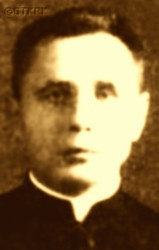
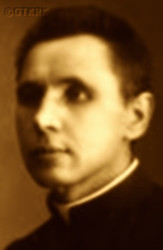
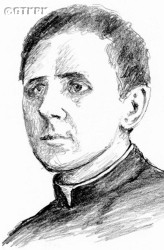
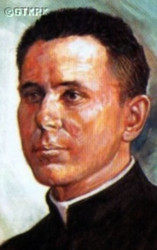
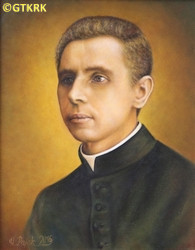
religious status
blessed
surname
DOBIASZ
forename(s)
Ignatius (pl. Ignacy)

function
religious cleric
creed
Latin (Roman Catholic) Church RCmore on
en.wikipedia.org
[access: 2014.09.21]
congregation
Society of St Francis de Sales SDBmore on
en.wikipedia.org
[access: 2013.05.19]
(i.e. Salesians of Don Bosco)
diocese / province
St Jack Cracow Inspectorate SDB
Cracow archdiocesemore on
en.wikipedia.org
[access: 2013.05.19]
date and place
of death
27.06.1941

KL Auschwitzconcentration camp
today: Oświęcim, Oświęcim gm., Oświęcim pov., Lesser Poland voiv., Poland
more on
en.wikipedia.org
[access: 2022.01.09]
details of death
After the German and Russian invasion of the Poland in 09.1939 and the start of World War II, after the beginning of the German occupation, Kraków — where ministered — became the „capital” of a German‐occupied and run quasi‐state called the Germ. Generalgouvernement (Eng. General Governorate), i.e. GG.
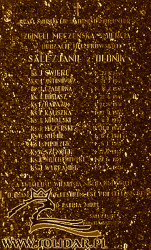
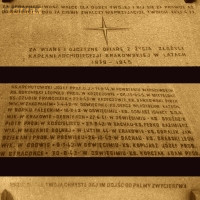
There, on 23.05.1941, arrested by the Germ. Geheime Staatspolizei (Eng. Secret State Police), i.e. Gestapo, in the Seminary of the Salesian Congregation SDB, at 39 Tyniecka Street, together with 9 other friars of the Congregation (two others were arrested a few days earlier; yet two more a few days later in Kielce).
The reason for the arrests was prob. a denunciation from a friar from another congregation on the cooperation of the Salesian Fathers with Polish resistance organizations (part of the Polish Clandestine State) and the assistance provided to Polish soldiers in hiding. The arresting Germans, however, claimed that it was „the fooling of the people and instilling in them the belief that Poland had not perished, that it would rise again”. One of the Germans added: „Whoever has the courage to speak about Poland must also have the courage and suffer for Poland”.
Held in the prison on Montelupich Street in Kraków.
From there, on 26.06.1941, transported to the Germ. Konzentrationslager (Eng. concentration camp) KL Auschwitz, then located in the Germ. Provinz Oberschlesien (Eng. Province of Upper Silesia), i.e. in occupied Polish territories directly incorporated into the German state.
There assigned to Germ. Kommando (Eng. commando) of forced slave labor — along with several of his fellow prisoners and a few Jews — referred to as the Germ. Strafkompanie (Eng. penal company).
Forced to work in the so‐called Pl. Żwirowisko (Eng. Gravel pit), outside the camp fence. The largest of the gravel pits was located next to the so‐called Germ. Theatergebäude (Eng. theater building). In 1941, it became the site of many executions of imprisoned Poles.
A fellow friar, Fr Valentin Waloszek SDB, who survived, recalled: „Each of us received a heavy iron wheelbarrow, a pickaxe, and a shovel. We were told that we had to work very quickly, constantly running, without looking back or resting. Our work consisted of breaking up stones with pickaxes, loading them into the wheelbarrow along with gravel, and carrying them to a 7‐meter–deep pit, some 50 meters away from us”.
And concluded: „He was an elderly 60‐year‐old priest, sickly and exhausted. He couldn't cope with the work imposed on him. Often stopped, rested.
[…] This attracted the attention of his torturers. «Aha, you don't feel like working either!» The kapo said: «Of course, it's easier to fool people and steal than to put in the work! I'll help you right away! Now, load the stones! Run to the pit!» With a final effort, he carries out the kapo's order. But he is no longer able to carry the wheelbarrow away.
Seeing this, bloody Franz began to beat the venerable old man with a stick.
He dragged himself with difficulty to the edge of the deep pit, but was unable to tip the wheelbarrow over… Franz pushed him down.
[…] After long efforts, beaten constantly, he dragged himself to the surface.
[…] Now the kapo tortured his victim until he gave up the ghost.
Words of prayer flowed from our lips to God, for the peace of his soul!”.
This kapo, i.e. Germ. Funktionshäftling (Eng. prisoner functionary), supervisor of the Germ. Kommando — directly subordinate to the camp members of the genocidal Germ. Die Schutzstaffel der NSDAP (Eng. NSDAP Protection Squad), i.e. «SS», a paramilitary formation subordinate to the ruling National Socialist German Workers' Party NSDAP in Germany — was a certain Franz Teresiak, born 23.01.1914 in Oberhausen, German criminal, brought by the Germans in 1940 from the KL Sachsenhausen concentration camp to perform supervisory functions in Auschwitz. On that day he murdered four members of the Salesian Congregation SDB. Although Teresiak had not heard the speech delivered on 14.06.1940, by the camp's deputy commandant, SS‐Hauptsturmführer Karl Fritzsch, to the first transport of Poles to KL Auschwitz, certainly knew its content and diligently adhered to the promises expressed therein: „You have come here not to a sanatorium, but to a German concentration camp, from which there is no other way out than through the chimney […] We will take great pleasure in driving you all through the grates of the crematorium ovens. For us, all of you together are not people, just a pile of manure […] If someone doesn't like it, they can go to the wires, [i.e. throw themselves at electrically charged fence], right away. If there are Jews in the transport, they have the right to live no longer than two weeks, priests a month, the rest three months”.
prisoner camp's numbers
17364Click to display source page (KL AuschwitzClick to display the description)
cause of death
murder
perpetrators
Germans
sites and events
KL AuschwitzClick to display the description, Regierungsbezirk KattowitzClick to display the description, Cracow (Montelupich)Click to display the description, 23.05.1941 arrests (Cracow)Click to display the description, GeneralgouvernementClick to display the description, Ribbentrop‐MolotovClick to display the description, Pius XI's encyclicalsClick to display the description
date and place
of birth
14.01.1880Birth certification on:
www.familysearch.org
[access: 2025.08.19]

Ciochowicetoday: Toszek gm., Gliwice pov., Silesia voiv., Poland
more on
en.wikipedia.org
[access: 2022.01.28]
parents
DOBIASZ Ignatius
🞲 ?, ? — 🕆 ?, ?

JAROSZKA Joanna
🞲 ?, ? — 🕆 ?, ?
baptism
16.01.1880Birth certification on:
www.familysearch.org
[access: 2025.08.19]

Toszektoday: Toszek gm., Gliwice pov., Silesia voiv., Poland
more on
en.wikipedia.org
[access: 2022.02.15]
St Catherine of Alexandria RC church
religious vows
06.10.1900 (temporary)
21.09.1903 (permanent)
presbyter (holy orders)
ordination
28.06.1908

Ivreatoday: Turin prov., Piedmont reg., Italy
more on
en.wikipedia.org
[access: 2022.09.11]
positions held
1934 – 1941
friar — KrakówDębniki district
today: Kraków city pov., Lesser Poland voiv., Poland
more on
en.wikipedia.org
[access: 2021.12.18] ⋄ Blessed Virgin Mary Immaculate Conception Society's Houses, Salesians of Don Bosco SDB — confessor and vicar of St Stanislav Kostka parish in Kraków–Dębniki
1931 – 1933
friar — Warsawtoday: Warsaw city pov., Masovia voiv., Poland
more on
en.wikipedia.org
[access: 2021.10.09] ⋄ Society's House, Salesians of Don Bosco SDB — vicar
1923
friar — Oświęcimtoday: Oświęcim gm., Oświęcim pov., Lesser Poland voiv., Poland
more on
en.wikipedia.org
[access: 2021.06.07] ⋄ Society's House (Casa Madre), Salesians of Don Bosco SDB — moral theology and Latin lecturer at gymnasium in Educational Institute
1922
lecturer — KrakówDębniki district
today: Kraków city pov., Lesser Poland voiv., Poland
more on
en.wikipedia.org
[access: 2021.12.18] ⋄ St Francis de Sales Gymnasium for Boys, i.e. Philosophical Studentate, Blessed Virgin Mary Immaculate Conception Congregation's house (known as „Łosiówka”, at 30 Tyniecka Str.), Salesians of Don Bosco SDB — i.e. moral theology
1921
friar — Oświęcimtoday: Oświęcim gm., Oświęcim pov., Lesser Poland voiv., Poland
more on
en.wikipedia.org
[access: 2021.06.07] ⋄ Society's House (Casa Madre), Salesians of Don Bosco SDB — moral theology lecturer at gymnasium in Educational Institute
1918 – 1920
friar — KrakówDębniki district
today: Kraków city pov., Lesser Poland voiv., Poland
more on
en.wikipedia.org
[access: 2021.12.18] ⋄ Blessed Virgin Mary Immaculate Conception Society's Houses, Salesians of Don Bosco SDB — catechist and vicar of St Stanislav Kostka parish in Kraków–Dębniki
1916 – 1918
friar — Pleszówtoday: part of Nowa Huta XVIII district, Kraków city pov., Lesser Poland voiv., Poland
more on
en.wikipedia.org
[access: 2021.06.07] ⋄ Society's House, Salesians of Don Bosco SDB — confessor
1912 – 1914
friar — PrzemyślZasanie district
today: Przemyśl city pov., Subcarpathia voiv., Poland
more on
en.wikipedia.org
[access: 2021.04.01] ⋄ Society's House, Salesians of Don Bosco SDB — prefect / treasury officer at the Educational Institute
1911
friar — Dashavatoday: Stryi urban hrom., Stryi rai., Lviv obl., Ukraine
more on
en.wikipedia.org
[access: 2022.09.11] ⋄ Society's House, Salesians of Don Bosco SDB — primary school prefect
1908 – 1910
friar — Oświęcimtoday: Oświęcim gm., Oświęcim pov., Lesser Poland voiv., Poland
more on
en.wikipedia.org
[access: 2021.06.07] ⋄ Society's House (Casa Madre), Salesians of Don Bosco SDB — catechist at town schools
friar — San Benigno Canavesetoday: Turin prov., Piedmont reg., Italy
more on
en.wikipedia.org
[access: 2022.09.11] ⋄ Society's House, Salesians of Don Bosco SDB — assistance (educational and pastoral practice)
till 1908
student — Foglizzo Canavesetoday: Foglizzo, Turin prov., Piedmont reg., Italy
more on
en.wikipedia.org
[access: 2021.12.18] ⋄ theology, Theological Institute (higher theological seminary), Salesians of Don Bosco SDB
till 21.12.1906
student — Turintoday: Turin city prov., Piedmont reg., Italy
more on
en.wikipedia.org
[access: 2020.11.01] ⋄ Agricultural Academy — studies crowned with a diploma in agronomy
student — Ivreatoday: Turin prov., Piedmont reg., Italy
more on
en.wikipedia.org
[access: 2022.09.11] ⋄ Philosophical Institute (also known as the Philosophical Studentate), Salesians of Don Bosco SDB
16.08.1898 – 1900
novitiate — Ivreatoday: Turin prov., Piedmont reg., Italy
more on
en.wikipedia.org
[access: 2022.09.11] ⋄ Society's House, Salesians of Don Bosco SDB
21.05.1894 – 1898
pupil — Turintoday: Turin city prov., Piedmont reg., Italy
more on
en.wikipedia.org
[access: 2020.11.01] ⋄ Valsalice College i.e. Gymnasium, Society's House, Salesians of Don Bosco SDB
till c. 1894
pupil — Ciochowicetoday: Toszek gm., Gliwice pov., Silesia voiv., Poland
more on
en.wikipedia.org
[access: 2022.01.28] ⋄ elementary school
others related
in death
ANTONOWICZClick to display biography Ignatius Thaddeus, CZADERNAClick to display biography Joseph, HARAZIMClick to display biography Francis Louis, KOWALSKIClick to display biography Joseph, MROCZEKClick to display biography Louis John, NIEMIRClick to display biography Vladislav, ŚWIERCClick to display biography John, WOJCIECHOWSKIClick to display biography Casimir, WYBRANIECClick to display biography Joseph, GOLDAClick to display biography Charles, MIŚKAClick to display biography Francis, SZEMBEKClick to display biography Francis Vladimir
sites and events
descriptions
KL Auschwitz: German Germ. Konzentrationslager (Eng. concentration camp) KL and Germ. Vernichtungslager (Eng. extermination camp) VL Auschwitz was set up by Germans around 27.01.1940 n. Oświęcim, on the German territory (initially in Germ. Provinz Schlesien — Silesia Province; and from 1941 Germ. Provinz Oberschlesien — Upper Silesia Province). Initially mainly Poles were interned. From 1942 it became the centre for holocaust of European Jews. Part of the KL Auschwitz concentration camps’ complex was Germ. Vernichtungslager (Eng. extermination camp) VL Auschwitz II Birkenau, located not far away from the main camp. There Germans murdered likely in excess of million people, mainly Jews, in gas chambers. In KL Auschwitz alone, the Germans murdered c. 30,000 prisoners by lethal injection. Until 1941, people were killed by intravenous injections of concentrated hydrogen peroxide, ether, hydrogen peroxide, or gasoline. Later, an intracardiac injection was used — with a needle about 10 cm long — of 10‐15 ml of a 30% solution of phenol C6H5OH (acquired from the German concern IG Farben, or more precisely from its subsidiary Bayer, and still used by Bayer AG, among others, for the production of aspirin), which killed within 15 seconds. Altogether In excess of 400 priests and religious went through the KL Auschwitz, c. 40% of which were murdered (mainly Poles). (more on: en.auschwitz.org.plClick to attempt to display webpage
[access: 2012.11.23], www.meczennicy.pelplin.plClick to attempt to display webpage
[access: 2013.07.06])
Regierungsbezirk Kattowitz: After the Polish defeat in the 09.1939 campaign, which was the result of the Ribbentrop‐Molotov Pact and constituted the first stage of World War II, and the beginning of German occupation in part of Poland (in the other, eastern part of Poland, the Russian occupation began), the Germans divided the occupied Polish territory into five main regions (and a few smaller). The largest one was transformed into Germ. Generalgouvernement (Eng. General Governorate), intended exclusively for Poles and Jews and constituting part of the so‐called Germ. Großdeutschland (Eng. Greater Germany). From two separate new provinces were created. The two remaining were incorporated into existing German provinces. One of those was Polish Upper Silesia, which on 08.09.1939, by decree of the German leader Adolf Hitler (formally came into force on 26.10.1939), was incorporated into Germany as the Germ. Regierungsbezirk Kattowitz (Eng. Katowice Regency) and became part of the Germ. Provinz Schlesien (Eng. Province of Silesia) based in Wrocław. On 01.04.1940, the Germ. Regierungsbezirk Kattowitz was enlarged by several pre‐war German counties, and on 18.01.1941, a new German province was created, the Germ. Provinz Oberschlesien (Eng. Province of Upper Silesia), which, apart from the Germ. Regierungsbezirk Kattowitz, also included the Opole region. From 26.10.1939, when the regency was established, the law of the German state was in force there, the same as in Berlin. The main axis of the policy of the new regency, the territory of which the Germans recognized as the Germ. „Ursprünglich Deutsche” (Eng. „natively German”), despite the fact only 6% of its pre–war Polish part were Germans, was Germ. „Entpolonisierung” (Eng. „Depolonisation”), i.e. forced Germanization. The main mechanism was the introduction of the Germ. Deutsche Volksliste DVL, a German nationality list that was supposed to specify the national affiliation of the inhabitants of the region. The largest group marked in the compulsory registrations was Group 3, people who identified themselves as „Silesians” (in 1943 about 41%), and people remaining outside the DVL (about 36%). The latter group was intended to be deported to the Germ. Generalgouvernement (which did not happen en masse because German industry needed slave labor). Group 3, considered by the Germans as capable of Germanization, was subject to certain legal restrictions, and was subject to, among others, to conscription into the German Wehrmacht army. Children could only learn in German. A policy of terror was pursued against the Polish population. There was a special police court, controlled by the Germ. Geheime Staatspolizei (Eng. Secret State Police), i.e. the Gestapo, before which c. 4,000‐5,000 people were detained. For the years 1942‐1945 over 2,000 of them were verified, of which 1,890 were sentenced to death, including 286 in public executions. Thousands of people were murdered during the so‐called «Intelligenzaktion Schlesien», including 300‐650 Polish teachers and c. 61 Polish Catholic priests. The regency hosted a German concentration and extermination camp KL Auschwitz, where the Germans imprisoned c. 1,100,000 Jews (murdering c.1,000,000, i.e. c. 90% of them) and c. 140,000 Poles (murdering c. 70,000, i.e. c. 50% of them). After the end of hostilities of World War II, the overseer of this province, the Germ. Reichsstatthalter (Eng. Reich Governor) and the Germ. Gauleiter (Eng. district head) of the German National Socialist Party, Fritz Brecht, committed suicide. (more on: en.wikipedia.orgClick to attempt to display webpage
[access: 2024.06.24])
Cracow (Montelupich): Cracow penal prison, during occupation run by the Germans — from 28.02.1941 by Germ. Geheime Staatspolizei (Eng. Secret State Police, known as Gestapo. In 1940‐1944 Germans jailed there approx. 50,000 prisoners, mainly Poles and Jews. Some of them were transported to KL Auschwitz concentration camp, some were executed. After cease in war effort the prison was used by UB — a Polish unit of Russian NKVD — as a prison for Polish independence resistance fighters, some of which were subsequently sent to prisons and slave labour camps in Russia. (more on: en.wikipedia.orgClick to attempt to display webpage
[access: 2014.10.31])
23.05.1941 arrests (Cracow): On 23.05.1941 Germans arrested in Cracow 10 Salesian Fathers SDB (two others were apprehended few days earlierl yet two others were arrested few days later in Kielce), ostensibly for assumed collaboration with Polish resistance movement (part of future Polish Clandestine State) and support and help given to Polish army officers in hiding. All were taken to Montelupich Str. prison and next to German KL Auschwitz concentration camp, where only two survived. Most of the rest where cruelly murdered. (more on: cejsh.icm.edu.plClick to attempt to display webpage
[access: 2017.11.07])
Generalgouvernement: After the Polish defeat in the 09.1939 campaign, which was the result of the Ribbentrop‐Molotov Pact and constituted the first stage of World War II, and the beginning of German occupation in part of Poland (in the other, eastern part of Poland, the Russian occupation began), the Germans divided the occupied Polish territory into five main regions. In two of them new German provinces were created, two other were incorporated into other provinces. However, the fifth part was treated separately, and in a political sense it was supposed to recreate the German idea from 1915 (during World War I, after the defeat of the Russians in the Battle of Gorlice in 05.1915) of creating a Polish enclave within Germany. Illegal in the sense of international law, i.e. Hague Convention, and public law, managed by the Germans according to separate laws — especially established for the Polish Germ. Untermenschen (Eng. subhumans) — till the Russian offensive in 1945 it constituted part of the Germ. Großdeutschland (Eng. Greater Germany). Till 31.07.1940 formally called Germ. Generalgouvernement für die besetzten polnischen Gebiete (Eng. General Government for the occupied Polish lands) — later simply Germ. Generalgouvernement (Eng. General Governorate), as in the years 1915‐1918. From 07.1941, i.e. after the German attack on 22.06.1941 against the erstwhile ally, the Russians, it also included the Galicia district, i.e. the Polish pre‐war south‐eastern voivodeships. A special criminal law was enacted and applied to Poles and Jews, allowing for the arbitrary administration of the death penalty regardless of the age of the „perpetrator”, and sanctioning the use of collective responsibility. After the end of the military conflict of the World War UU, the government of the Germ. Generalgouvernement was recognized as a criminal organization, and its leader, governor Hans Frank, guilty of war crimes and crimes against humanity and executed. (more on: en.wikipedia.orgClick to attempt to display webpage
[access: 2024.12.13])
Ribbentrop‐Molotov: Genocidal Russian‐German alliance pact between Russian leader Joseph Stalin and German leader Adolf Hitler signed on 23.08.1939 in Moscow by respective foreign ministers, Mr. Vyacheslav Molotov for Russia and Joachim von Ribbentrop for Germany. The pact sanctioned and was the direct cause of joint Russian and German invasion of Poland and the outbreak of the World War II in 09.1939. In a political sense, the pact was an attempt to restore the status quo ante before 1914, with one exception, namely the „commercial” exchange of the so‐called „Kingdom of Poland”, which in 1914 was part of the Russian Empire, fore Eastern Galicia (today's western Ukraine), in 1914 belonging to the Austro‐Hungarian Empire. Galicia, including Lviv, was to be taken over by the Russians, the „Kingdom of Poland” — under the name of the General Governorate — Germany. The resultant „war was one of the greatest calamities and dramas of humanity in history, for two atheistic and anti‐Christian ideologies — national and international socialism — rejected God and His fifth Decalogue commandment: Thou shall not kill!” (Abp Stanislav Gądecki, 01.09.2019). The decisions taken — backed up by the betrayal of the formal allies of Poland, France and Germany, which on 12.09.1939, at a joint conference in Abbeville, decided not to provide aid to attacked Poland and not to take military action against Germany (a clear breach of treaty obligations with Poland) — were on 28.09.1939 slightly altered and made more precise when a treaty on „German‐Russian boundaries and friendship” was agreed by the same murderous signatories. One of its findings was establishment of spheres of influence in Central and Eastern Europe and in consequence IV partition of Poland. In one of its secret annexes agreed, that: „the Signatories will not tolerate on its respective territories any Polish propaganda that affects the territory of the other Side. On their respective territories they will suppress all such propaganda and inform each other of the measures taken to accomplish it”. The agreements resulted in a series of meeting between two genocidal organization representing both sides — German Gestapo and Russian NKVD when coordination of efforts to exterminate Polish intelligentsia and Polish leading classes (in Germany called «Intelligenzaktion», in Russia took the form of Katyń massacres) where discussed. Resulted in deaths of hundreds of thousands of Polish intelligentsia, including thousands of priests presented here, and tens of millions of ordinary people,. The results of this Russian‐German pact lasted till 1989 and are still in evidence even today. (more on: en.wikipedia.orgClick to attempt to display webpage
[access: 2015.09.30])
Pius XI's encyclicals: Facing the creation of two totalitarian systems in Europe, which seemed to compete with each other, though there were more similarities than contradictions between them, Pope Pius XI issued in 03.1937 (within 5 days) two encyclicals. In the „Mit brennender Sorge” (Eng. „With Burning Concern”) published on 14.03.1938, condemned the national socialism prevailing in Germany. The Pope wrote: „Whoever, following the old Germanic‐pre‐Christian beliefs, puts various impersonal fate in the place of a personal God, denies the wisdom of God and Providence […], whoever exalts earthly values: race or nation, or state, or state system, representatives of state power or other fundamental values of human society, […] and makes them the highest standard of all values, including religious ones, and idolizes them, this one […] is far from true faith in God and from a worldview corresponding to such faith”. On 19.03.1937, published „Divini Redemptoris” (Eng. „Divine Redeemer”), in which criticized Russian communism, dialectical materialism and the class struggle theory. The Pope wrote: „Communism deprives man of freedom, and therefore the spiritual basis of all life norms. It deprives the human person of all his dignity and any moral support with which he could resist the onslaught of blind passions […] This is the new gospel that Bolshevik and godless communism preaches as a message of salvation and redemption of humanity”… Pius XI demanded that the established human law be subjected to the natural law of God , recommended the implementation of the ideal of a Christian state and society, and called on Catholics to resist. Two years later, National Socialist Germany and Communist Russia came together and started World War II. (more on: www.vatican.vaClick to attempt to display webpage
[access: 2023.05.28], www.vatican.vaClick to attempt to display webpage
[access: 2023.05.28])
sources
personal:
pl.wikipedia.orgClick to attempt to display webpage
[access: 2012.11.23], www.magazyn.donbosco.plClick to attempt to display webpage
[access: 2013.05.19], debniki.sdb.org.plClick to attempt to display webpage
[access: 2025.08.19], www.familysearch.orgClick to attempt to display webpage
[access: 2025.08.19], www.hagiographycircle.comClick to attempt to display webpage
[access: 2012.11.23], diecezja.plClick to attempt to display webpage
[access: 2026.07.13]
original images:
www.harmeze.franciszkanie.plClick to attempt to display webpage
[access: 2013.02.15], www.salon24.plClick to attempt to display webpage
[access: 2017.11.07], www.ssb24.plClick to attempt to display webpage
[access: 2017.11.07], www.dolfi-wood.comClick to attempt to display webpage
[access: 2021.12.19], salezjanieoswiecim.plClick to attempt to display webpage
[access: 2025.02.11], www.bj.uj.edu.plClick to attempt to display webpage
[access: 2013.05.19], pl.wikipedia.orgClick to attempt to display webpage
[access: 2013.12.04], www.harmeze.franciszkanie.plClick to attempt to display webpage
[access: 2014.03.21]

LETTER to CUSTODIAN/ADMINISTRATOR
If you have an Email client on your communicator/computer — such as Mozilla Thunderbird, Windows Mail or Microsoft Outlook, described at WikipediaPatrz:
en.wikipedia.org, among others — try the link below, please:
LETTER to CUSTODIAN/ADMINISTRATORClick and try to call your own Email client
If however you do not run such a client or the above link is not active please send an email to the Custodian/Administrator using your account — in your customary email/correspondence engine — at the following address:

giving the following as the subject:
MARTYROLOGY: DOBIASZ Ignatius
To return to the biography press below:
 Click to return to biography