Roman Catholic
St Sigismund parish
05-507 Słomczyn
85 Wiślana Str.
Konstancin deanery
Warsaw archdiocese, Poland


full list:
displayClick to display full list

searchClick to search full list by categories
wyświetlKliknij by wyświetlić pełną listę po polsku

szukajKliknij by przeszukać listę wg kategorii po polsku

Martyrology of the clergy — Poland
XX century (1914 – 1989)
personal data
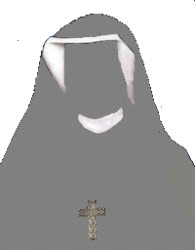
surname
ROCHOWICZ
forename(s)
Bronislava (pl. Bronisława)
religious forename(s)
Francesca (pl. Franciszka)
function
nun
creed
Latin (Roman Catholic) Church RCmore on
en.wikipedia.org
[access: 2014.09.21]
congregation
Congregation of the Sisters of Our Lady of Mercy ISMMmore on
en.wikipedia.org
[access: 2015.04.18]
(i.e. Our Lady of Mercy sisters)
date and place
of death
23.09.1944

Walendówtoday: Nadarzyn gm., Pruszków pov., Masovia voiv., Poland
more on
en.wikipedia.org
[access: 2022.01.28]
details of death
Entered the Congregation of the Sisters of Our Lady of Mercy ISMM at a time when the Russian–occupied territories (part of the partioned Poland) were still subject to a decree issued by Tsar Alexander II on 08.11.1864 — promulgated in the immediate aftermath of the January Uprising in Poland — which, among other measures, imposed a total ban on the admission of new candidates to religious orders. According to historical sources, „in order to circumvent administrative restrictions, the sisters shifted to semi‐clandestine operations, and the convent functioned under the guise of a "charitable and support home"”. In 1873, a new chapel was constructed: „To mislead the Russian administrative authorities, the small, single‐nave, rectangular structure (measuring 8×17 meters) was built with a flat roof; the main entrance was positioned facing an inner courtyard, while a small apse — oriented toward Żytnia Street — was concealed within the residential buildings”.
As a result of the genocidal German–Russian agreement of 23.08.1939, known as the Molotov–Ribbentrop Pact, confirmed on 28.09.1939 by the dict. „Treaty on the German–Russian Borders and Friendship”, also known as the second Molotov–Ribbentrop Pact, Germany and Russia invaded Poland in 09.1939, marking the beginning of World War II. Warsaw, the capital of Poland, from 28.09.1939 was under German occupation and was the seat of the Germ. Distrikt Warschau (Eng. District of Warsaw) of a German‐occupied and run quasi‐state called the Germ. Generalgouvernement (Eng. General Governorate), i.e. GG, with its capital in Kraków.
Following the German attack on 22.06.1941 on their erstwhile ally, the Russians, a conflict between Germany and Russia ensued. Within the GG the Germans began implementing the genocidal plan known as the Germ. «Endlösung der Judenfrage» ( Eng. „Final Solution to the Jewish Question”), which operated under the codename «Aktion Reinhardt» (Eng. „Operation Reinhardt”). The monastery on Żytnia Street was located right next to the wall of the Warsaw Ghetto — one of the ghetto's gate was nearby. According to sources: „For a time, one of the most cruel Germans, nicknamed "Frankenstein" by the ghetto residents, worked at this very gate.
He shot people, taking sadistic pleasure in it”. The nuns provided aid to persecuted Jews, especially between 1941 and 1944. A source states: „When the Germans closed off the ghetto, many Jewish men and women came to us, seeking advice and rescue from their tragic situation. Naturally, they were treated with the utmost discretion; any steps taken to provide them with a place to live or some form of work were known only to the single sister who took responsibility for these matters. No records were kept — no notes, names, or addresses”. That „single sister” was the author of these words, Sr Bernarda Julie Wilczek; however, „she was assisted by other fellow nuns who were "in the know" regarding these activities. The other sisters were not privy to the specific details of the aid provided to Jews, though they were aware that such matters were handled by Sister Bernarda, who coordinated with other convents of the Congregation — most often to hide Jewish girls within them”. She was one of them.
In 1944, due to a series of Russian victories, the battlefront began to approach Warsaw — on 13.07.1944, the Russian offensive began, later called the Lviv–Sandomierz Operation. At the end of 07.1944, the front was merely a few dozen kilometers from Warsaw.
At that time, the leadership of the Polish Clandestine State, i.e. PPP, the largest resistance movement in occupied Europe — as part of Operation Pl. „Burza” (Eng. „Tempest”), i.e. taking control of Polish towns and villages, also by armed action through partisan units subordinate to the PPP, e.g. the Home Army AK, after the Germans had abandoned them and before the Russians entered, which began on 04.01.1944, when Russian troops crossed the pre‐war eastern border of Poland — decided to start the uprising in Warsaw. On 31.07.1944, a combat order was issued: „Alarm, deliver to the District Commanders themselves [...] I order «W» on August 1, 5 p.m.”, signed by „Monter”, i.e. Colonel Anthony Chruściel, commander of the AK Warsaw‐City District, appointed, by virtue of his position, by the PPP and the AK as the commander of the uprising. On 01.08.1944, at the «W» hour, the Uprising broke out.
The Germans and Russians responded with a temporary, unwritten, but de facto truce and alliance between the two sides. The Russians slowed down the Lviv–Sandomierz operation, and on 29.08.1944, stopped it — on the Vistula River, while the Uprising was ongoing on the other side of the river. This was undoubtedly a decision of the highest levels of Russian power — despite earlier radio appeals from 29.07.1944, calling on the residents of the capital to start a spontaneous fight against the Germans, e.g. „People of Warsaw! To arms! Let the entire population form a wall around the State National Council, around the Warsaw Underground Army. Strike at the Germans!” — The Russians not only failed to provide aid to the Uprising, but until 18.09.1944, at the end of the Uprising, they did not allow Allied planes carrying aid and weapons to the insurgents to stop and refuel in Russian‐controlled areas east of the Vistula River. Therefore, the Uprising received only minor external air support, mainly from the airport in Brindisi, in southern Italy, provided, i.a. by Polish pilots who, to reach Warsaw, had to fly through all of German‐occupied Europe and then return the same route, constantly exposed to German anti‐aircraft defense.
The Germans took advantage of this tactical „truce” and slowly suppressed the Uprising, murdering between 150,000 and 200,000 civilians during the Uprising.
It is likely that as early as the night of 01‐02.08.1944, the German leader Adolf Hitler — the Chancellor of the Reich, known as Germ. Führer (Eng. Leader), head of the National Socialist German Workers' Party NSDAP — and Reichsführer‐SS Heinrich Himmler — the Germ. Reichsminister des Innern (Eng. Reich Minister of the Interior) — issued an order. This order is known from the account of SS‐Obergruppenführer Erich von dem Bach–Zelewski, who was responsible for the pacification of the Warsaw Uprising: „Every inhabitant is to be killed; no prisoners are to be taken. Warsaw is to be razed to the ground, thereby serving as a terrifying example for all of Europe”.
The first step was the dict.
Wola Massacre — a genocide perpetrated against the residents of Warsaw's Wola district, which reached its peak between 05‐07.08.1944 — when the Germans murdered up to 65,000 Polish men, women, and children in numerous executions, including patients and staff from three hospitals in the district. The Wola Massacre is „often considered the single largest massacre of civilians in Europe during World War II, as well as the single greatest atrocity ever committed against the Polish nation”.
The motherhouse of her ISMM Congregation was situated directly along the path of the German advance from Wola toward the center of Warsaw. On 02.08.1944, in the chapel of the Congregation’s motherhouse, Sergeant‐Cadet Janus Brochwicz–Lewiński, nom‐de‐guerre „Gryf”, together with c. 100 soldiers from the Pl. „Parasol” (Eng. „Umbrella”) Battalion — a special–operations unit of the AK's Directorate of Subversion, composed primarily of scouts from the clandestine Pl. „Szare Szeregi” (Eng. „Grey Ranks”) — attended Holy Mass to pray for a free Poland. Immediately afterward, they headed into battle to defend e.g. Michler's Palace — a site that became the subject of one of the most famous Warsaw Uprising songs, Pl. „Pałacyk Michla” (Eng. „Michl's Palace”). Following several assaults by German armored forces, the Michler's Palace fell on 05.08.1944, marking the beginning of the bloodiest phase of the Wola Massacre. By 09.08.1944 the Germans had reached Żytnia Street.
The Congregation’s motherhouse was set on fire by the Germans — specifically, members of the SS‐Sturmbrigade belonging to the criminal 36th Grenadier Division, commanded by SS‐Oberführer Oskar Dirlewanger and composed of Germans as well as many Russians, Belarusians, and Ukrainians — along with units brought in from the Germ. Reichsgau Wartheland (Eng. Reich District of Wartha Land) by SS‐Gruppenführer and Generalleutnant der Waffen‐SS Heinz Reinefarth.
51 nuns, together with c. 200 people under their care, were driven out of the house and forced to march in a column toward the Wola district (the same fate befell 44 nuns from the nearby provincial house of the Congregation of the Franciscan Sisters of the Family of Mary CSFFM, located at 97 Żelazna Street).
Their destination was the DL 121 Pruszków transit and screening camp.
There, as an elderly nun was released, pulled out, or cast out of the camp.
Made her way to the Congregation’s house in Walendów, located c. 10 km away. The Congregation's net site describes the situation as follows: „Upon learning that the Germans were forcibly displacing the population of Warsaw to the camp [DL 121 Pruszków], the sisters went there. For two months, they traveled back and forth, rescuing as many people as they could — getting them out of the camp and providing food, clothing, and undergarments. Among those they saved were 22 nuns from our own Congregation, many priests from the Old Town, […], and Bp Karol Niemira [, the auxilliary of the Pinsk diocese] […] Refugees, continuing to arrive from Warsaw, occupied every available living space, including attics and cellars. With a shortage of rooms, they took shelter in outbuildings, the cowshed, and the garden. The sisters gave them everything they possibly could. In their own bedrooms, they were packed so tightly that there was no space even to walk between the beds; at times, some had to make do with a bench in the refectory”.
A few weeks later, as a result of the trauma endured, passed away. The Congregation's records contain an entry: „Sister Francisca's ailing heart could not withstand the ordeals of that period. After spending a few weeks in Walendów, she departed for the Father's house”.
cause of death
extermination
perpetrators
Germans
sites and events
DL 121 PruszkówClick to display the description, Warsaw UprisingClick to display the description, Help to the JewsClick to display the description, Ribbentrop‐MolotovClick to display the description, Pius XI's encyclicalsClick to display the description
date and place
of birth
05.08.1864Birth certification on:
metryki.genealodzy.pl
[access: 2026.10.31]


Bieżuńtoday: Bieżuń gm., Żuromin pov., Masovia voiv., Poland
more on
en.wikipedia.org
[access: 2021.12.18]
parents
ROCHOWICZ Luke
🞲 ?, ? — 🕆 ?, ?

KRUKOWSKA Eve
🞲 ?, ? — 🕆 ?, ?
baptism
14.08.1864Birth certification on:
metryki.genealodzy.pl
[access: 2026.10.31]

Bieżuńtoday: Bieżuń gm., Żuromin pov., Masovia voiv., Poland
more on
en.wikipedia.org
[access: 2021.12.18]
Holy Trinity RC_church
religious vows
10.04.1908 (permanent)
positions held
till 1944
nun — Warsawtoday: Warsaw city pov., Masovia voiv., Poland
more on
en.wikipedia.org
[access: 2021.10.09] ⋄ General House (at 3/5 Żytnia Str.), Our Lady of Mercy sisters ISMM — due to Graves' disease, served in roles that did not require great physical exertion — such as housekeeper, porter, or sacristan; after breaking her arm, served as a sacristan in a small private oratory; likely spent her entire life at the Congregation’s house in Warsaw
09.09.1898
accession — Warsawtoday: Warsaw city pov., Masovia voiv., Poland
more on
en.wikipedia.org
[access: 2021.10.09] ⋄ Our Lady of Mercy sisters ISMM — novitiate under the guidance of Mother Xaviera Ożarowska, prob. in Warsaw
others related
in death
KACHLIKClick to display biography Stanislava (Sr Olga), KAMLIKClick to display biography Janet (Sr Olga), MESYJASZClick to display biography Michelle (Sr Hyacintha)
sites and events
descriptions
DL 121 Pruszków: Germ. Durchgangslager 121 Pruszków (Eng. Transit Camp) — transit camp where Germans herded Warsaw (and its vicinity) civilian population captured during and after Warsaw Uprising. Set up on 06.01.1944 functioned till 12.1944. C. 390,000‐410,000 people were held captive. Most of them were sent subsequently to concentration camps and forced slave labour in Germany. Few hundred ‐ few thousands of them perished in the camp. (more on: pl.wikipedia.orgClick to attempt to display webpage
[access: 2015.03.01])
Warsaw Uprising: Lasted from 01.08.1944 till 03.10.1944. Was an attempt to liberate Polish capital from occupying Germans by the Polish Clandestine State — a unique in the history of the world political structure on the territories occupied by the Germans, effectively governing clandestinely in Poland — and by fighting on its behalf underground military units, mainly of Home Army (former Armed Struggle Association ZWZ) and National Armed Forced (NSZ). At the same time Russians stopped on purpose the offensive on all front, halted on the other bank of Vistula river and watched calmly the annihilation of the city, refusing even the mid‐landing rights to the Allied planes carrying weapons and supplies to the insurgents from Italy. During the Uprising Germans murdered approx. 200,000 Poles, mainly civilians. Approx. 200 priests and nuns died in fighting or were murdered by the Germans, many in mass executions. (more on: en.wikipedia.orgClick to attempt to display webpage
[access: 2013.08.17])
Help to the Jews: During World War II on the Polish occupied territories Germans forbid to give any support to the Jews under penalty of death. E.g., on 15.10.1941, the Germ. Generalgouverneur (Eng. General Governor) of the Germ. Generalgouvernement (Eng. General Governorate), i.e. GG, Hans Frank, issued the „3rd Ordinance on Restrictions on Residence in the General Governorate”, in which § 1 stated that: „1) Jews who leave their designated district without authorization are subject to the death penalty. The same penalty applies to persons who knowingly provide such Jews with a hiding place”; and „2) Instigators and accomplices are subject to the same punishment as the perpetrator; an attempted act will be punished as a completed act. In less serious cases, severe imprisonment or prison may be imposed”. This ordinance was further elaborated by the district leaders of GG. E.g., on 10.11.1941, the Germ. Gouverneur (Eng. Governor) of the Germ. Distrikt Warschau (Eng. Warsaw District) in GG, Ludwig Fischer, issued a proclamation stating that: „A Jew who in the future unauthorizedly leaves the residential district assigned to him will be punished with death”. And added: „The same punishment applies to anyone who knowingly provides shelter to such Jews or helps them in any other way (e.g., by providing accommodation, board, by taking them on vehicles of any kind, etc.)”. In practice, this meant that responsibility for hiding Jews rested not only with the owners of the premises, but also with all the people being there, generally the family of the person hiding them. When at the turn of 1941/1942 the Germans began to implement the genocidal plan Germ. Endlösung der Judenfrage (Eng. Final Solution of the Jewish Question), when the deportation of Jews from the Warsaw ghetto to the Germ. Vernichtungslager (Eng. extermination camp) VL Treblinka was underway, the Polish writer Sophie Kossak–Szczucka on 11.08.1942 issued an appeal „Protest!”, published in the underground press in a circulation of 5,000 copies. She wrote: „The world looks at this crime, more terrible than anything history has ever seen, and — it remains silent […] This silence cannot be tolerated any longer. Whatever its motives — it is despicable. We cannot remain passive in the face of crime. Whoever remains silent in the face of murder becomes an accomplice to the murderer. Whoever does not condemn, consents. Therefore, we, Catholics — Poles, are speaking out. Our feelings towards Jews have not changed. We do not cease to consider them political, economic, and ideological enemies of Poland. Moreover, we realize that they hate us more than they hate Germans […] Awareness of these feelings, however, does not release us from the obligation to condemn the crime […] Whoever does not understand this, whoever would dare to link Poland's proud, free future with the despicable joy of their neighbor's misfortune — is therefore neither a Catholic nor a Pole!” The „Protest” was signed by the „Front for the Rebirth of Poland”, i.e. FOP, a clandestine Catholic organization that was a continuation of Catholic Action during the German occupation. On 27.09.1942, the Polish Clandestine State, the largest resistance organization in German–occupied Europe, at the initiative of Sophie Kossak–Szczucka and Wanda Krahelska–Filipowicz, a member of the Polish Socialist Party, established the Provisional Committee to Aid Jews. On 04.12.1942, the Council to Aid Jews at the Polish Government Delegature in occupied Poland, codenamed „Conrad Żegota”, was established in its place. Hundreds of Polish priests and religious extended help to the Jews, under threat of life. Many of them were caught and murdered.
Ribbentrop‐Molotov: Genocidal Russian‐German alliance pact between Russian leader Joseph Stalin and German leader Adolf Hitler signed on 23.08.1939 in Moscow by respective foreign ministers, Mr. Vyacheslav Molotov for Russia and Joachim von Ribbentrop for Germany. The pact sanctioned and was the direct cause of joint Russian and German invasion of Poland and the outbreak of the World War II in 09.1939. In a political sense, the pact was an attempt to restore the status quo ante before 1914, with one exception, namely the „commercial” exchange of the so‐called „Kingdom of Poland”, which in 1914 was part of the Russian Empire, fore Eastern Galicia (today's western Ukraine), in 1914 belonging to the Austro‐Hungarian Empire. Galicia, including Lviv, was to be taken over by the Russians, the „Kingdom of Poland” — under the name of the General Governorate — Germany. The resultant „war was one of the greatest calamities and dramas of humanity in history, for two atheistic and anti‐Christian ideologies — national and international socialism — rejected God and His fifth Decalogue commandment: Thou shall not kill!” (Abp Stanislav Gądecki, 01.09.2019). The decisions taken — backed up by the betrayal of the formal allies of Poland, France and Germany, which on 12.09.1939, at a joint conference in Abbeville, decided not to provide aid to attacked Poland and not to take military action against Germany (a clear breach of treaty obligations with Poland) — were on 28.09.1939 slightly altered and made more precise when a treaty on „German‐Russian boundaries and friendship” was agreed by the same murderous signatories. One of its findings was establishment of spheres of influence in Central and Eastern Europe and in consequence IV partition of Poland. In one of its secret annexes agreed, that: „the Signatories will not tolerate on its respective territories any Polish propaganda that affects the territory of the other Side. On their respective territories they will suppress all such propaganda and inform each other of the measures taken to accomplish it”. The agreements resulted in a series of meeting between two genocidal organization representing both sides — German Gestapo and Russian NKVD when coordination of efforts to exterminate Polish intelligentsia and Polish leading classes (in Germany called «Intelligenzaktion», in Russia took the form of Katyń massacres) where discussed. Resulted in deaths of hundreds of thousands of Polish intelligentsia, including thousands of priests presented here, and tens of millions of ordinary people,. The results of this Russian‐German pact lasted till 1989 and are still in evidence even today. (more on: en.wikipedia.orgClick to attempt to display webpage
[access: 2015.09.30])
Pius XI's encyclicals: Facing the creation of two totalitarian systems in Europe, which seemed to compete with each other, though there were more similarities than contradictions between them, Pope Pius XI issued in 03.1937 (within 5 days) two encyclicals. In the „Mit brennender Sorge” (Eng. „With Burning Concern”) published on 14.03.1938, condemned the national socialism prevailing in Germany. The Pope wrote: „Whoever, following the old Germanic‐pre‐Christian beliefs, puts various impersonal fate in the place of a personal God, denies the wisdom of God and Providence […], whoever exalts earthly values: race or nation, or state, or state system, representatives of state power or other fundamental values of human society, […] and makes them the highest standard of all values, including religious ones, and idolizes them, this one […] is far from true faith in God and from a worldview corresponding to such faith”. On 19.03.1937, published „Divini Redemptoris” (Eng. „Divine Redeemer”), in which criticized Russian communism, dialectical materialism and the class struggle theory. The Pope wrote: „Communism deprives man of freedom, and therefore the spiritual basis of all life norms. It deprives the human person of all his dignity and any moral support with which he could resist the onslaught of blind passions […] This is the new gospel that Bolshevik and godless communism preaches as a message of salvation and redemption of humanity”… Pius XI demanded that the established human law be subjected to the natural law of God , recommended the implementation of the ideal of a Christian state and society, and called on Catholics to resist. Two years later, National Socialist Germany and Communist Russia came together and started World War II. (more on: www.vatican.vaClick to attempt to display webpage
[access: 2023.05.28], www.vatican.vaClick to attempt to display webpage
[access: 2023.05.28])
sources
personal:
www.1944.plClick to attempt to display webpage
[access: 2019.04.16], metryki.genealodzy.plClick to attempt to display webpage
[access: 2026.10.31]
bibliographical:
„Martyrology of the Polish Roman Catholic clergy under nazi occupation in 1939‐1945”, Victor Jacewicz, John Woś, vol. I‐V, Warsaw Theological Academy, 1977‐1981
Sr Stella Boruch, Secretary General
Congregation of the Sisters of Our Lady of Mercy, Warsaw, 3/9 Żytnia Street, private correspondence, 28.10.2026
LETTER to CUSTODIAN/ADMINISTRATOR
If you have an Email client on your communicator/computer — such as Mozilla Thunderbird, Windows Mail or Microsoft Outlook, described at WikipediaPatrz:
en.wikipedia.org, among others — try the link below, please:
LETTER to CUSTODIAN/ADMINISTRATORClick and try to call your own Email client
If however you do not run such a client or the above link is not active please send an email to the Custodian/Administrator using your account — in your customary email/correspondence engine — at the following address:

giving the following as the subject:
MARTYROLOGY: ROCHOWICZ Bronislava
To return to the biography press below: