Roman Catholic
St Sigismund parish
05-507 Słomczyn
85 Wiślana Str.
Konstancin deanery
Warsaw archdiocese, Poland





full list:
displayClick to display full list

searchClick to search full list by categories
wyświetlKliknij by wyświetlić pełną listę po polsku

szukajKliknij by przeszukać listę wg kategorii po polsku

Martyrology of the clergy — Poland
XX century (1914 – 1989)
personal data

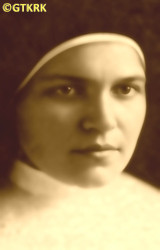


religious status
blessed
surname
CHROBOT
forename(s)
Josefa (pl. Józefa)
religious forename(s)
Mary Canute of Jesus in Gethsemane (pl. Maria Kanuta od Pana Jezusa w Ogrójcu)


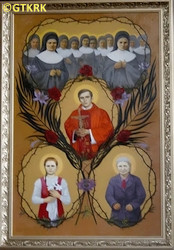

function
nun
creed
Latin (Roman Catholic) Church RCmore on
en.wikipedia.org
[access: 2014.09.21]
congregation
Congregation of the Sisters of the Holy Family of Nazareth CSFNmore on
en.wikipedia.org
[access: 2013.05.19]
(i.e. Sisters of the Holy Family of Nazareth)
diocese / province
Warsaw Province of Holiest Name of Jesus CSFN
date and place
of death
01.08.1943

Batorówkaforester's lodge
today: non‐existent, Koshelevo ssov., Navahrudak dist., Grodno reg., Belarus
more on
www.radzima.net
[access: 2020.07.31]
details of death
From 1931 served at the Sisters of the Holy Family of Nazareth Congregation's house in Navahrudak, the capital of the Polish Nowogródek Voivodeship and also the county capital. Estimating the population of this town seems difficult. Data from the 1931 census is available, indicating that Navahrudak had a population of c. 13,252, of which 4,026 were Roman Catholics — mostly Poles, 2,383 were Orthodox — mostly Belarusians, and 6,309 were Jews. In the preceding decade, the town's population had doubled — this prob. was the result of with establishing the capital of the voivodeship and related offices in Navahrudak. It is not known how the population changed in the years 1931‐1939. However, assuming that it did not grow so rapidly, and rather in accordance with the estimated rate of population growth of the entire Nowogródek voivodeship, c. 15,500 people could have lived in Navahrudak in 1939, of which Roman Catholics constituted c. 32%, Orthodox Christians c. 18%, and Jews c. 45%.
After the German and Russian invasion of Poland in 09.1939 and the start of World War II, after start of the Russian occupation, persecuted, along with her fellow nuns, by the Russians. The nuns were forbidden to conduct school activities and forced to leave their religious house. In the spring of 1940, they were expelled from the farm buildings of the Congregation's house, where they had initially taken refuge (they were also allowed use of the part of the garden at that time), and forced to take up gainful employment in Navahrudak and remove their habits. They dispersed and lived in the homes of private families. Worked as cleaners and maids. But they met — „maintained a bond through the church, […] twice a day: at Holy Mass and at the evening rosary, […] celebrated daily with the Blessed Sacrament exposed”.
It is not known where lived at the time — Fr Alexander Zienkiewicz, chaplain to the Congregation of the Sisters of Nazareth and rector of the fara church, i.e. former parish church, did not record this in his memoirs.
Over time, the number of Poles in Navahrudak decreased. This was the beginning of a series of great „ethnic experiments” — i.e. solving social and national problems through mass deportations — of which the Russians proved to be masters, drawing on centuries of experience in this field. The Russians subjected Poles in particular to repression, arresting Polish intelligentsia, teachers, doctors, landowners, government officials, foresters, policemen, and even the families of Polish military personnel. Many other Poles became victims of four large waves of deportations. In Belarus, e.g. in Navahrudak, two deportations were particularly tragic: the first, around 10‐11.02.1940, „to Siberia”.
and the last, fourth, around 04‐05.1941, mainly to Kazakhstan. Accounts of the first often mention that „they came at night, without warning, and took away entire families, from infants to the elderly”. Within a few minutes, people lost their entire lives: „10.02.1940, was the day I parted with what I loved. With an NKVD revolver at his head, my father signed a document stating that we would be resettled to another place out of good and free will. I will not describe what happened during the twenty minutes we had to gather. It was Saturday and my mother had only put bread in the oven… so we didn't have that for the trip either. NKVD‐man snatched the ham from my father, saying that they had plenty of everything there, but not to forget to take a saw and an axe”. „We practically didn't take anything with us, because they didn't let us move around the house […] There were big snowdrifts and heavy frost”. In the first large deportation alone, c. 140,000 Poles were sent „to Siberia”.
including c. 50,000 from the area that the Russians called Western Belarus, where i.a. Navahrudak was located. Furthermore, 150,000‐200,000 men were conscripted into the Russian army, and c. 100,000 were forced to work for Russian industry, mainly in the mines of the Donets Basin and in heavy industry plants in the Urals and Siberia.
Despite persecution, the nuns of the Congregation sent parcels to Poles deported by the Russians.
During the German attack on 22.06.1941, on their erstwhile ally, the Russians — the German occupation started on 04/06.07.1941 — the town was partially destroyed. On 28.06.1941, the Germans carried out a three‐hour air raid on the defenseless town — though the Russian troops were no longer there. According to sources, „Navahrudak […] was one erupting volcano of fire and smoke. Fortunately, there were few casualties among the population. The inhabitants largely managed to disperse into the surrounding fields and settlements”. The Sisters of the Holy Family of Nazareth's Congregation house was not destroyed, so the nuns were able to return. The Germans also allowed them to don their habits and resume their activities with children and youth. However, „no Polish school was allowed to open”.
Navahrudak became the seat of the Germ. Kreisgebiete (Eng. county) Nowogrodek, within the Germ. Generalbezirk Weißruthenien (Eng. General District of Belarus), part of the German‐occupied and run quasi‐state called the Germ. Reichskommissariat Ostland (Eng. Reich Commissariat East). And the persecution of Poles and Jews began immediately, which was in harmony with the opinions of millions of Germans, e.g. Claus Schenk Graf von Stauffenberg, the future failed assassin of the leader of the German ruling National Socialist German Workers' Party, i.e. NSDAP, Adolf Hitler: „The local population is an incredible rabble, with a great many Jews and mixed–race people. A nation that clearly needs a whip to feel good. Thousands of prisoners will certainly contribute to the development of our agriculture. Germans can benefit from this, because they are diligent, hard‐working, and undemanding”.
Already on 26.07.1941, the Germans gathered — with the help of the Germ. Judenrat (Eng. Jewish Council), which had been established a little earlier — a group of men in the town square. They lined them up, selected c. 50 and murdered them on the spot. The aforementioned Fr Alexander Zienkiewicz wrote: „Scarred corpses lie on the cobblestones in front of the market hall, and a [military] brass band concert is taking place a few dozen steps from the crime scene. The group of musicians, dressed in their best, with fresh and cheerful faces, is looked upon only by the rows of gloomy eye sockets of burnt–out tenement houses. Among the ashes, the stench, and the smoke, the light waves of Strauss's waltzes flow and echo against the stumps of the blackened walls, creating a macabre, hellish atmosphere”.
Immediately afterwards, the Germans began terrorizing the Polish community. Fr Zienkiewicz noted: „In August, the field gendarmerie executes Poles and Belarusians suspected of sympathizing with communism. I intervened at the commandant's office regarding a few people. Heard a reply: Germ. 'Zu spat' (Eng. 'Too late') […] [After the troops have passed], a civil administration is being organized. One of its first acts is the shooting [in 08.1941] of engineer Vincent Smolski ([a Pole, elected] mayor) and several other prominent Poles for 'sabotaging' the orders of the German authorities — as the official announcement stated. A Belarusian becomes mayor”….
The persecution of Jews intensified. At the end of 08.1941, another 50 Jews were murdered, including members of the first Germ. Judenrat. On 28.09.1941, Jews were forbidden to leave the city. At the end of 1941 the Germans began implementing the genocidal state plan Germ. «Endlösung der Judenfrage» (Eng. „Final Solution of the Jewish Question”). On 08.12.1941, a detachment of c. 260 German infantrymen surrounded the city. A selection was made among the Jews in the square in front of the courthouse. C. 1,300 were herded to the northern suburb of Peresyeka, where the area around the market square — c. 28 houses — had been surrounded by a wooden fence the day before. The remaining, over 5,000 Jews, were loaded onto trucks and taken c. 3 km southwest, to the vicinity of the village of Skrydlevo. There, behind the military barracks, the Germans and prob. members of the collaborationist Germ. Weißruthenische Hilfspolizei (Eng. Belarusian Auxiliary Police) and Germ. Litauische Schutzmannschaftsbataillone (Eng. Lithuanian Schutzmannschaft Battalions) shot them all over previously dug ditches. And at the end of winter, in the beginning of spring 1942, the gathering of the remaining Jews from all over the Germ. Kreisgebiete began in Navahrudak. By 05.1942, c. 6,500 Jews were gathered in the ghetto in Peresyeka.
At the same time, in the Naliboki Forest, c. 40‐50 km to the northeast, Russian soldiers who had avoided internment by the Germans in 1941 began to gather. A large partisan center was established, c. 3,000 strong. The first significant skirmish with the Germans took place on 09.06.1942, near the town of Naliboki, when the 125th „Stalin” unit destroyed the „German SS formation, Lithuanian and the German police”. At the same time, Russian partisan units began to attack neighboring villages in search of provisions, treating the villagers „as enemies”. The Polish resistance Home Army AK (part of the Polish Clandestine State) began to defend them, although it did not attack the Germans frontally at that time — in accordance with the ban on such actions issued by the Polish government („Resolution of the Committee for National Affairs of 27.04.1940”), that excluded from the ban only „repressions against spies and provocateurs”.
The German reaction was to intensify the persecution of the Polish community. „All forms and manifestations of the cultural life of Poles were destroyed. No Polish school was allowed to open” — in accordance with the guidelines articulated as early as 28.09.1939, by two officials of the German Central Germ. Rassenpolitisches Amt der NSDAP (Eng. National Office of Racial Policy), Erhard Wetzel and Günther Hecht — both with doctoral degrees, of course: the former in law, the latter in herpetology, i.e. the branch of zoology that studies amphibians and reptiles — based on the guidelines articulated two days earlier by the German socialist leader, Adolf Hitler. In the memorandum Germ. „Die Frage der Behandlung der Bevölkerung der ehemaligen polnischen Gebiete nach rassepolitischen Gesichtspunkten” (Eng. „The Treatment of the Population of the Former Polish Territories from the Point of View of Racial Policy”) these outstanding representatives of the „master race” wrote, i.a. that in the occupied Polish territories: „Universities and other higher education institutions, vocational schools and secondary schools have always been centers of Polish chauvinistic upbringing and therefore should be closed altogether. Only elementary schools should be allowed, which should teach only the most primitive things: arithmetic, reading and writing. Education in nationally important subjects, such as geography, history, the history of literature, and gymnastics, must be banned”. The response of the Polish Clandestine State — the largest resistance movement in occupied Europe — was to create a network of secret education. Among others one of the co‐nuns, Sr Canisia Eugenie Mackiewicz, participated in it. The aforementioned Fr Zienkiewicz recalled: „Sister Canisia, a very talented teacher, organized, at the request of parents, secret teaching of Polish children their native language and history”. And added: „The groups gathered in private homes. Although caution was exercised and the number of children probably did not exceed fifty, the Belarusians found out about it and reported it […] to the Germ. Geheime Staatspolizei (Eng. Secret State Police), i.e. the Gestapo”.
On 29.06.1942, as part of a broader plan to exterminate Poles, codenamed «Polenaktion», the Germans arrested the Navahrudak parish priest and dean, Fr Michael Dalecki, the Vselyub parish priest, Fr Joseph Kuczyński, and Fr Stephen Sieczka from Byarozavkas. After a month in prison in Navahrudak — they were accused i.a. of hiding Jewish children — the first two were shot by the Germans on 31.07.1942, along with c. 60 other Poles, in a forest near the barracks, not far from the place where Jews were murdered on 08.12.1941.
A week later, on 07.08.1942, the Germans, together with Belarusian collaborators from Germ. Weißruthenische Hilfspolizei, as well as the Estonian Germ. Schutzmannschaft–Front–Bataillon 36 „Arensburg” (Eng. 36th Police Front Battalion „Arensburg”), i.e. Estonian collaborators, who had arrived in Navahrudak a few days earlier, carried out the second Germ. Aktion (Eng. operation) against the Jews. In a forest c. 5 km to the north, near the village of Litovka, on the road to Vselyub, they murdered c. 5,500 Jews from the Navahrudak ghetto, in previously prepared pits. The third Germ. Aktion took place on 04.02.1943, when i.a. a group of children were murdered by the Germans and Lithuanian collaborators in Litovka. Another 250 were murdered on 07.05.1943, in Navahrudak itself. The rest were liquidated individually, and only some managed to escape and hide — with the help of Polish and Belarusian villagers — in the forests.
Even before the murder of the last Jews in Navahrudak, the Sisters of the Holy Family of Nazareth were thrown out of the Congregation's house. The premises were taken over by a certain Boris Ragula, a former soldier of the Polish army, later a Soviet prisoner, and from 1941 a German collaborator. At the beginning of 1943, he began working in the German city administration and began preparations for the formation of an armed Belarusian unit to fight alongside the Germans — later, in 1944, formed as the Germ. Schuma–Reiter–Abteilung Rogula (Eng. Police Mounted Unit Rogula), and transformed into the Germ. Schutzmannschaft–Reiter–Bataillon 68 (Eng. Police Mounted Battalion 68). The Belarusians took over the building of the former school run by the nuns and threw them out of their house. The Sisters of the Holy Family of Nazareth moved to a nearby ruin, vacant after the murdered Jews, and from there they went every day to the „farm buildings with a cottage (laundry)” that had been left to them, „until the evening rosary, which was still solemnly said every day in the parish church, after which they returned home”.
Meanwhile, in the winter of 1942/1943 and in the spring and summer of 1943, the decisive battles of World War II took place in the east. On 18‐22.01.1943, the Russians managed to secure a strip c. 12 km wide that enabled the supply of food and weapons to besieged Sankt Petersburg (then Leningrad). On 02.02.1943, the Battle of Stalingrad ended in total German defeat. On 21.02‐18.03.1943, the Germans managed to capture Kharkov, but in the next step, they were unable to dislodge the Russians — in arguably the largest tank battle in history — from the dict. Kursk Salient. The Germans lost their strategic advantage on the front and the offensive passed into Russian hands.
At the same time, partisan units were consolidating in the Naliboki Forest. Besides the aforementioned Soviet/Russian units, Jewish units were formed, composed of escapees from ghettos and the from the Germ. «Endlösung der Judenfrage», under the command of the notorious Bielski brothers. Both groups cooperated, often requisitioning — many times of a robbery and banditry nature: these „economic operations” were accompanied by beatings, murders, and rapes of women — of food and other materials in the Polish villages surrounding the Naliboki Forest. I.a. on 08.05.1943, Russian partisans and a group of Jewish Bielski brothers attacked the town of Naliboki, murdering c. 128 Polish inhabitants suspected of collaborating with Polish partisans. For the Polish resistance Home Army AK became active, i.e. soldiers of Subdistrict V of AK „Stowbtsy” of the Inspectorate AK „Baranavichy”, which was part of the District AK „Navahrudak”.
The Germans reacted by creating in 11.1942 an ad hoc special unit, named after its commander SS‐Brigadeführer Curt von Gottberg, Germ. Kampfgruppe von Gottberg (Eng. Gottberg Battle Group), which was entrusted with the task of catching Jewish escapees and fighting against partisan groups. In an operational order of 07.12.1942, von Gottberg ordered: „The task […] is to attack and destroy bandits. Every bandit, Jew, Gypsy and suspected gang member is to be treated as enemy”. According to sources, „in reality, Kampfgruppe von Gottberg almost completely depopulated entire regions of Belarus”.
On 19.06.1943, an AK unit from Subdistrict V AK „Stowbtsy” attacked Ivyanets, which in 1939 could have had c. 5,000 inhabitants, prob. 80% Poles, and c. 1,000 Jews, who were no longer alive in 1943. The AK captured the town, destroying the local German garrison. Arrested activists of the Polish Clandestine State were released from prison, 40‐150 Germans and collaborators were liquidated, a lot of weapons were captured, etc. C. 100‐200 officers of the collaborating Germ. Weißruthenische Hilfspolizei „voluntarily joined the Polish unit”.
In retaliation, the Germans murdered c. 150 inhabitants of Ivyanets, and on 13.07.1943, they began the Germ. «Unternehmen Hermann» (Eng. „Operation Hermann”). The Germ. 1. SS‐Infanteriebrigade (Eng. 1st SS Infantry Brigade) and the Germ. Kampfgruppe von Gottberg, supported by the collaborative Belarusian units Germ. Schutzmannschaft (Eng. protection groups), i.e. Schuma; Latvian, i.e. several Germ. Lettische Polizei Front Bataillon (Eng. Latvian Police Battalions); and Lithuanian and Ukrainian Schuma units; totaling c. 9,000–60,000 men, attacked the Naliboki Forest. To deprive the partisans of their support base, the Germans created a strip of „scorched earth” within a 10‐15 km radius around the forest.
It partially covered Navahrudak. On 17‐18.07.1943, the Germans arrested c. 120 people there, mainly Poles, as hostages.
At that time, 11 Sisters of the Holy Family of Nazareth offered their lives in exchange for the lives of the hostages who had families and children, and the only priest — the already mentioned Fr Alexander Zienkiewicz. Fr Ziemkiewicz, then already — after the murder of Fr Michael Dalecki — the parish priest of Navahrudak, dean and vicar of the northern part of the Pinsk diocese, recalled: „Somewhere in the afternoon of that dramatic day [of the arrests], during a meeting with me, M. Stella [i.e. Sr Adele Mardosewicz, superior of the Sisters of Nazareth in Navahrudak] says with her characteristic simplicity: «My God, if a sacrifice of life is necessary, let them shoot us rather than those who have families — we even pray for that»”.
And the Germans commuted the death penalty for most of the hostages to forced labor in Germany. On 25.07.1943, deported them — only a few were released. They all survived World War II.
Fr Zienkiewicz then realized that his name had been included on a list of Poles considered by Belarusian collaborators to be sympathetic to the partisans, which had been passed on to the Gestapo, and began to partially hide — i.a. spent his nights away from home. Years later, he noted:
„A few days after the transport of prisoners left […], M. Stella approached me and again, with a simplicity worthy of the great times, told me without any preamble or chosen words (words were too weak a means of expressing thoughts and experiences at that time): «My God, my God, Father Chaplain is much more needed in this world than we are, so we pray now that God would take us rather than you, if further sacrifice is needed»”.
On 31.07.1943, the nuns were summoned to the police station in Navahrudak, in the building of the former Polish Voivodeship Office.
Fr Zienkiewicz wrote: „At 6:00 the rosary began, after which the Sisters went to their little house, and confession was held in the church.
I confessed a few people and went out in front of the church. Uphill along 3rd of May Street, with quite a lively gait, the figures of the Sisters, draped in black habits and veils, were walking in pairs….
They had just passed the Mazurkiewicz family's house and, probably carrying crosses of premonitions, were climbing the steep hillside towards the market square….
Whoever among the town's inhabitants saw them in this procession, saw them on earth among the living for the last time”….
When they arrived at the police station at 7:30 PM, they were immediately taken away to be shot, but due to problems finding a suitable location, they were brought back and placed in a jail cell. Fr Zienkiewicz wrote: „The Sisters spent a short summer night in the basement of the building. What they experienced there — God only knows… A Tatar from Navahrudak, a stoker of the central heating system, told in great secrecy that he saw shapes of crucified figures on the basement floor. So the Victims were preparing for the gates of eternity — lying prostrate. They carried with them into the afterlife the secret of their inner experiences, of this terrible yet sublime «Mount of Olives»”.
At dawn the next day, they were taken away again and murdered c. 5 km southwest of the city, near the Batorivka forester's lodge, near the aforementioned village of Skrydlev, where c. 5,000 Jews had been murdered in the forest a year and a half earlier.
They were wearing their habits and were not restrained.
Fr Zienkiewicz recalled:
„The terrible truth slowly begins to creep out of hiding, killing words on the lips… Finally, after a few days, it becomes known to all Poles […] [Fellow nun, Sister Margaret Louise Banaś, who at the time of the nuns' arrest was working as a nurse in the local hospital] managed to discreetly leave the town with a few women to look for the grave and indeed found a fresh, poorly covered grave […] in a forest a few hundred steps from the road. Kneeling down by the grave, she began to dig up a thin layer of sand with her hand and after a few minutes she came across the leg of a corpse… Unable to verify otherwise whether it was really the body of one of the Sisters, she tore the garter from that leg….
And now the whole terrible truth was revealed… She saw Sister Sergia's number on that garter.
[…] From the position of the bodies during exhumation, it can be concluded that some of the Sisters fell into the grave seriously injured rather than killed. The position of the bodies was observed to be unnatural for the murdered and they were very contorted. Some of them were in a semi‐sitting position. The skulls of the heads were not blown apart, which allows us to conclude that they were murdered with a shot from a small‐caliber revolver. Experts, however, did not rule out the use of automatic weapons from a distance.
[…] A German from Latvia, after arriving in Navahrudak for the 'cleansing', ordered breakfast prepared for him in a Polish home. Enchanted by the perfection of the preparation, returned several times […] He also appeared on that terrible Sunday, probably shortly after the execution, at the same house and asked for breakfast. Was very drunk and unable to hide his nervousness. During breakfast, his excitement increased. At one point, he grabbed his head and said, «Oh, how they walked! You should have seen how they walked».
[…] From fragmentary statements, and mainly from the behavior of one of the executioners, one can conclude what a powerful, supernatural glow of glory surrounded the nuns sliding into the open pit — this fragile sex — 'sexus fragilis', when from the depths of their souls they said to God the sacrificial — «yes, Father»….
After passing through this Navahrudak Calvary of fear and suffering, after making a pure sacrifice for people dear and close to them — so we trusted in God — the victorious Bridegroom and Savior led their souls «this very day» to the «Father's dwelling», where they found the end of suffering and eternal light. And the bodies rested in the shade of birches and pines under a yellow layer of sand….
The twelfth victim was a boy who had been detained in the town a few weeks earlier — a resident of a village neighboring the execution site. He may well have been the principal laborer in digging the pit, and was shot to eliminate an outside witness to the crime”.
Why did the Germans accept the nuns' sacrifice? It is unknown. Let us give the floor to Fr Zienkiewicz one last time: „The Gestapo men committed the murder on their own initiative — that is, within the shroud of their official secrets”.
In total, during the Germ. «Unternehmen Hermann» „German troops completely or partially burned down 150 villages. From 4,199 to 4,280 people were killed, mostly Polish and Belarusian civilians. Nearly 21,000 people were sent to forced labor in the Third Reich, and thousands of others were relocated outside the blockade zone, at the same time having their property stolen”. The criminal profession was perfected at that time by i.a. the Germ. Chef der Bandenbekämpfung (Eng. head of groups combating forest gangs), SS‐Obergruppenführer Erich von dem Bach‐Zelewski; and the SS‐Sonderregiment Dirlewanger, commanded by the serial rapist and pedophile, SS‐Oberführer Oskar Dirlewanger. They later used the acquired „experience” to suppress the Warsaw Uprising in 08‐10.1944, murdering over 200,000 Poles.
Lat. „O bone Deus! In quae tempora me reservasti, ut ista patiar!” (Eng. „O good God! For what times have you reserved me, that I may suffer these things?”).
cause of death
mass murder
perpetrators
Germans
sites and events
«Unternehmen Hermann»Click to display the description, Collective responsibility („Hostages”)Click to display the description, «Polenaktion» 1942Click to display the description, Ribbentrop‐MolotovClick to display the description, Pius XI's encyclicalsClick to display the description
date and place
of birth
22.05.1896Birth certification on:
metryki.genealodzy.pl
[access: 2025.03.01]


Raczyntoday: Czarnożyły gm., Wieluń pov., Łódź voiv., Poland
more on
en.wikipedia.org
[access: 2021.12.18]
parents
CHROBOT Bartholomew
🞲 1856, ? — 🕆 1911, ?

FIGA Julianna
🞲 1864, Mechnicetoday: Kępno gm., Kępno pov., Greater Poland voiv., Poland
more on
en.wikipedia.org
[access: 2026.10.31] — 🕆 09.06.1948, Turzectoday: Stoczek Łukowski urban gm., Łuków pov., Lublin voiv., Poland
more on
en.wikipedia.org
[access: 2026.10.31]
baptism
23.05.1896Birth certification on:
metryki.genealodzy.pl
[access: 2025.03.01]

Raczyntoday: Czarnożyły gm., Wieluń pov., Łódź voiv., Poland
more on
en.wikipedia.org
[access: 2021.12.18]
St Nicholas the Bishop and Confessor and St Tekla the Martyr RC_church
religious vows
16.07.1925 (temporary)
22.07.1931 (permanent)
positions held
1931 – 1943
nun — Navahrudaktoday: Navahrudak dist., Grodno reg., Belarus
more on
en.wikipedia.org
[access: 2021.07.04] ⋄ Christ the King Congregation's house, Sisters of the Holy Family of Nazareth CSFN — cook in a school run by the Congregation and a religious house, served in the „White Parish Church” and the house of the community of Christ the King
nun — Lvivtoday: Lviv urban hrom., Lviv rai., Lviv obl., Ukraine
more on
en.wikipedia.org
[access: 2022.01.16] ⋄ Congregation's house, Sisters of the Holy Family of Nazareth CSFN — cook, porter and help in schools run by the Congregation
nun — Stryitoday: Stryi urban hrom., Stryi rai., Lviv obl., Ukraine
more on
en.wikipedia.org
[access: 2020.12.03] ⋄ Congregation's house, Sisters of the Holy Family of Nazareth CSFN — cook, porter and help in schools run by the Congregation
07.1923 – 16.07.1925
novitiate — Grodnotoday: Grodno dist., Grodno reg., Belarus
more on
en.wikipedia.org
[access: 2023.01.18] ⋄ Congregation's house, Sisters of the Holy Family of Nazareth CSFN
1922 – 1923
postulate — Częstochowatoday: Częstochowa city pov., Silesia voiv., Poland
more on
en.wikipedia.org
[access: 2021.12.18] ⋄ Congregation's house, Sisters of the Holy Family of Nazareth CSFN
21.04.1922
accession — Sisters of the Holy Family of Nazareth CSFN
others related
in death
BOROWIKClick to display biography Pauline (Sr Mary Felicity), CIERPKAClick to display biography Helen (Sr Mary Gwidona of Divine Mercy), JÓŹWIKClick to display biography Eleonor Angela (Sr Mary Daniella of Jesus and Virgin Mary), KUKOŁOWICZClick to display biography Anne (Sr Mary Raymonda of Jesus and Mary), MACKIEWICZClick to display biography Eugenia Anne (Sr Mary Canisia), MARDOSEWICZClick to display biography Adele (Sr Mary Stella of the Blessed Sacrament), MATUSZEWSKAClick to display biography Leocadia (Sr Mary Heliodora), NARMONTOWICZClick to display biography Veronica (Sr Mary Boromea), RAPIEJClick to display biography Julia (Sr Mary Sergia of Our Lady of Sorrows), ŻAKClick to display biography Hedwig Caroline (Sr Mary Imelda of Host Jesus), AULICHClick to display biography Leopold, BAJKOClick to display biography Joseph, BARADYNClick to display biography Joseph, BUKRABAClick to display biography Casimir, DOŁŻYKClick to display biography Paul, IWICKIClick to display biography Vitold, PUCHAŁAClick to display biography Joseph (Fr Achilles), RYBAŁTOWSKIClick to display biography Casimir, STĘPIEŃClick to display biography Charles (Fr Herman), UDALSKIClick to display biography Anthony, ULIŃSKIClick to display biography Francis, DALECKIClick to display biography Michael, KUCZYŃSKIClick to display biography Joseph
sites and events
descriptions
«Unternehmen Hermann»: On 19.06.1943 a unit of Polish resistance Home Army AK (part of Polish Clandestine State) from Stowbtsy in Belarus attacked Ivyanets. The town was captured — in history this act is known as „Ivyanets insurgency” — and German garrison defeated. All prisoners were released, among them a dozen or so Jews, including a few physicians. C. 40‐150 Germans and their collaborators were executed. C. 100‐200 functionaries of Belarusian support police, collaborating with Germans, voluntarily joined the partisan unit. After 18 hours partisans left Ivyanets and moved towards nearby Nalibocka Forest. In retaliation Germans immediately murdered c. 150 inhabitants of Ivyanets and organized a wide ranging anti‐partisan operation known under its codename „Hermann”. The main aim was elimination of partisan units — Polish and Russian — operating in Nalibocka Forest. It started on 13.07.1943. C. 9,000 Germans and its collaborators — including Russians — participated supported by airplanes, artillery and heavy weaponry. Around the forest Germans set up a strip of „scorched earth”, c. 10‐15 km wide. During operation Germans burnt to ground more than 60 Polish and Belarus villages and murdered c. 4,280 civilians including a few Catholic priests — those regarded as supporting the partisans were executed, hanged, burnt alive. C. 21,000‐25,000 civilians were sent to 3rd Reich, i.e. Germany, for slave labour, and thousands — including elderly, women and children — were evicted beyond the blockade strip. Partisans however — both Polish and Russians — managed to break of the encirclement, despite huge losses. One of the towns in the vicinity of the region under operation — c. 20 km from Nalibocka Forest — was Nowogródek. During the operation Germans arrested there c. 120 its inhabitants and regarded as hostages. Local Sisters of the Holy Family of Nazareth nuns — in Nowogródek since 04.09.1929, providing religious education and instruction to children and youth — stood up in their defense. 11 of them were arrested by the Germans and murdered. (more on: en.wikipedia.orgClick to attempt to display webpage
[access: 2018.10.04])
Collective responsibility („Hostages”): A criminal practice implemented by the Germans in the occupied territories of Poland, applied from the very first day of World War II. At its core was an appointment and public announcement of a list of names of selected people whose lives depended on absolute compliance with German orders. Any violation of these ordinances, by any person, regardless of the circumstances, resulted in the murder of the designated „hostages”. In the first days of the war and occupation, it was used i.a. by the German Wehrmacht army to prevent acts of continuation of the defense by the Poles. Later, especially in the German‐run General Governorate, it was part of the official policy of the occupation authorities — collective responsibility for any acts of resistance to the occupier's practices. For the life of one German, even if death was due to customary reasons, the Germans carried out executions from a dozen to even a hundred Poles previously designated as „hostages”.
«Polenaktion» 1942: In the summer of 1942 in German‐occupied Germ. Generalbezirk Weißruthenien (Eng. General Region of Belarus) — in Nowogródek region among others — Germans carried out «Polenaktion» initiative: the name introduced in a special resolution drafted by Reichssicherheitshauptamt RSHA (Eng. Reich Main Security Office). The action included sacking of all Poles from civilian regional apparatus and police and replacing them with Belarusians. Thousands of Poles were also forcibly deported to Germany as slave labourers. On 26‐30.06.1942 in all counties of the region more than 1,000 representatives of Polish intelligentsia were arrested and subsequently murdered. In Lida region 16 Polish priests were arrested among others. 5 Polish parish priests from Hlybokaye and Pastavy deanery were murdered as well. At the same time Germans set up KL Koldichevo concentration camp n. Baranavichy. The implementation of this genocide project was entrusted to Belarusian collaborationist formations, political, administrative — responsible for preparation of proscription lists — and police, i.e. niem. Weißruthenische Hilfspolizei (Eng. Belarusian Auxiliary Police), supported by Ukrainian, Lithuanian, Latvian and Russian (RONA) collaborators. The action was coordinated with the liquidation of the Jewish ghettos in the Germ. Generalbezirk Weißruthenien.
Ribbentrop‐Molotov: Genocidal Russian‐German alliance pact between Russian leader Joseph Stalin and German leader Adolf Hitler signed on 23.08.1939 in Moscow by respective foreign ministers, Mr. Vyacheslav Molotov for Russia and Joachim von Ribbentrop for Germany. The pact sanctioned and was the direct cause of joint Russian and German invasion of Poland and the outbreak of the World War II in 09.1939. In a political sense, the pact was an attempt to restore the status quo ante before 1914, with one exception, namely the „commercial” exchange of the so‐called „Kingdom of Poland”, which in 1914 was part of the Russian Empire, fore Eastern Galicia (today's western Ukraine), in 1914 belonging to the Austro‐Hungarian Empire. Galicia, including Lviv, was to be taken over by the Russians, the „Kingdom of Poland” — under the name of the General Governorate — Germany. The resultant „war was one of the greatest calamities and dramas of humanity in history, for two atheistic and anti‐Christian ideologies — national and international socialism — rejected God and His fifth Decalogue commandment: Thou shall not kill!” (Abp Stanislav Gądecki, 01.09.2019). The decisions taken — backed up by the betrayal of the formal allies of Poland, France and Germany, which on 12.09.1939, at a joint conference in Abbeville, decided not to provide aid to attacked Poland and not to take military action against Germany (a clear breach of treaty obligations with Poland) — were on 28.09.1939 slightly altered and made more precise when a treaty on „German‐Russian boundaries and friendship” was agreed by the same murderous signatories. One of its findings was establishment of spheres of influence in Central and Eastern Europe and in consequence IV partition of Poland. In one of its secret annexes agreed, that: „the Signatories will not tolerate on its respective territories any Polish propaganda that affects the territory of the other Side. On their respective territories they will suppress all such propaganda and inform each other of the measures taken to accomplish it”. The agreements resulted in a series of meeting between two genocidal organization representing both sides — German Gestapo and Russian NKVD when coordination of efforts to exterminate Polish intelligentsia and Polish leading classes (in Germany called «Intelligenzaktion», in Russia took the form of Katyń massacres) where discussed. Resulted in deaths of hundreds of thousands of Polish intelligentsia, including thousands of priests presented here, and tens of millions of ordinary people,. The results of this Russian‐German pact lasted till 1989 and are still in evidence even today. (more on: en.wikipedia.orgClick to attempt to display webpage
[access: 2015.09.30])
Pius XI's encyclicals: Facing the creation of two totalitarian systems in Europe, which seemed to compete with each other, though there were more similarities than contradictions between them, Pope Pius XI issued in 03.1937 (within 5 days) two encyclicals. In the „Mit brennender Sorge” (Eng. „With Burning Concern”) published on 14.03.1938, condemned the national socialism prevailing in Germany. The Pope wrote: „Whoever, following the old Germanic‐pre‐Christian beliefs, puts various impersonal fate in the place of a personal God, denies the wisdom of God and Providence […], whoever exalts earthly values: race or nation, or state, or state system, representatives of state power or other fundamental values of human society, […] and makes them the highest standard of all values, including religious ones, and idolizes them, this one […] is far from true faith in God and from a worldview corresponding to such faith”. On 19.03.1937, published „Divini Redemptoris” (Eng. „Divine Redeemer”), in which criticized Russian communism, dialectical materialism and the class struggle theory. The Pope wrote: „Communism deprives man of freedom, and therefore the spiritual basis of all life norms. It deprives the human person of all his dignity and any moral support with which he could resist the onslaught of blind passions […] This is the new gospel that Bolshevik and godless communism preaches as a message of salvation and redemption of humanity”… Pius XI demanded that the established human law be subjected to the natural law of God , recommended the implementation of the ideal of a Christian state and society, and called on Catholics to resist. Two years later, National Socialist Germany and Communist Russia came together and started World War II. (more on: www.vatican.vaClick to attempt to display webpage
[access: 2023.05.28], www.vatican.vaClick to attempt to display webpage
[access: 2023.05.28])
sources
personal:
pl.wikipedia.orgClick to attempt to display webpage
[access: 2012.11.23], opoka.org.plClick to attempt to display webpage
[access: 2018.10.04], metryki.genealodzy.plClick to attempt to display webpage
[access: 2025.03.01]
bibliographical:
„A martyrology of Polish clergy under German occupation, 1939‐1945”, Fr Szołdrski Vladislaus CSSR, Rome 1965
„Sacrifice accepted”, Fr Alexander Zienkiewicz, Rome, 1968
s. Rosa, private correspondence, 15.09.2026
original images:
commons.wikimedia.orgClick to attempt to display webpage
[access: 2021.12.19], www.radiomaryja.plClick to attempt to display webpage
[access: 2018.10.04], kosciol.wiara.plClick to attempt to display webpage
[access: 2018.10.04], swstefan.plClick to attempt to display webpage
[access: 2018.10.04], get.google.comClick to attempt to display webpage
[access: 2018.10.04], www.flickr.comClick to attempt to display webpage
[access: 2014.05.09], www.flickr.comClick to attempt to display webpage
[access: 2014.05.09], blogmedia24.plClick to attempt to display webpage
[access: 2014.05.09], blogmedia24.plClick to attempt to display webpage
[access: 2014.05.09], kanizja.plClick to attempt to display webpage
[access: 2026.10.31]

LETTER to CUSTODIAN/ADMINISTRATOR
If you have an Email client on your communicator/computer — such as Mozilla Thunderbird, Windows Mail or Microsoft Outlook, described at WikipediaPatrz:
en.wikipedia.org, among others — try the link below, please:
LETTER to CUSTODIAN/ADMINISTRATORClick and try to call your own Email client
If however you do not run such a client or the above link is not active please send an email to the Custodian/Administrator using your account — in your customary email/correspondence engine — at the following address:

giving the following as the subject:
MARTYROLOGY: CHROBOT Josefa
To return to the biography press below: